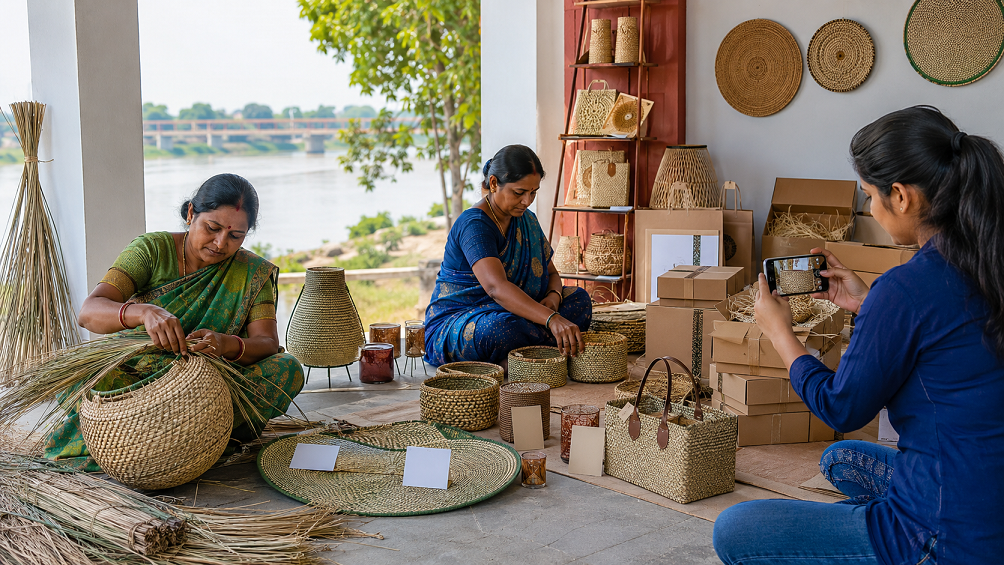
Prayagraj’s women-led Moonj craft is a strong example of how rural handmade products can move from household tradition to serious buyer-facing commerce. On August 17, 2026, Times of India reported that Moonj craft in Prayagraj, Uttar Pradesh, has become part of a wider women-led economic shift, with self-help groups helping rural women turn a long-practiced weaving tradition into income, visibility, and market participation. A related June 30, 2026 report said the state government had roped in the Skill Development Mission to train women artisans in design and market readiness for Moonj products, Prayagraj’s One District One Product item.
For Shimply’s handmade-commerce audience, the real lesson is not just that Moonj craft is beautiful, eco-friendly, or women-led. The bigger lesson is that utility craft needs better storytelling. Buyers do not only want to know that a basket, mat, carry bag, prayer basket, wall hanging, lampshade, or storage piece is handmade. They want to know what it is used for, what it can hold, how it should be cleaned, how strong it is, where it fits in a home, and whether it is gift-ready.
That is where many rural craft sellers lose online buyers. They describe origin but not function. They say “traditional” but not “how to use.” Prayagraj’s Moonj craft shows why utility storytelling must become part of rural handmade selling.
Why Prayagraj’s Moonj Craft Matters Now
The August 2026 Times of India report described Moonj craft as an eco-friendly tradition rooted for centuries around the Yamuna River in Prayagraj. It said the craft had historically been seen as a household chore passed down through generations but is now gaining stronger economic identity through structured promotion, self-help groups, and the ODOP framework.
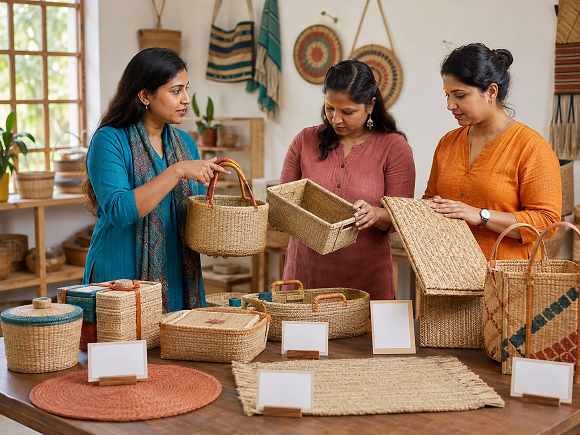
That shift matters because Moonj is not a purely decorative craft. It is a utility craft. The National Portal of India’s ODOP listing for Moonj products describes Prayagraj as known for baskets, mats, household items, sleeping and sitting mats, lampshades, and wall hangings. This product range is exactly why better storytelling is needed. A buyer may like the look of Moonj, but online purchase decisions depend on practical details.
Is a Moonj basket for laundry, pantry storage, festive gifting, puja items, fruit, toys, cosmetics, or decor? Is a mat for sitting, sleeping, ritual use, yoga-like floor seating, or wall styling? Is a carry bag daily-use, decorative, lightweight, or occasion-specific? Each use case needs different product language.
A rural craft seller who explains utility clearly is more likely to turn admiration into purchase.
Why Women-Led SHGs Need Product-Level Identity
The August 17 report framed Moonj craft around rural women’s economic independence and self-help group participation. It described how self-help groups give women a structure to pool resources, purchase raw material, standardize quality, access banking, and participate in exhibitions and buyer-facing opportunities.
That structure is important, but product pages must make the seller identity visible. A buyer should know whether the product comes from a women’s SHG, an individual artisan, a village cluster, a cooperative-style group, a training programme, or an aggregator. The label “women-led” should not be reduced to a slogan. It should become a trust signal.
A strong Moonj listing can include the artisan group name, village or area, product category, material, approximate making time, quality checks, and care instructions. It should also explain whether the product is ready stock, made to order, or customizable.
This matters because rural handmade buyers often want to support women-led production, but they also need product confidence. Seller identity and utility clarity should work together.
What Utility Storytelling Means For Moonj Products
Utility storytelling means describing a handmade product in terms of real-life use, not only heritage. Moonj sellers should explain what each product does, where it belongs, what weight or use it can handle, how it should be cleaned, and how it can be gifted.
For example, a Moonj basket should not simply be described as “traditional handmade basket.” It should say whether it is meant for dry storage, festival gifting, fruit display, laundry, toiletries, office organization, or decorative shelving. A Moonj mat should explain whether it is meant for floor seating, home decor, ritual use, or wall display. A Moonj lampshade should include size, fitting guidance, cleaning instructions, and whether it is sold with hardware or only as a shade.
That kind of detail does not weaken the handmade story. It makes the product easier to buy.
| Product Detail | Why It Matters | Buyer Trust Signal |
|---|---|---|
| Use Case | Tells buyers whether the item is for storage, decor, gifting, ritual use, or daily utility | Reduces confusion |
| Size And Capacity | Helps buyers judge where the product fits | Prevents wrong expectations |
| Material And Weave | Explains Moonj grass, structure, flexibility, and handmade variation | Builds product confidence |
| Cleaning Guidance | Shows how to dust, wipe, store, and protect the item | Helps the product last |
| Weight Limit Or Fragility Note | Clarifies what the item should not be used for | Reduces misuse |
| Gift Packaging | Shows whether the product can be sent as a present | Supports higher-value orders |
| Customization Options | Explains size, color, design, or bundle possibilities | Connects craft to ecommerce demand |
This is the difference between a craft listing and a useful product page. Moonj craft can carry heritage, but the buyer still needs to know how the object will work in daily life.
Why The 90-Day Training Programme Matters For Ecommerce
The June 30, 2026 Times of India report said the Skill Development Mission launched a 90-day training programme for Moonj artisans under the ODOP scheme. It reported that around 100 artisans were selected for the first phase and that Triveni Social Foundation, chaired by Amit Singh, was conducting training, with 50 artisans attending daily at the foundation’s office in PDA Colony, Naini.
That training matters because rural craft sellers are not only competing on craft skill. They are competing on design adaptation, ecommerce photography, product naming, customization, packaging, and online buyer communication.
The report also named Mansi Bharti of Maheva Purab Patti, who said the programme would help artisans acquire advanced design skills and improve market value. Another artisan, Nasima of Maheva, said demand for customized products through ecommerce companies was rising and that artisans needed tools ranging from AI to other modern technologies, along with the know-how to use them.
That comment is important for Shimply’s audience because it shows the gap between making skill and selling skill. Women artisans may already know how to weave Moonj products. The next step is learning how to translate that skill into product pages, buyer conversations, and customization workflows.
Why Moonj Sellers Need Better Product Naming
Product naming is one of the easiest ways to improve Moonj ecommerce listings. Many handmade sellers use names that are too broad: Moonj basket, Moonj bag, Moonj mat, handmade decor, natural grass item. These names do not help buyers understand the product.
A better product title should include craft, use, size, and context. For example: “Prayagraj Moonj Dry Storage Basket,” “Handwoven Moonj Festival Gift Basket,” “Moonj Floor Sitting Mat,” “Moonj Wall Hanging Decor,” or “Moonj Carry Bag For Light Daily Use.” These titles help buyers and search systems understand what the item is.
Moonj products can also be grouped into collections: home storage, ritual use, gift baskets, wall decor, floor mats, lighting decor, women-made accessories, and custom ecommerce products. Collections help buyers shop by need instead of browsing through a mixed list of handmade objects.
This is especially important because Moonj products often overlap between utility and decor. A basket can be functional, decorative, and gift-ready. The product page should make the primary use clear.
Why Material And Care Details Are Essential
Moonj is a natural material, which makes care guidance important. Buyers need to know how the product behaves around moisture, dust, weight, sun exposure, and storage. A listing should explain that handmade natural-fiber products can vary slightly in size, color, and weave. It should also explain how to keep the product dry, how to clean it gently, and where it should not be used.
This is not only about preventing damage. It is about trust. A seller who explains care is showing that they understand the product beyond its appearance.
For gift buyers, care cards are even more important. A Moonj gift basket or decorative item should arrive with a small origin note and care guide. The recipient should know that the product is handmade in Prayagraj, made from Moonj grass, and best used in a particular way.
Shimply’s guide to Indian craft gift sets makes the same point for handmade gifting: a product becomes easier to gift when packaging, care, use, and origin are explained clearly.
How Moonj Sellers Can Use Customization Without Losing Clarity
Nasima’s comment about rising demand for customized products through ecommerce platforms points to a major opportunity. Moonj products are well-suited to customization because buyers may want different sizes, colors, handles, lids, basket shapes, wall decor patterns, or gift-bundle formats.
But customization needs structure. A seller should not simply say “customization available.” The product page should explain what can be customized and what cannot. Size, color accents, product set combinations, initials, packaging, bulk orders, and festival hampers may all be possible, but each option should have clear timelines and limits.
Customization can also create buyer confusion if the seller does not show examples. Moonj sellers should photograph standard sizes, popular color combinations, gift basket formats, and custom order variations. Buyers need visual references before they request a change.
A strong customization page can include lead time, minimum order quantity, available product types, color options, packaging options, and care notes. This turns custom demand into a manageable sales system.
Why Product Photography Should Show Function
Moonj craft needs more functional photography. A basket should be shown empty, filled, carried, placed on a shelf, packed as a gift, and photographed close-up. A mat should be shown from above, rolled, placed in a room, and close enough to show weave structure. A bag should be shown on a person, beside everyday objects, and with scale references.
Good photography helps buyers understand size, strength, texture, and use. It also reduces returns and complaints.
For Moonj products, sellers should avoid overly decorative photos that hide practical details. A buyer should be able to see the opening, handle, base, weave thickness, edge finishing, and interior space. If a product is meant for dry items only, the photo set should not imply food storage, wet use, or heavy carrying unless that is accurate.
Utility storytelling starts with images before the buyer reads a word.
Why Moonj Craft Needs Better Packaging Proof
Natural-fiber products can be lightweight but bulky. That creates packaging questions. A buyer may wonder whether a basket will arrive crushed, whether a lampshade will deform, whether a mat will be rolled or folded, and whether a gift basket can be shipped without losing shape.
Sellers should show packaging proof. A product page can include one photo of the item packed for shipping, one photo of the gift packaging, and one note explaining how the product is protected. This is especially useful for buyers outside Prayagraj or outside India.
Packaging also supports premium pricing. A handmade product that arrives with a care card, origin note, protective wrap, and clear use guidance feels more professional. It tells the buyer that the seller understands ecommerce, not only craft making.
How Rural Handmade Sellers Can Avoid Generic Eco-Friendly Claims
Moonj products are often described as eco-friendly because they are made from natural grass. That can be a useful selling point, but sellers should avoid vague sustainability language. “Eco-friendly” is less persuasive than specific information.
A better product page might say the item is handwoven from Moonj grass, made in a women-led Prayagraj artisan group, designed for dry storage or gifting, and packaged with minimal plastic where possible. Specific claims are easier to trust.
Sellers should also avoid overclaiming durability or universal use. Natural-fiber products have limits. They may not be suitable for wet bathrooms, heavy loads, outdoor rain exposure, or rough handling unless designed for those uses. Honest limits build more trust than broad promises.
For utility products, clarity is more powerful than hype.
Why Rural Craft Storytelling Should Focus On Confidence
The strongest Moonj craft storytelling will not only say that women are empowered or that the craft is traditional. It will help buyers confidently choose, use, gift, clean, and reorder products.
That confidence starts with seller identity. Who made it? Where was it made? What group or cluster does it come from? What is the craft material? What can the product do? What should the buyer avoid? How should it be cared for? Can it be customized? Can it be gifted?
Prayagraj’s women-led Moonj craft has strong cultural and economic meaning. But online, meaning must be paired with information. Rural handmade sellers who explain utility clearly can reach buyers who want beautiful products that also solve real household, gifting, and decor needs.
Moonj craft already has the story. The next step is making that story useful enough for buyers to act on it.