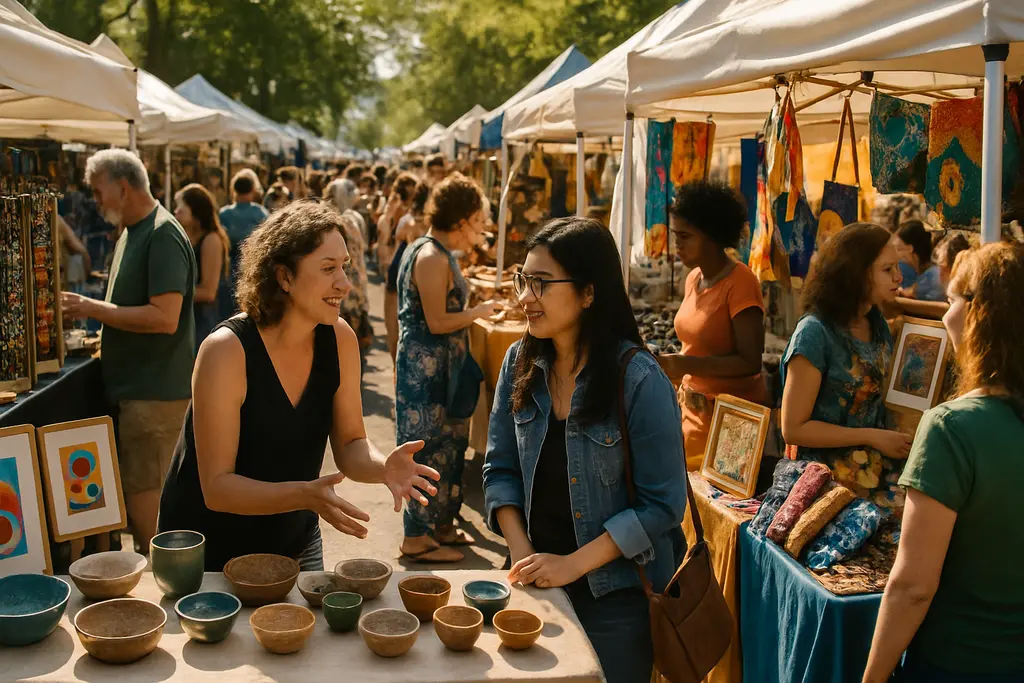
Winchester Art in August offers a useful regional case study for people who care about local makers, handmade work, and the trust that forms when art is seen in everyday civic spaces. The 2026 edition was the 24th annual program and ran through August 2026, with exhibitions and business-window displays placed around Winchester, according to the Winchester Cultural Council program page. For a town-based art program, that structure matters: the work is not isolated inside one venue, but placed where residents and visitors already move through shops, streets, and public routines.
The program’s scale was modest enough to remain local, yet broad enough to show a clear civic pattern. In 2026, 26 artists were paired with 28 locations and businesses, according to the Winchester Artists Network. That pairing model can help buyers and viewers connect individual artists with specific places, rather than treating handmade and visual art as anonymous decoration. It also gives small businesses a cultural role beyond retail display.
Why Winchester Art in August Matters Locally
Winchester Art in August As A Trust Signal
The value of Winchester Art in August is not only that art appears in shop windows. Its more lasting contribution is that it makes local authorship visible. In handmade and creator-commerce settings, trust often begins before a purchase. Viewers want to know whether a piece comes from a person with a practice, a place, and a point of view. A town program that names artists, places work in identifiable businesses, and frames the month as a shared cultural event can make that relationship easier to see.
The 2026 program was a collaboration between the Winchester Cultural Council and the Winchester Artists’ Network. The research notes also state that there was no participation fee for artists or businesses, with support from the town of Winchester and funding from the Winchester Cultural Council. That point is significant for cultural access. Fees can discourage participation, especially for artists who are balancing studio time, paid work, materials, and family obligations. A fee-free structure does not prove broad access on its own, but it does remove one visible barrier for participants.
For regional shoppers, this kind of format can also reduce uncertainty. Seeing a painting, photograph, jewelry piece, or print in a local business does not replace studio visits, galleries, or direct artist conversations. Still, it can create a first layer of familiarity. The viewer sees the work in a known setting, sees the artist identified, and may begin to understand the range of creative practice in Winchester beyond a single gallery stop.
Public Space Without Flattening The Art
There is a caution here. Business-window art programs work best when the art is not reduced to background atmosphere for shopping. The artistic integrity of the work depends on clear credit, enough context, and a display arrangement that respects the maker. The research notes indicate that the 2026 program included both window and interior displays downtown on Church, Thompson, Main, and Mt. Vernon Streets, as well as Waterfield Road. Streamers marked participating spaces with the message, “Art Here: come in there’s more to see.”
That kind of visual cue can help viewers recognize that the works are part of a coordinated cultural program rather than incidental store styling. For makers, credit and context are not minor details. They are part of the trust system. A watercolor, oil painting, gouache piece, acrylic work, pastel, block print, collage, mixed-media work, jewelry piece, or photograph carries choices of medium, technique, and subject. A display should give the viewer enough information to see the work as art made by a person, not simply as a commercial prop.
What The 2026 Program Showed
A Calendar Built Around Repeated Contact
The 2026 calendar included several public touchpoints. The public kickoff, a grand opening reception, was held on Thursday, August 6, 2026, at the Griffin Museum of Photography at 67 Shore Road. On Saturday, August 15, 2026, “Art in the Park” took place at the Winchester Farmers’ Market on the Town Common, with displays, demonstrations, and hands-on arts opportunities. As of August 25, 2026, those two events had already occurred, while the exhibitions and business displays continued through the month.
Repeated contact matters for local art. A single opening can draw attention, but a month-long structure gives people more than one chance to notice the work. Someone might first see a window display while doing errands, then encounter a demonstration at the farmers’ market, then recognize an artist’s name at a later reception. That sequence is not guaranteed, and the research does not provide attendance figures. Even so, the design of the program supports multiple forms of attention rather than relying on one short event.
The individual artist receptions added another layer. On Thursday, August 13, 2026, Deb O’Brien’s acrylic landscapes were featured at Revolve Boutique, 24 Thompson Street, from 6 to 8 p.m. On Thursday, August 20, 2026, Bespoke of Winchester, 27 Church Street, featured Wendy Jo New’s jewelry and Holly Khalil’s oil paintings and block prints from 6 to 8 p.m.; on the same date, Jui-Lan “Juily” Su was featured at Leslie Saul & Associates, 611 Main Street, from 4 to 6 p.m. On Thursday, August 27, 2026, Lucia Rubini was scheduled to display work by her and her students at Rubini Art, 22 Park Street, from 6 to 8 p.m.
Medium Range And Maker Identity
Winchester Art in August also matters because the research notes show a wide range of media. The displays included watercolor, oil, gouache, acrylic, pastel, block prints, mixed media, collage, contemporary jewelry, and photography. That range is useful for a “Shop by Region” reading because it resists a narrow definition of local making. Handmade and local art are not confined to one material category. They can include framed works, wearable objects, prints, and photographic practice.
For buyers, that range asks for different kinds of judgment. A jewelry buyer may ask about materials, wearability, and care. A print buyer may ask about process, editioning, and framing. A photography viewer may think about image, surface, and presentation. A painter’s audience may focus on medium, scale, and subject. A strong local program does not have to answer every technical question in the display itself, but it should help viewers know where those questions can be directed.
Shimply has treated this relationship between maker context and buyer trust in regional craft coverage before, including its review of the Gloucester Handcrafted Goods Festival. The Winchester example is different in format, but it raises a related point: clear maker identity helps people evaluate handmade work with more care and less assumption.
How Public Displays Shape Buyer Trust
Local Businesses As Cultural Hosts
The pairing of 26 artists with 28 locations in 2026 suggests a distributed model of cultural hosting. Most locations hosted one artist, while some featured more than one. That arrangement can give small businesses a civic function without asking them to become formal galleries. It also introduces artists to people who may not routinely enter gallery spaces.
Still, trust depends on how that hosting is handled. A business display should make the artist’s name visible, avoid crowding the work, and respect the medium. The research does not give installation standards, so it would be inappropriate to judge display quality from the notes alone. What can be said is that the program’s structure created many points of contact between artists, businesses, and viewers across Winchester’s downtown streets.
For readers comparing regional cultural programs across the same publishing network, Robsonic provides additional arts-related insights. The useful lesson for maker commerce remains consistent: trust grows when place, authorship, and presentation are treated as connected parts of the viewing experience.
What Buyers Can Read From A Regional Program
A local art program is not the same as a marketplace, but it can still shape future buying behavior. A person who sees a maker’s work in a trusted community setting may be more prepared to ask informed questions later. The buyer may remember a medium, a subject, a name, or a business location. That memory can matter when deciding whether to commission, purchase, or recommend a local artist.
For artists, the lesson is practical. Public exposure works best when it is paired with clear information. A display should answer basic questions: who made the work, what medium was used, whether the work is for sale, how the artist can be contacted, and whether the work shown is part of a larger practice. These are not marketing tricks. They are basic respect for the viewer and the maker.
The 2026 Winchester program also shows why regional shopping should not be reduced to convenience. Buying locally, in an art context, can mean supporting named makers, recognizing the cultural labor behind objects, and seeing how art lives in shared civic spaces. Without attendance or sales data, no claim can be made about economic impact. The supported point is narrower and still meaningful: the program made local artists visible across 28 locations during August 2026.
Winchester Art in August And Local Maker Trust
Winchester Art in August shows how a town-based program can connect visual art, small businesses, public events, and maker visibility without needing a single centralized venue. Its 2026 structure included a museum kickoff, business displays, downtown window and interior installations, a farmers’ market event, and artist receptions. The program also included media ranging from painting and printmaking to jewelry and photography.
For handmade arts advocates, the most useful takeaway is the relationship between visibility and context. Local art becomes easier to trust when viewers can identify the maker, see the work in a community setting, and return to it over time. That trust should not be exaggerated into claims about sales, economic impact, or audience size unless reliable figures are available. Based on the available research, the fair conclusion is that Winchester’s August 2026 program created a structured, town-supported way for artists and businesses to share space.
For shoppers, the program offered a regional lens: look closely at the work, read the artist information, ask careful questions, and respect the time and skill behind each piece. For makers, it offered a reminder that public display is strongest when credit, medium, and contact points are clear. Winchester Art in August did not need inflated claims to be worth attention. Its value rested in a grounded civic idea: local art earns trust when people can see where it lives, who made it, and how a community chooses to make room for it.