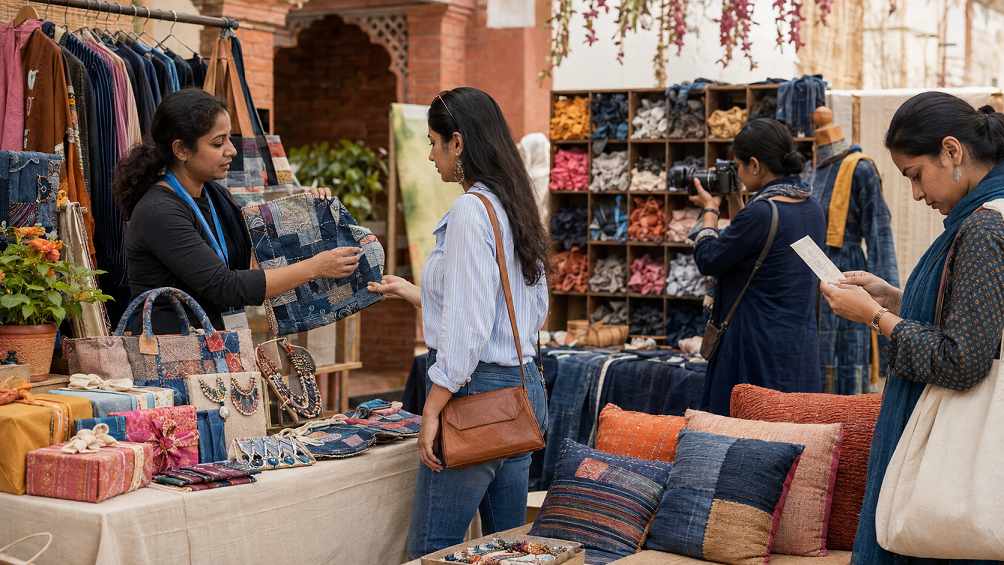
Weave The Future 4.0 turned textile waste into a public-facing craft and design conversation at Dilli Haat, New Delhi. Organised by the Office of the Development Commissioner (Handlooms), Ministry of Textiles, Government of India, the Upcycling Edition ran from July 12 to July 17, 2026, bringing together artisans, weavers, designers, innovators, recyclers, thrift collectives, repair practitioners, brands, academic institutions, and civil society organisations working around circular textiles.
For Shimply’s handmade-commerce audience, the event matters because upcycled textile craft has a product-page problem. A buyer may admire a bag made from fabric scraps, jewellery made from leftover silk, home décor made from rescued handloom textiles, or apparel reconstructed from surplus cloth. But admiration is not enough online. Buyers need to understand what the product is made of, where the material came from, why each piece may vary, how durable it is, how it should be cared for, and why it should be valued as craft rather than treated as “waste craft.”
That is why upcycled textile sellers need better product pages. Weave The Future 4.0 showed the creative potential of textile waste. The next step is translating that potential into clear, searchable, gift-ready listings that build buyer trust.
Why Weave The Future 4.0 Matters For Handmade Sellers
The Ministry of Textiles announced Weave The Future 4.0 – Upcycling Edition as an initiative to promote circularity, sustainable production, and innovation in the textile and handloom sector. The official release said the fourth edition would feature more than 100 brands, recyclers, artisans, thrift collectives, repair practitioners, and material innovators showcasing upcycling, recycling, repair, repurposing, and circular design.
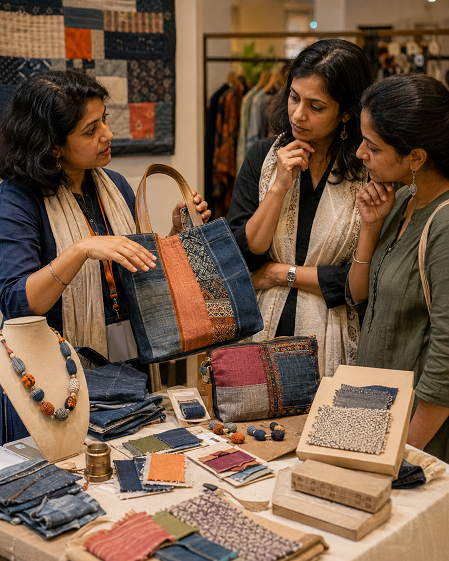
That range matters because upcycled textile craft is no longer a narrow niche. It now touches clothing, footwear, home furnishings, accessories, packaging, jewellery, paper-like materials, buttons, and mixed-media craft. The official Weave The Future platform described the fourth edition as a larger return to the initiative’s founding upcycling theme, with textile waste being reimagined across categories including clothing, footwear, home furnishings, accessories, and packaging.
For handmade sellers, this is a signal. Buyers are becoming more aware of circular design, but they still need guidance. Upcycled products can look exciting in an exhibition setting, yet online listings often fail when they do not explain material history, construction, care, and use.
A product page should do what a good craft stall does in person: slow the buyer down, explain the work, answer practical questions, and show why the object has value.
The Textile Waste Number Buyers Need To Understand
The scale of the issue is large. PIB reported that India generates approximately 70.73 lakh tonnes of textile waste annually, including about 29.73 lakh tonnes of pre-consumer waste and 41 lakh tonnes of post-consumer waste. The Ministry framed Weave The Future 4.0 as a way to show how innovation, traditional craftsmanship, and circular design can turn textile waste into economic, social, and environmental value.
A Times of India report from August 1, 2026, described visitors at Weave The Future 4.0 encountering a mountain of discarded clothes before entering the exhibition at Dilli Haat INA. Inside, artisans displayed garments, crafts, and accessories made from fabric scraps and rescued handloom textiles, making the waste-to-value story visible to Delhi visitors.
For online sellers, that visual impact has to be recreated through information. A buyer who did not stand in front of the installation needs context. If a product is made from tailor scraps, deadstock fabric, discarded denim, rescued handloom cloth, surplus silk, old saris, fabric strips, or mixed textile waste, the product page should say so clearly.
Without that context, an upcycled product can look like any other colorful handmade item. With that context, the buyer understands the material story.
Why Upcycled Textile Craft Is Harder To Explain Online
Upcycled textile craft carries more variables than a standard product. The material may change from batch to batch. Colors may vary. Fabric weight may differ. One product may include cotton, silk, denim, wool, synthetic blends, or unknown mixed scraps. Stitching, patching, braiding, crocheting, quilting, mending, or fabric manipulation may be part of the design.
That makes product pages harder but also more important. A buyer needs to know whether the product is one-of-a-kind, made in small batches, or repeatable. They need to know whether the material has been cleaned, reinforced, lined, backed, patched, or treated. They need to know whether the item is decorative, wearable, washable, giftable, or meant for light use.
This is where many sellers lose trust. They use strong words like “sustainable,” “eco-friendly,” or “upcycled” but do not explain the material or process. Buyers may like the idea but hesitate because the listing does not answer basic questions.
Upcycled craft needs proof, not vague virtue language.
What A Better Upcycled Textile Product Page Should Include
A strong product page for upcycled textile craft should combine material transparency, craft process, care, and buyer use. The buyer should not have to message the seller to understand the basics.
| Product Page Detail | Why It Matters | Buyer Trust Signal |
|---|---|---|
| Material Source | Explains whether the product uses scraps, deadstock, rescued handloom, denim, saris, or surplus cloth | Shows the upcycling claim has substance |
| Fiber Or Fabric Type | Helps buyers understand feel, durability, and care | Reduces uncertainty |
| Craft Technique | Explains patching, weaving, crochet, braiding, quilting, mending, or textile manipulation | Shows handmade value |
| Variation Notice | Prepares buyers for one-of-a-kind color and pattern changes | Prevents disappointment |
| Care Instructions | Tells buyers how to wash, store, or protect the product | Lowers return risk |
| Use Case | Clarifies whether it is daily-use, occasion-use, decorative, or gift-ready | Helps purchase decisions |
| Packaging Details | Shows whether the product is ready to gift or ship safely | Supports online conversion |
This structure helps buyers understand that “upcycled” is not a shortcut. It is a design and craft decision.
What The Featured Makers Showed About Product Storytelling
Weave The Future 4.0 offered strong examples of how specific product stories can make upcycled craft easier to understand. The Times of India report named Delhi-based Arshia Bawa, founder of The Nani Project, who sources fabric scraps from local tailors, spins them on a charkha into usable yarn, and crochets them into new products. The report also noted her use of ply split braiding, a craft associated with Jaisalmer.
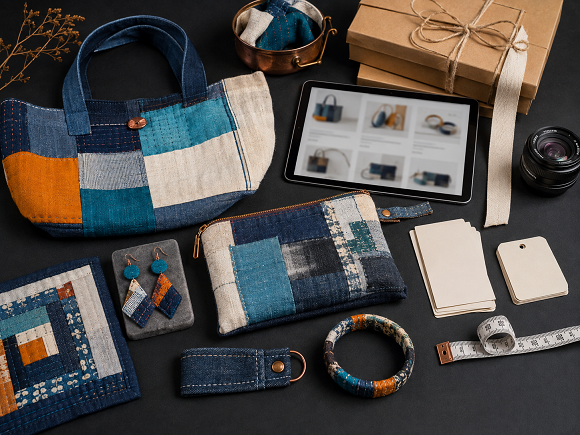
That story is powerful because it gives buyers four layers of information: material source, transformation process, tool, and craft connection. A product page built around those details would be far stronger than a generic “handmade upcycled accessory” listing.
The report also mentioned Poulami, founder of the upcycled textile jewellery brand Maati, using katrans, or textile scraps, from cotton to silk, inlaid in wooden frames to create earrings, necklaces, and rings. That kind of product needs close-up photos, material notes, weight details, care instructions, and variation guidance because buyers are purchasing both jewellery and textile reuse.
Designer Urvashi Kaur showed apparel from her Renew Project, while the report described works by Jyoti Panwar under Munart and design-led circular brand NO MORE, which works with reclaimed denim, airbags, seatbelts, billboard flex, and surplus fabrics. These examples show how broad upcycled textile craft has become. It is not only patchwork clothing. It can be jewellery, art, accessories, bags, apparel, and home products.
The lesson for sellers is clear: the more unusual the material, the clearer the product page must be.
Why “What Is It Made Of?” Is The Right Buyer Question
The Ministry also launched the “What Is It Made Of?” Textile Waste Innovation Challenge during Weave The Future 4.0. PIB described it as a national initiative encouraging innovative, scalable, and practical solutions to India’s textile waste challenge. The competition was open to students, artisans and weavers, designers, researchers, entrepreneurs, innovators, and citizens, with applications accepted up to July 20, 2026.
The official Weave The Future page framed the challenge around questions that are useful for product pages too: what a product is made of, where it began, and what will happen to it after use.
Those questions should sit at the heart of every upcycled textile listing. Buyers should be able to understand the product’s past, present, and future. Past: where did the textile come from? Present: what has it become? Future: how should it be used, repaired, cared for, or disposed of?
For Shimply’s audience, this is the product-page opportunity. Upcycled sellers can use the same logic to make listings more searchable and more trustworthy.
Why Upcycled Craft Needs Better Photography
Upcycled products often depend on detail. A buyer needs to see seams, joins, fabric contrast, patchwork, reinforcement, lining, closures, texture, and scale. A single styled image is not enough.
For a bag made from reclaimed denim and surplus fabric, show the inside, straps, stitching, pockets, and scale on a person or table. For textile jewellery, show front, back, closure, weight, and ear or neck scale. For upcycled apparel, show the full garment, patch details, care label, fit, and texture. For home décor, show placement, dimensions, backing, filling, and cleaning guidance.
Upcycled products also need honest color representation. Since many pieces use varied scraps, sellers should show several examples from the same batch. If buyers cannot choose the exact pattern, say that. If each product is one-of-one, say that too.
Good photography prevents the wrong expectation. It tells buyers that variation is part of the product, not a flaw.
Why Care Cards Matter For Reclaimed Materials
Care cards are especially important for upcycled textile products because the material mix may not behave like a single new fabric. A product may combine cotton scraps with silk, denim, polyester, wool, embroidery thread, wood, metal, lining fabric, or glue-backed details.
A seller should not use one generic wash instruction for everything. If the product is washable, explain how. If it should be spot cleaned, say so. If color transfer is possible, warn the buyer. If the product is jewellery, explain storage and moisture care. If the item uses mixed media, clarify whether it is decorative rather than washable.
Care cards also make products more giftable. A buyer giving an upcycled handmade item wants the recipient to understand why it is special and how to keep it in good condition.
Shimply’s earlier guide to Indian craft gift sets made a similar point for handmade gifting: a product becomes easier to buy when the seller explains care, packaging, shipping, and the reason the pieces belong together. Upcycled textile craft needs that same clarity.
How Sellers Can Avoid Greenwashing
Upcycled sellers should be careful with sustainability claims. A product made from waste material can be valuable, but that does not automatically make every claim safe. Sellers should avoid saying a product is “zero waste,” “carbon neutral,” “fully sustainable,” or “chemical-free” unless they can support those claims.
A stronger listing uses specific language: made from tailor scraps, reconstructed from deadstock fabric, created from rescued handloom pieces, lined with surplus cotton, or designed using reclaimed denim. Specific claims are more credible than broad claims.
Sellers can also explain limits. If the material supply changes, say that. If colors vary, say that. If only part of the product is upcycled, say which part. If new hardware, thread, lining, or packaging is used, disclose it.
Honesty builds trust. It also protects sellers from disappointing buyers who expect perfection from a product designed around reuse.
How Upcycled Products Can Become Gift-Ready
Upcycled textile craft has strong gift potential because each item can carry a story. But a gift buyer needs more than a story. They need presentation, durability, and clarity.
A gift-ready upcycled product should include a short origin note, care card, packaging photo, size information, and use suggestion. If it is one-of-a-kind, the product page should frame that clearly. If it is made from reclaimed fabric, the seller should explain why small differences in color or texture are expected.
Gift bundles can work especially well. A seller could pair an upcycled textile pouch with a handmade note card, a small jewellery piece, or a care insert. A home décor seller could offer cushions, table runners, or wall textiles as themed sets. A jewellery seller could create small gift boxes with matching earrings and care notes.
The key is not to make the bundle look like leftover material. The key is to make it feel considered, finished, and easy to give.
What Marketplaces Should Learn From Weave The Future 4.0
Weave The Future 4.0 shows that upcycled textile craft needs better listing templates. Marketplaces should not treat upcycled products like ordinary fashion or décor listings. They should give sellers fields for material origin, upcycled percentage, fiber type, care, repairability, variation, and end-of-life guidance.
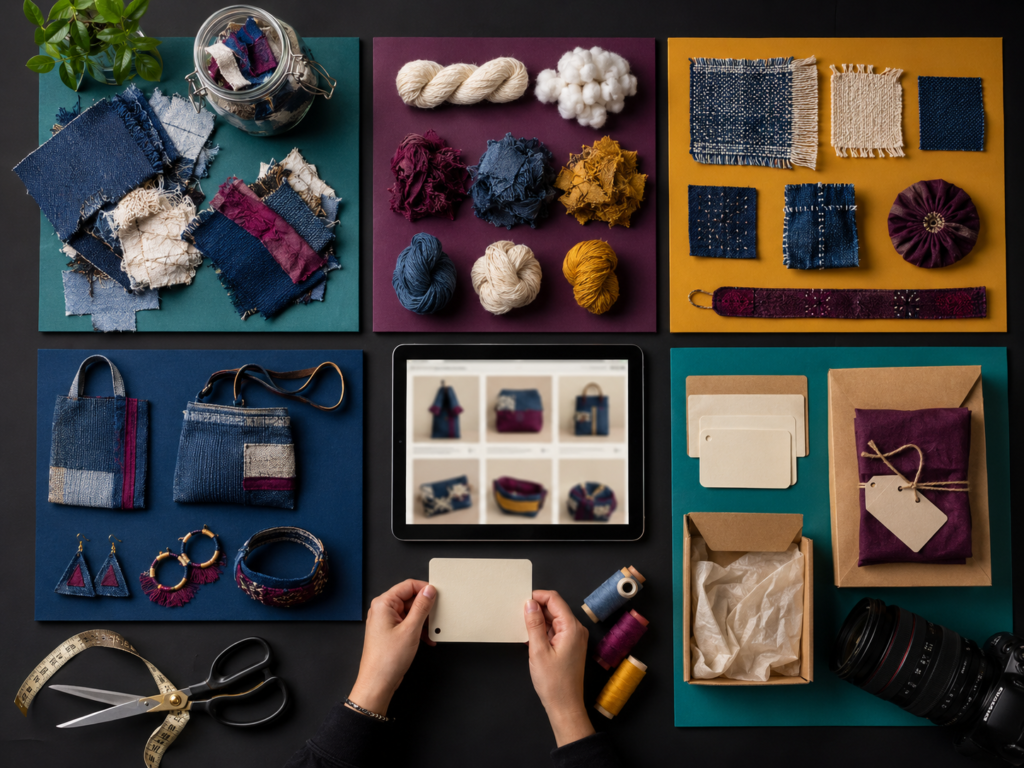
A better marketplace template could ask: What material was reclaimed? Was it pre-consumer or post-consumer waste? What new materials were added? Is the product washable? Is every piece unique? Can it be repaired? Is the packaging recycled, reusable, or standard? What should the buyer do when the product reaches the end of its use?
These details help honest sellers stand out. They also help buyers compare products fairly. A reclaimed handloom bag and a mass-made printed pouch should not be judged by the same information standards.
Why Product Pages Are Part Of Circular Design
Weave The Future 4.0 made circular design visible at Dilli Haat. But circularity does not end when a product is made. It continues through how the buyer understands, uses, repairs, stores, gifts, and eventually passes on the item.
That is why product pages are part of circular design. A clear listing can extend product life by teaching buyers how to care for it. A good care card can prevent damage. A repair note can encourage mending instead of disposal. A material story can help buyers value the item more. A gift insert can carry the product’s meaning to the recipient.
For handmade sellers, this is a practical advantage. Better product pages do not only improve SEO. They reduce confusion, support better pricing, lower returns, and make upcycled craft easier to gift.
Weave The Future 4.0 showed that discarded textiles can become apparel, accessories, jewellery, home products, packaging, and art. Now sellers need digital pages that explain those transformations with the same care as the making itself.