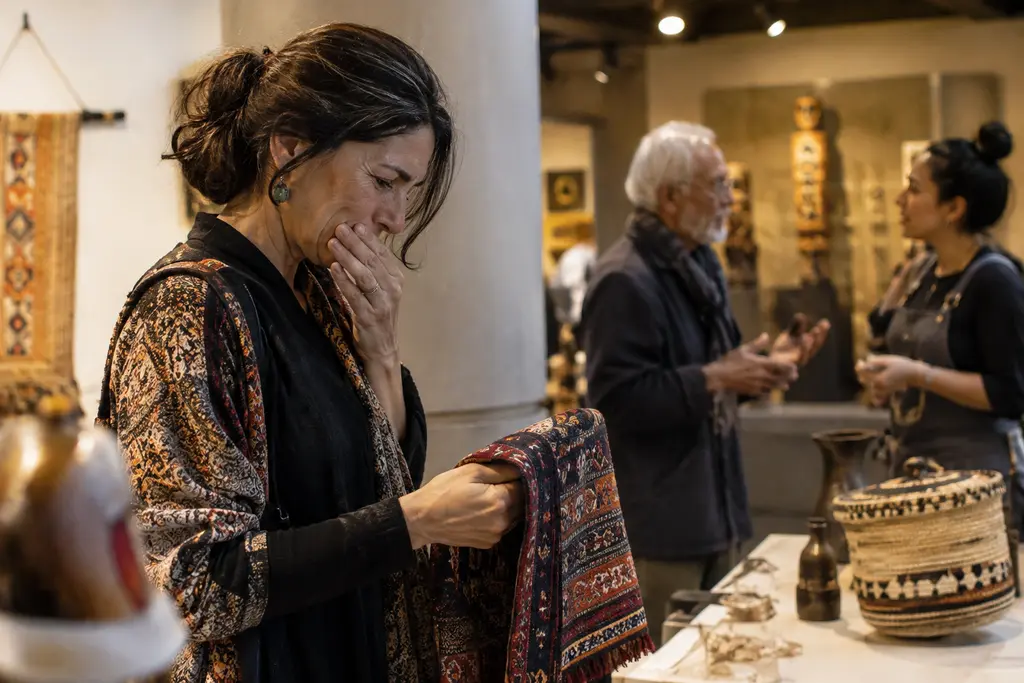
The In Our Hands Exhibition at Ruiz-Healy Art in San Antonio, Texas, is on view from September 16 to November 7, 2026, and pairs Jennifer Ling Datchuk with Consuelo Jimenez Underwood in a focused study of migration, gender, ancestry, and handmade material practice, according to Meer. Because the exhibition remains open as of October 27, 2026, any reading should stay close to the published record rather than assume visitor response. Still, the available details support a careful wellness angle: craft here does not promise healing as a clinical outcome, but it does create space for reflection on belonging, inherited memory, and the weight of social borders.
The exhibition is also part of Handwork: celebrating American craft 2026, a nationwide initiative led by Craft in America during the United States Semiquincentennial. That setting matters. A 250th-anniversary frame can easily flatten craft into patriotic display, yet this pairing points toward a less tidy question: whose hands are allowed to define American craft, and whose histories have been treated as marginal, domestic, migrant, or decorative?
Why The In Our Hands Exhibition Matters
In Our Hands Exhibition As A Material Dialogue
The In Our Hands Exhibition is not only a two-artist presentation. It is a material conversation between artists who use craft-associated media to address identity and social power. Underwood works with textile, mixed media, safety pins, barbed wire, silk, plastic, and found objects such as wrappers and bags. Datchuk uses porcelain, synthetic and human hair, blue-and-white patterns, reflective surfaces, and video. Those materials are not neutral containers. They carry associations with labor, adornment, domestic expectation, repair, surveillance, and cultural inheritance.
For craft viewers, this is a key point. Handmade work can be praised too quickly for beauty, patience, or skill while the political and cultural force of the object is softened. In this exhibition, the material record resists that softening. Barbed wire, safety pins, acrylic manicures, porcelain hands, hair, flags, and found bags bring bodily presence into the gallery. They ask viewers to read craft as evidence: of movement, restriction, family lineage, gendered performance, and the systems that decide whose bodies feel safe.
Handwork 2026 And Public Memory
Because the exhibition sits inside Handwork: celebrating American craft 2026, it also raises questions about public memory. American craft is often narrated through studio movements, regional traditions, museum collections, and market categories. The pairing of Underwood and Datchuk asks for a wider frame in which migration, race, gender, and ancestry are not side topics. They are part of the craft record itself.
For readers following craft education across Shimply, the related discussion of craft cultural context offers a useful companion to this exhibition because it focuses on provenance, materials, and maker identity without reducing tradition to a sales label. If you’re exploring public-culture writing within this network, the site Kay Granger serves as a related platform, emphasizing the evidence available for the art and its cultural context.
Migration, Border Material, And Identity
Underwood’s Border Materials
Consuelo Jimenez Underwood was born in 1949 and is described in the exhibition account as the daughter of migrant agricultural workers, with a Chicana mother and a Huichol Indigenous father. Her childhood included frequent movement across the U.S.–Mexico border. That biography should not be treated as an explanatory shortcut, but it does help clarify why borders, movement, and cultural mixture recur in her work. Her identity is identified through Chicana, Huichol Indigenous, and Mexican-American contexts, and the materials she uses often make separation and connection visible at the same time.
One referenced work, Free Falling Flag, joins woven interpretations of the U.S. and Mexican flags with safety pins and barbed wire. The description also notes a white field beneath with a brown circle of barbed wire. Based on that account, the work can be read as refusing a simple national divide: the flags are joined, but the joining is painful, provisional, and exposed. Safety pins can suggest repair or emergency fastening. Barbed wire suggests enclosure, danger, and imposed boundary. Their combination keeps the viewer from romanticizing border identity as easy fusion.
The Smithsonian American Art Museum’s discussion of Underwood’s Virgen de los Caminos states that the 1994 work measures 58 × 36 inches, or 147.3 × 91.4 centimeters, and is made of embroidered and quilted cotton and silk with graphite, honoring immigrant children through religious symbolism, caution sign motifs, flowers, and barbed wire Smithsonian American Art Museum. That fact pattern reinforces how Underwood uses textile language to address vulnerability without abandoning visual tenderness.
Datchuk’s Porcelain And Adornment
Jennifer Ling Datchuk’s practice, as described in the exhibition account, uses porcelain, synthetic and human hair, blue-and-white patterns, reflective surfaces, and video to examine gender, race, performance, domesticity, and structures that define women, especially Asian women. Porcelain is especially charged in this context because it is associated with refinement, fragility, value, and cultural exchange. In Datchuk’s hands, it becomes a way to question how bodies are displayed, handled, judged, and disciplined.
Her work For Your Eyes Only includes porcelain hands with acrylic manicures holding objects such as a peach, a chicken foot, and a reproduction of the Venus of Willendorf. The published description links the work to thresholds: girlhood to womanhood, and the experience of being a person of color in white and male spaces. A cautious reading would say that Datchuk does not separate adornment from pressure. The manicure, the hand, and the held object all point toward social expectation: what is touched, what is shown, and what must be performed for another person’s gaze.
Wellness Reading Without Overclaiming
Belonging Is Not A Measured Outcome
A wellness reading of the In Our Hands Exhibition should be careful. The research available here does not provide visitor surveys, mental health measures, or clinical claims. It would be irresponsible to say that viewing the exhibition heals trauma or produces measurable emotional benefits. What can be said is narrower and more supportable: the exhibition gives visual form to belonging, resilience, identity, and inherited pressure through handmade objects and culturally specific materials.
That distinction matters for craft writing. Art can help people think, feel, remember, and speak, but public claims about wellness should not outrun the evidence. The stronger claim is that the exhibition creates conditions for reflection. Viewers may encounter symbols of migration, domestic labor, gendered presentation, and border enforcement in a form that is tactile and human-scaled. The handmade quality can slow the encounter, asking the viewer to notice repeated stitches, woven joins, porcelain gestures, and objects that carry bodily associations.
Handmade Objects And Viewer Trust
Trust is also part of the wellness frame. People often feel the force of handmade objects because they sense human labor in the work. In artisan markets, that labor can be misused as a vague authenticity claim. In a gallery setting such as this one, the materials are named and tied to the artists’ concerns. That transparency supports a more ethical encounter. Viewers are not asked to admire craft in isolation from the social contexts that shape it.
The In Our Hands Exhibition shows why material clarity matters. Underwood’s safety pins and barbed wire are not decorative additions. Datchuk’s porcelain hands and acrylic manicures are not simply stylish surfaces. The materials guide interpretation. They also remind craft buyers, curators, and writers that authenticity is not a mood. It is built from context, naming, sourcing, and respect for the artist’s stated concerns.
How Craft Commerce Can Learn From The Exhibition
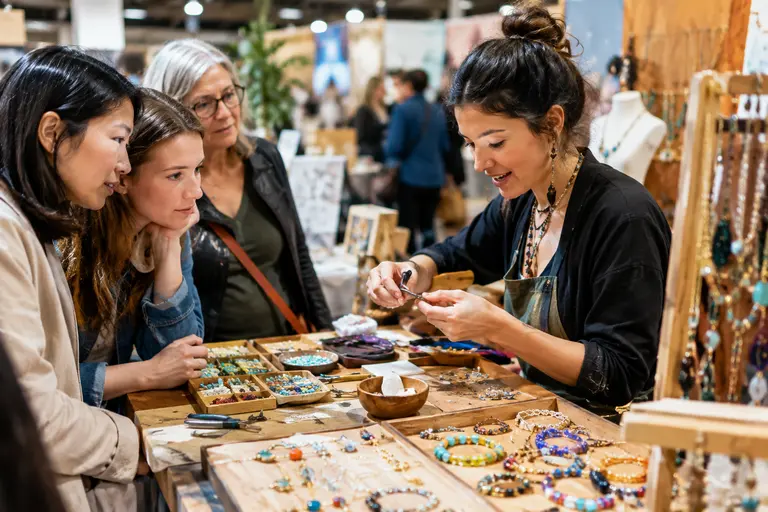
Although this is an exhibition, not a marketplace case study, it offers practical lessons for handmade and creator-commerce spaces. Sellers working with culturally specific craft should avoid vague heritage language that strips objects of maker identity or social context. Buyers should be given enough information to understand materials, origin, technique, and intended meaning where the maker chooses to share it.
Several careful practices follow from this exhibition’s framing:
- Name materials plainly rather than using cultural identity as decoration.
- Separate verifiable provenance from broad claims about tradition or authenticity.
- Respect the artist’s or maker’s own framing of ancestry, gender, migration, and identity.
- Avoid wellness promises that cannot be supported by evidence.
These practices protect both the maker and the viewer. They also help prevent craft from being reduced to a surface trend. The works by Underwood and Datchuk show that handmade materials can carry grief, humor, pressure, repair, and critique. A trustworthy craft culture must leave room for all of those meanings.
What The In Our Hands Exhibition Leaves In View
The In Our Hands Exhibition leaves viewers with a demanding but useful proposition: craft can hold identity without simplifying it. Underwood’s work connects migration, Indigenous and Chicana identity, religious imagery, caution signs, and border materials. Datchuk’s work connects porcelain, hair, manicure, gaze, race, gender, and domestic expectation. Neither artist treats craft as a retreat from social life. Both use material practice to make social life harder to ignore.
For a wellness category, that matters because belonging is not only a private feeling. It is shaped by borders, family histories, race, gender, and the objects through which people learn who they are allowed to be. The exhibition does not resolve those pressures, and the available evidence does not support inflated claims. Its value lies in a more grounded place: it shows how handmade art can make migration and identity visible in forms that ask for attention, care, and trust.