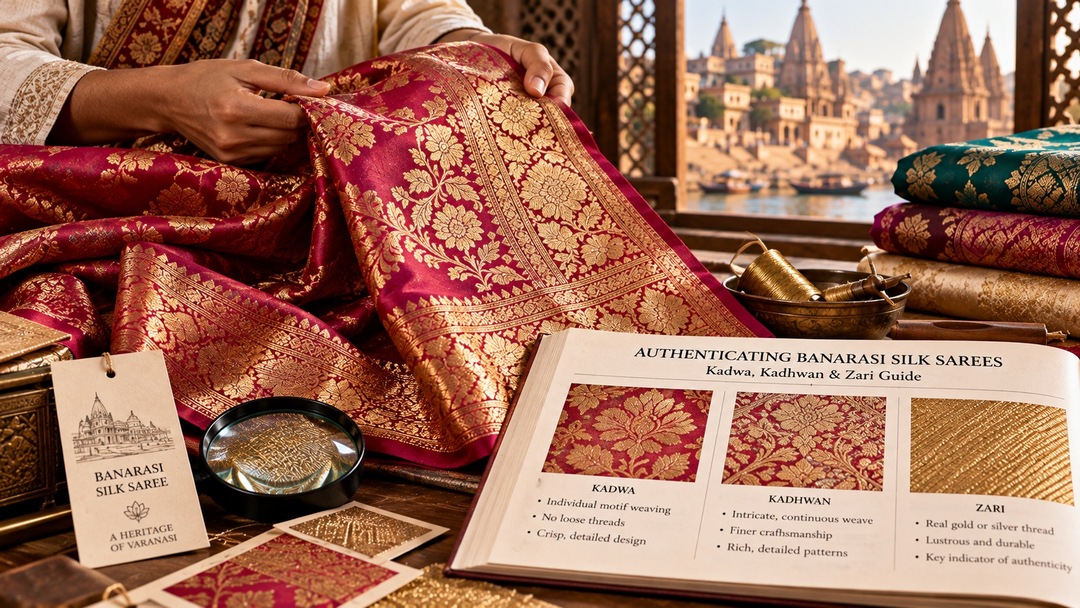
For centuries, the sacred weaving clusters along the ghats of Varanasi have produced what many textile historians consider the zenith of subcontinental luxury: the Banarasi silk saree. Characterized by dense brocades, Mughal-inspired flora, and metallic luster, these heirloom drapes have anchored Indian bridal trousseaus for generations. Yet today’s textile marketplace presents acute challenges for collectors. Automated Chinese and Surat powerlooms, computerized jacquard cards, synthetic polyester blends, and electroplated copper threads routinely imitate the ornate surfaces of genuine handloom weaves with calculated precision.
Connoisseurship requires looking beneath promotional marketing tags to inspect the physical architecture of the cloth. Much like discerning collectors studying South Indian pit-loom joins through Shimply’s authenticity and buying guides, evaluating a Varanasi handloom requires understanding structural weaving techniques. A genuine handwoven Banarasi saree is not merely an arrangement of silk filaments; it is a labor-intensive engineering feat governed by manual shuttle manipulation, independent discontinuous weft lockouts, and authentic metallurgical standards. Learning to distinguish true Kadwa needle-style weaving from commercial cutwork and powerloom facsimiles is essential for safeguarding heritage craftsmanship and making sound acquisitions.
The Structural Engineering of Kadwa Versus Fekwa Weaving
The defining structural benchmark of museum-grade Banarasi weaving is the Kadwa technique (historically referred to as Kadhwan). In handloom terminology, Kadwa represents an intricate form of discontinuous extra-weft brocading. When crafting a Kadwa motif—such as an ornate floral buta, paisley kalka, or architectural medallion—the weaver hand-interweaves each metallic thread individually around the warp threads using a miniature wooden spool resembling a blunt needle. Each motif is woven completely independently across the fabric face.
Because every Kadwa motif is bound and tied off manually, no supplemental zari or silk yarn floats continuously across the reverse side of the garment. When you invert an authentic Kadwa saree, the back surface appears remarkably clean and flat, displaying subtle anchor knots rather than trailing loose threads. This meticulous process requires immense patience; a master weaver and an assistant may spend anywhere from four weeks to six months executing a single Kadwa brocade saree, as every floral petal requires separate shuttle passes.
Conversely, commercial powerlooms and semi-mechanized setups cannot replicate independent discontinuous wefts. Instead, mass-market manufacturers rely on Fekwa (continuous throw) cutwork techniques. In Fekwa weaving, the shuttle carrying the extra zari weft flies across the entire width of the loom, depositing thread across the empty fields between motifs. Once removed from the loom, workers use mechanical shears or hand scissors to sever these loose horizontal floating threads on the reverse side. Inspecting the back of a cutwork saree reveals hundreds of raw, sharp-edged thread ends that catch on jewelry, chafe against underskirts, and unravel over repeated dry cleaning.
Diagnostic Comparison of Varanasi Handloom and Commercial Powerloom Textiles
Separating authentic handloom Banarasi brocades from high-speed powerloom imitations requires a systematic audit across multiple textile markers. Automated jacquards produce relentless mechanical uniformity, whereas manual handlooms carry the organic rhythm of human breath and hand tension. The following table provides an analytical breakdown of structural indicators:
| Structural Dimension | Authentic Handloom Kadwa Banarasi | Commercial Powerloom Cutwork (Fekwa) | Physical Inspection Protocol |
| Reverse Motif Architecture | Clean, flat reverse; each motif tied off independently with zero trailing floats | Dense field of sheared thread ends; visible cutwork stubble across empty spaces | Flip fabric over; check whether reverse is smooth or covered in clipped thread fringes |
| Selvedge Edge Contour | Slightly irregular, organic pin-hole selvedge from manual shuttle turnarounds | Laser-straight, razor-sharp edge with rigid mechanical overlock or heat sealing | Examine lateral border edges; handloom selvedges feel supple and show minute micro-shifts |
| Motif Embossing & Depth | Three-dimensional, sculpted relief resembling fine hand-embroidered bullion | Flat, stamped appearance with uniform surface tension across warp and weft | Rake direct light across motifs; Kadwa shows raised depth and tactile contour |
| Zari Composition | Pure silver-gilt filament wrapped around natural silk core (Real Zari) | Copper wire or slit plastic polyester film (Tested Zari / Lurex) | Scrape fringe thread lightly; authentic zari reveals gold over silver onto silk core |
The selvedge edge of a Banarasi saree serves as an unmistakable signature. On traditional handlooms, shuttle speed varies according to artisan tempo, producing a supple, slightly uneven edge marked by small weaver pin holes used to regulate tension on the wooden frame. Industrial powerlooms feed yarn under pneumatic or rapier tension at hundreds of picks per minute, creating an unnaturally stiff, dead-straight edge. If the outer selvedge appears synthetic, rigid, or mechanically overlocked, the saree did not originate on a traditional pit loom.
Evaluating Zari Metallurgy: Real Silver, Electroplated Copper, and Slit Film
The luminous soul of a Banarasi saree lies in its metallic ornamentation. However, the designation “zari” is frequently misapplied across commercial retail listings. Historically, authentic Banarasi brocades incorporated Asli Zari (genuine zari). This noble metallurgical medium consists of an ultra-fine core thread of pure mulberry silk wound with a flattened wire of refined silver, which is subsequently immersed in a bath of 24-karat gold to achieve a warm, radiant gilt luster.
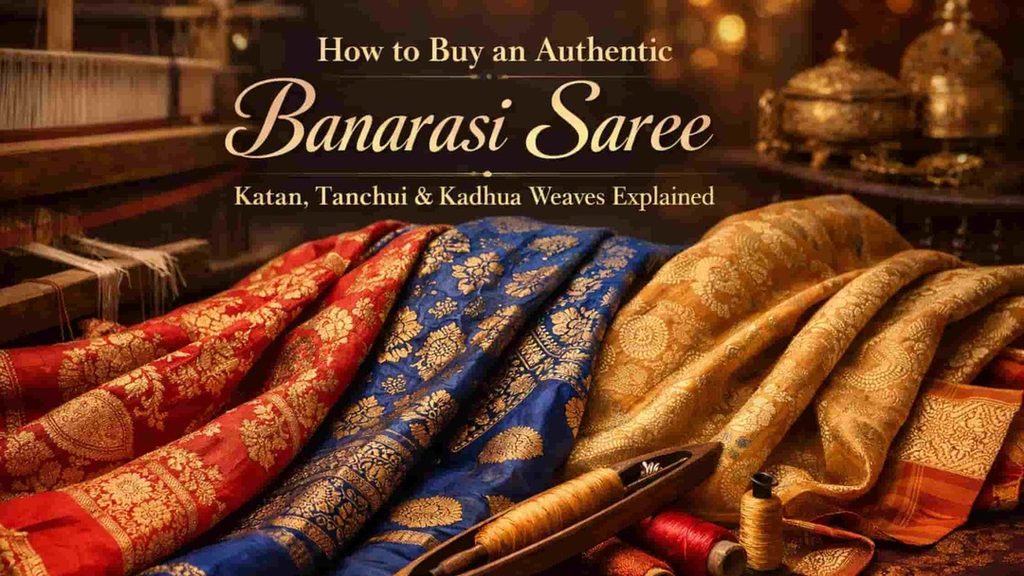
Modern mass production has largely replaced precious metal alloys with two commercial substitutes: “Tested Zari” and “Synthetic Metallic Yarn” (commonly known as metallic polyester or Lurex). Tested zari utilizes a core filament of bleached cotton or spun rayon wrapped in thin copper wire that is flash-plated with imitation silver or gold. While initially striking, copper oxidizes rapidly when exposed to humidity and atmospheric sulfur, transforming radiant bridal brocades into dull, tarnished greenish-black patterns within a few seasons. Synthetic metallic yarns abandon metal wire altogether, slicing metallized plastic film into hair-thin strips that yield a harsh, disco-ball reflection devoid of warmth or intrinsic value.
Collectors can deploy three non-destructive field tests to evaluate zari integrity:
- Tactile Temperature Assessment: Precious metals possess high thermal conductivity. Touching authentic real zari immediately draws heat away from fingertips, feeling distinctly cool upon initial contact before warming naturally. Plastic synthetic yarns feel neutral, room-temperature, and slick.
- Fringe Scrape Verification: Carefully separate a loose fringe thread from the end of the pallu and gently scrape the outer metallic leaf with a fingernail or jeweler’s loupe edge. Authentic gold-gilt zari reveals bright silver underneath, wrapped around a red or warm golden-yellow silk core. If the scrape exposes dull reddish copper or if the core is chalky white synthetic nylon, the garment features commercial tested zari.
- Weight and Fluidity Balance: Real silver zari imparts substantial, grounding weight without stiffness. A genuine handloom Kadwa saree drapes with liquid grace, contouring gently around the body. Synthetic powerloom brocades are often rigid and board-like, resisting soft pleating because plastic-coated threads cannot compress like natural silk and annealed silver.
Navigating Geographical Indication (GI) and Silk Mark Protections
To combat widespread counterfeit production in commercial weaving centers, the Banarasi saree was granted official Geographical Indication (GI) protection under the Geographical Indications of Goods (Registration and Protection) Act of 1999. The legal specifications mandate that authentic Banarasi sarees must be handwoven within the designated eastern Uttar Pradesh districts of Varanasi, Mirzapur, Chandauli, Jaunpur, Bhadohi, and Azamgarh. Furthermore, certified products must adhere to verified handloom processes and pure silk requirements.
However, shoppers must distinguish between fiber purity marks and handloom origin marks. The Silk Mark, administered by the Central Silk Board of India, certifies exclusively that the base yarn consists of 100 percent natural silk fiber rather than polyester, viscose, or rayon. A powerloom saree produced in Surat using pure Chinese silk can legitimately secure a Silk Mark label if its fibers are unadulterated. To verify artisan craftsmanship, buyers must look for the official Handloom Mark alongside the Varanasi GI logo, which carry unique holographic alphanumeric serial numbers linked to authorized weaver cooperative societies.
Preserving Heirlooms Through Informed Connoisseurship
Acquiring a genuine handloom Banarasi silk saree transcends retail shopping; it is an investment in cultural heritage, human dexterity, and living art. The thousands of individual thread turns that comprise a masterwork Kadwa brocade represent weeks of collaborative choreography between master weavers, warp winders, and pattern designers who have preserved these traditions for generations. In an era dominated by rapid synthetic production, discerning buyers carry the power to sustain these artisan communities.
By inspecting reverse motif architectures, confirming natural selvedge behaviors, evaluating real precious metal zari, and demanding verified GI certifications, collectors protect their households from industrial counterfeits. When approaching Varanasi textiles with technical discipline and informed reverence, enthusiasts ensure that every drape honors genuine handloom legacy, preserving a timeless subcontinental art form for generations to come.