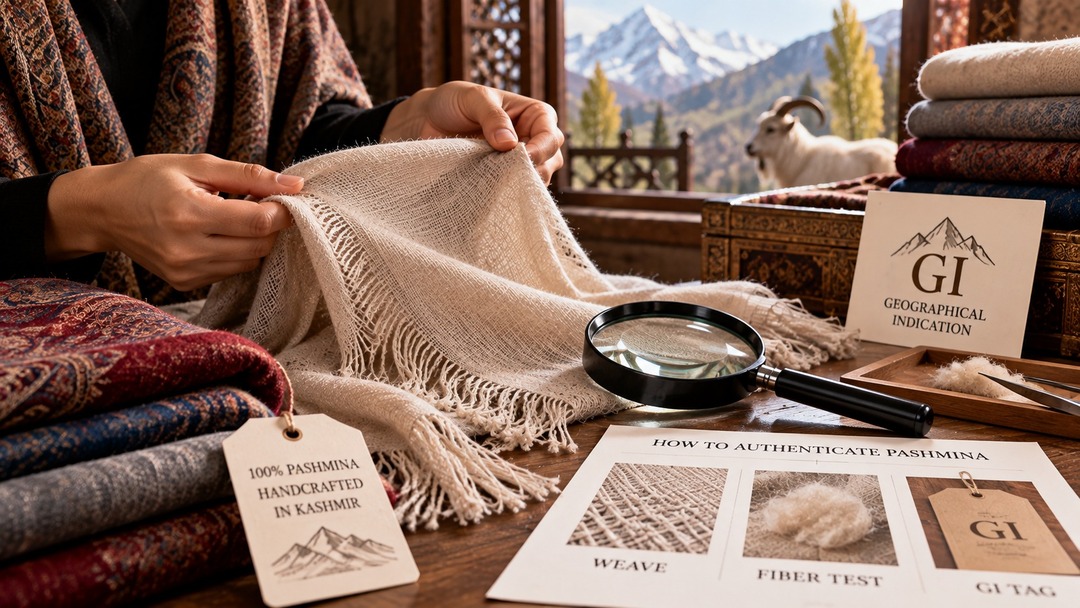
Few heirloom textiles carry the historical reverence and tactile romance of authentic Kashmiri Pashmina. Derived from the delicate undercoat fleece of the Capra hircus laniger goat native to the high-altitude Changthang plateau of Ladakh, genuine Pashmina has represented the pinnacle of subcontinental luxury for centuries. From Mughal royal courts to European aristocratic salons, these featherweight shawls earned international renown for their peerless thermal efficiency, soft touch, and artisanal drape. Yet in today’s globalized textile marketplace, acquiring genuine handmade Pashmina requires navigational diligence. High-speed commercial powerlooms, chemical softening washes, synthetic microfiber spinning, and blended sheep wool adulterations routinely flood retail markets under deceptive luxury labels.
Discerning collectors and responsible textile patrons understand that preserving regional artisanal legacies begins with rigorous connoisseurship. Much like the structural discipline required when buyers inspect handloom heirlooms, learning how to authenticate handloom Kanchipuram silk sarees or identify master pit-loom joins, evaluating handcrafted Kashmiri shawls demands an intimate knowledge of fiber physics, manual yarn preparation, and regulatory governance. True Kashmiri Pashmina is not simply a raw material; it is an integrated, centuries-old handicraft ecosystem where spinning wheel mechanics and wooden handlooms transform gossamer fleece into wearable cultural sculpture.
The Changthangi Raw Material and Manual Spinning Dynamics
The journey of authentic Pashmina begins over 14,000 feet above sea level in Ladakh, where winter temperatures plunge below minus thirty degrees Celsius. To survive this harsh alpine climate, the Changthangi goat grows a dual-layer fleece consisting of coarse exterior guard hairs and an exceptionally fine, hollow underfleece. During the annual spring molting cycle, pastoralist Changpa herders gather the fiber using specialized wooden combs rather than shears. This gentle harvesting yields unadulterated staple lengths averaging between 40 and 55 millimeters, characterized by a delicate cylindrical fiber diameter measuring between 12 and 15 microns. By comparison, high-grade Australian Merino wool ranges between 18 and 22 microns, while human hair averages 70 to 100 microns.
Transforming this delicate raw fleece into weavable yarn requires manual processing that automated industrial machinery cannot execute without fiber degradation. In traditional Kashmiri homes, women artisans clean raw fleece by rubbing it with finely ground cooked rice flour (khambir), which absorbs natural oils and dirt without stripping the fiber’s protective outer scales. Once de-haired, the raw fiber (known locally as raw pashm) is spun by hand onto the traditional wooden spinning wheel known as the yender.
Hand spinning imparts a gentle, asymmetric twist (a natural “S” or “Z” spiral) with variable manual tension. Because fragile Changthangi fleece possesses low tensile resistance, high-speed automated spinning frames snap pure 12-micron strands unless the fiber is reinforced with synthetic carrier filaments such as nylon or polyester. Consequently, an authentic pure Pashmina warp yarn can only be produced on a hand-operated yender or spun using water-soluble sizing polymers that are thoroughly washed out post-weaving. When examining a suspected shawl under magnification, the presence of subtle yarn irregularities, micro-slubs, and slight variations in thread thickness confirms manual spinning rather than mechanical uniformity.
The Handloom Diagnostic: Weave Architecture and Edge Behavior
Once spun, the delicate Pashmina yarn is warped onto a traditional Kashmiri wooden pit loom. Handloom weaving of Pashmina historically centers on the traditional chashm-e-bulbul (eye of the nightingale) pattern, a subtle diamond twill weave, or a balanced open plain weave. Handloom weavers regulate shuttle passage and beater pressure manually, resulting in a flexible, breathable textile with slight organic tension variations that grant the finished shawl its airy warmth.
In contrast, modern commercial powerlooms weave at high velocity, requiring tight mechanical tension that breaks delicate pure Pashmina. To prevent snapping on industrial machines, manufacturers blend 30 to 50 percent viscose, polyester, or high-twist nylon into the yarn, or subject the cloth to caustic chemical baths that artificially dissolve outer synthetic casings while leaving chemical residues that weaken the natural keratin. The table below outlines the core physical distinctions between genuine handcrafted Pashmina and commercial powerloom imitations:
| Structural Dimension | Handcrafted Kashmiri Pashmina | Commercial Machine / Powerloom Blend | Inspection Protocol |
| Weave Geometry | Subtle diamond twill (chashm-e-bulbul) or organic plain weave with micro-irregularities | Rigid, mechanical square-grid or dense twill lacking organic tension variation | Backlit inspection under magnifying lens; check for rhythmic thread micro-shifts |
| Selvedge Edge Finish | Natural, unhemmed raw fringe or gently twisted manual selvedge | Machine-cut, heat-sealed, or overlock-stitched straight edges | Inspect side edges; machine pin marks or rigid overlock indicates industrial loom |
| Fiber Drape & Touch | Soft, dry, warm hand-feel that blooms softer with wear without static electricity | Artificial greasy smoothness from silicone softeners; prone to synthetic static cling | Friction rub test against palm; natural fiber warms immediately without static sparks |
| Weight-to-Warmth Ratio | Exceptionally lightweight (180–250 grams for standard 2x1m shawl) with high loft | Noticeably heavy (over 350 grams) or unnaturally sheer and flimsy | Weigh garment on calibrated scale; check against certified area density benchmarks |
The selvedge edge of a shawl offers one of the most reliable visual clues. Handloom shawls feature an unadulterated, organic woven edge where weft yarns loop back naturally at the margins, finished with delicate raw self-fringes created by unclipped warp ends. Commercial powerloom fabrics, woven on wide continuous industrial bolts, are cut to dimension and secured with dense machine overlock stitching or heat-sealed synthetic hems to prevent fraying. An overlock-stitched side hem is an immediate warning of mass-market mechanical fabrication.
Practical Diagnostic Tests for Discerning Buyers
Evaluating a Pashmina shawl in a gallery or boutique requires practical testing methods that distinguish pure animal keratin from synthetic blends or treated sheep wool. While destructive laboratory analysis provides absolute certainty, several non-invasive physical diagnostics reveal fabric identity without harming the garment.
To evaluate a textile before committing to purchase, collectors can execute four systematic field diagnostics:
- The Thermal Friction Assessment: Hold the shawl between your palms and gently rub the fabric for ten seconds. Genuine animal fiber produces instant radiant warmth without generating static electricity. Synthetic microfiber blends (such as acrylic or viscose) create noticeable friction static that causes hair or dust to cling to the surface.
- The Non-Destructive Micro-Burn Check: Remove a single stray fiber strand from the loose fringe edge and introduce it to a flame. Pure Pashmina (animal protein) burns slowly with a distinct odor resembling singed hair, self-extinguishing immediately when removed from the flame and leaving a fine, crushable black carbon ash. Synthetic polyester or nylon melts into a hard, plastic bead with acrid chemical fumes.
- The Ring Test Misconception: While passing a shawl through a wedding ring is a famous marketing trope, it does not confirm authentic Pashmina. High-speed synthetic fabrics, fine silk habotai, and sheer viscose can slide through a ring with ease. The true test of Pashmina is not sheer slipperiness, but warmth retention relative to minimal textile weight.
- Microscopic Scale Inspection: Under a 40x jeweler’s loupe, authentic Pashmina fibers exhibit faint, smooth, flattened cuticle scales with low scale frequency (roughly 5 to 6 scales per 100 microns). Ordinary sheep wool displays sharp, serrated, prominent scales that cause prickly skin irritation, while synthetic fibers appear as featureless, smooth glass rods.
Applying these tactile and structural assessments protects buyers from falling victim to deceptive marketing labels such as “water pashmina” or “semi-pashmina,” which are industry euphemisms for synthetic rayon and polyester blends.
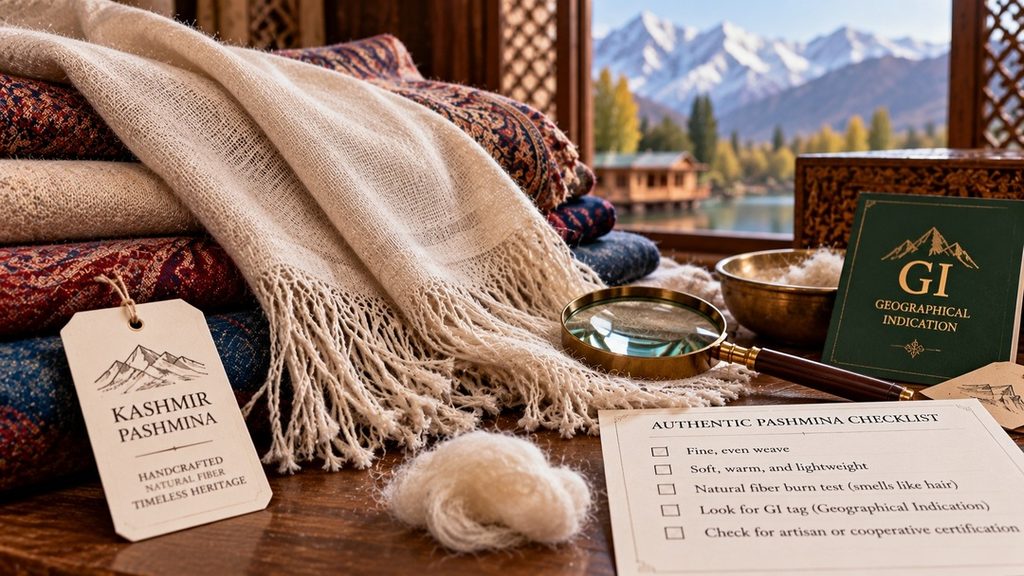
Government Certifications, GI Tagging, and Weaver Traceability
To eliminate consumer fraud and safeguard traditional artisans, the Government of India registered Kashmiri Pashmina under the Geographical Indications of Goods (Registration and Protection) Act of 1999. The legal specifications for Geographical Indication (GI) certification mandate that genuine Pashmina must be spun from 100 percent raw Pashm harvested from Ladakhi Changthangi goats, hand-spun on a traditional yender, and handwoven by registered artisans in Jammu & Kashmir.
The Craft Development Institute (CDI) in Srinagar, in collaboration with the Indian Institute of Carpet Technology (IICT), operates an advanced testing and quality certification laboratory. Shawls meeting these statutory standards receive a secure, non-removable micro-label equipped with an invisible secure code and an optical tag. Using specialized optical readers or scanning the accompanying digital certification, buyers can confirm the artisan cooperative registry number, yarn fineness metrics, and production batch history directly through the state certification database.
In addition to GI provenance, buyers should seek the Handloom Mark issued by the Office of the Development Commissioner for Handlooms under the Ministry of Textiles. While the Handloom Mark verifies manual loom production across various Indian craft traditions, the specific Kashmiri Pashmina GI tag provides dual assurance of geographical purity and raw material authenticity. Demanding verifiable GI paperwork ensures that capital flows directly back to Changpa pastoralists and Kashmiri master weavers rather than commercial powerloom intermediaries.
Sustaining Heritage Through Informed Patronage
Investing in authentic handcrafted Kashmiri Pashmina is an act of cultural stewardship. In a world increasingly saturated with disposable fast fashion and algorithmically produced synthetic apparel, a genuine hand-spun, handwoven Pashmina shawl represents months of human patience, generational motor memory, and profound harmony with nature. From the remote nomadic encampments of Changthang to the historic weaving quarters of downtown Srinagar, this craft sustains thousands of vulnerable artisan livelihoods.
By understanding weave architecture, recognizing the telltale markers of manual spinning, applying disciplined diagnostic tests, and insisting on certified GI provenance, discerning buyers ensure that their collections hold true heirloom value. Connoisseurship bridges the distance between consumer and maker, transforming an everyday purchase into an enduring partnership that keeps India’s finest fiber heritage alive for centuries to come.