For generations of discerning collectors, purchasing a Kanchipuram silk saree was an act anchored in hereditary confidence. A family visited temple town master weavers or trusted silk houses in Tamil Nadu, felt the substantial weight of pure mulberry filament, inspected the contrast border, and sealed the heirloom investment. Today, modern commerce presents an entirely different marketplace. High-speed electronic jacquard powerlooms, polyester-silk core yarns, electroplated copper threads, and sophisticated digital finishing treatments can mimic the sheen and surface drape of authentic handloom weaves with unsettling precision. Discerning buyers seeking genuine regional artistry through specialized curation platforms like Shimply frequently find that conventional trust tags are no longer sufficient on their own.
While government certifications like the Silk Mark and the official Geographical Indication (GI) label remain essential regulatory frameworks, their presence on a retail tag does not fully protect shoppers from subtle textile deceptions. A genuine handwoven Kanchipuram saree is not merely an assemblage of pure silk threads; it is a structural architectural marvel governed by multi-shuttle interlocking techniques, heavy twisted yarns, and real metallic alloys. To separate museum-grade heritage weaves from deceptive powerloom imitations, buyers must look beyond hanging tags and learn how to read the physical anatomy of the loom itself.
The Architectural Signature of Genuine Korvai Interlocking
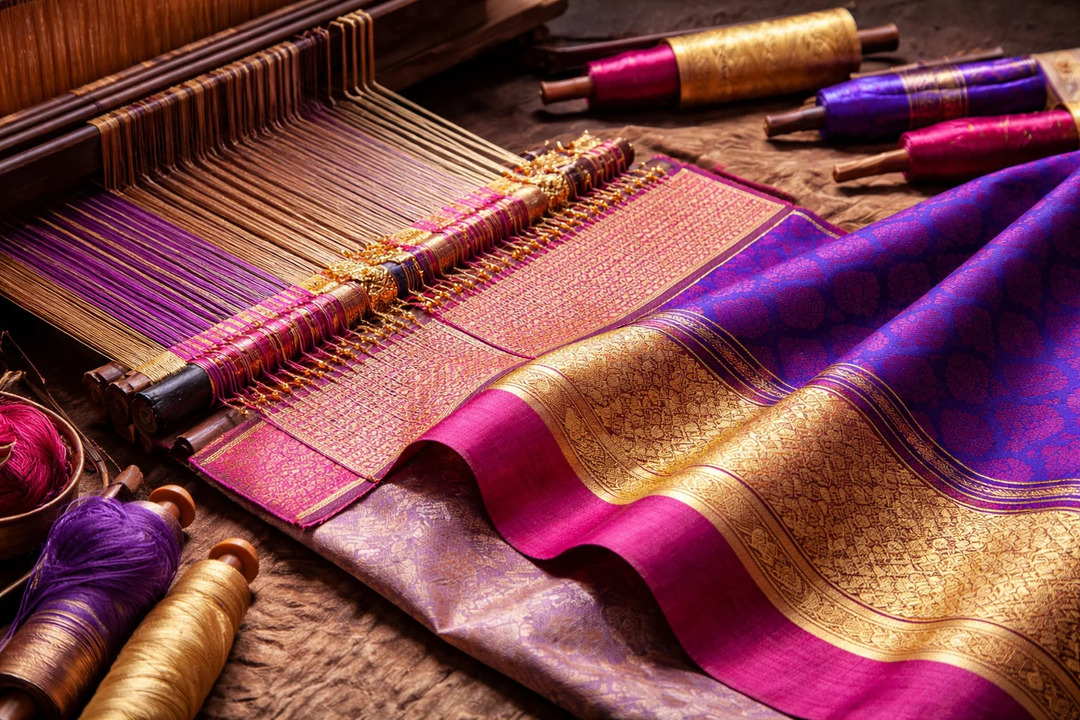
The defining hallmark of authentic Kanchipuram weaving is the korvai technique. In traditional Tamil handloom nomenclature, korvai literally translates to “syncing,” “catching together,” or “interlocking.” Traditional Kanchipuram aesthetics demand intense color saturation between the body of the saree and its contrasting borders—such as a rich emerald field paired with a deep crimson border. Because the warp threads of the body are a completely different color from the warp threads of the borders, weaving them requires three separate shuttles operated simultaneously on a pit loom.
In classical pit-loom weaving, the master artisan sits alongside an assistant or operates dual pedals to maneuver two border shuttles while throwing the main body shuttle across the central shed. Where the border color meets the body color, the weft threads loop through each other in an interlocking join before returning back. This manual interlocking produces a subtle, tactile ridge along the border seam, often embellished with triangular temple spikes known as reku or mokku. When you turn the saree over and inspect the reverse side of an authentic korvai join, you will see a clean, slightly stepped interlock where the two silk colors intertwine without bulk, glue, or machine overlock stitching.
Automated powerlooms, despite their mechanical velocity, cannot replicate true three-shuttle manual interlocking. Instead, commercial powerloom manufacturers employ two workarounds. The first is a single-shuttle continuous weft that weaves a uniform color across the entire width, with the border shade applied post-loom via synthetic roller printing or yarn tie-dyeing. The second is an “attached border” or mock-korvai technique, where separate border bands are machine-stitched onto a body panel or machine-woven using interlocking warp attachments that leave thick, rigid welt seams on the reverse side. If you run your index finger along the border join and encounter a flat machine seam or a raised stitched fold, the garment is an industrial fabrication rather than a genuine korvai handloom.
| Structural Characteristic | Authentic Handloom Kanchipuram | Commercial Powerloom Blend | Inspection Method |
|---|---|---|---|
| Border Joint (Korvai) | Three-shuttle interlocking wefts; organic, subtle zig-zag seam with no added stitching. | Continuous single-shuttle weft, over-dyed border, or machine-stitched attached welt. | Examine reverse seam under direct light; feel for manual thread loops versus machine stitch lines. |
| Pallu Transition (Petni) | Warp threads of body are twisted and tied to pallu warp threads in an interlocking splice. | Abrupt color change woven on a single warp or stitched cross-joint across the fabric width. | Inspect the pallu-to-body junction for subtle manual tie-in twist knots on the reverse side. |
| Reverse Side Motifs | Clean, embedded weave; minimal loose floating threads; each motif tied off neatly. | Dense bird’s nest of long cut-work floats or abrasive glued synthetic backing threads. | Turn fabric over; check if motif threads are woven into the structure or cut short mechanically. |
| Yarn Composition | Heavy 3-ply or 4-ply mulberry silk yarn (murukku pattu); substantial, fluid drape. | Low-twist single silk blended with viscose, nylon, or spun polyester core filaments. | Perform non-destructive burn test on loose fringe threads; check weight against fabric density. |
The Petni Warp Splice: Decoding the Pallu Junction
Just as the lateral borders require interlocking wefts, the contrast pallu (the ornamental end drape known locally as the mundhi) demands a sophisticated warp transition. In an authentic Kanchipuram saree, the pallu features an entirely distinct color and heavier zari concentration than the main body. Creating this transition on a traditional loom requires the petni technique, one of the most labor-intensive processes in Indian handloom heritage.
To execute a petni join, the weaver manually cuts the warp threads of the body across the entire width of the loom—often numbering upwards of 4,000 to 6,000 individual silk filaments. The artisan then hand-twists and splices each individual body thread onto a new set of contrasting warp yarns destined for the pallu. When weaving resumes, this spliced section creates a distinctive shaded or stepped gradient zone (often referred to as seer mundhi) where the body color subtly yields to the pallu color over a space of two to three inches.
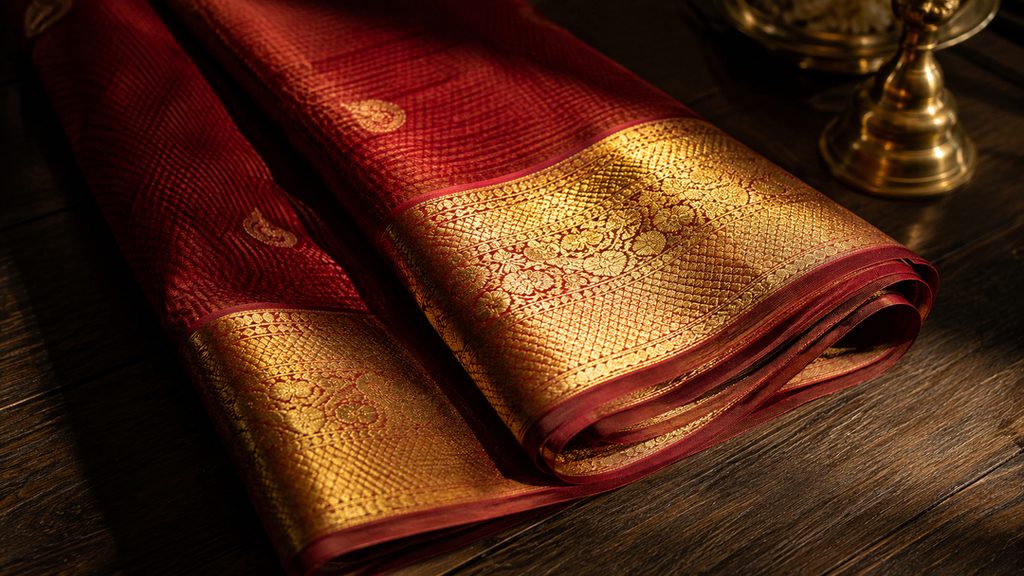
On powerlooms, stopping the machine to hand-tie thousands of individual silk warp ends is commercially unviable. Powerloom imitations circumvent this process by utilizing continuous synthetic warps where the pallu is simply woven with denser weft passes of imitation metallic thread over the existing background color, or by mechanically sewing an entirely separate pallu panel onto the saree body. By closely examining the boundary where the body meets the pallu, a collector can identify genuine petni work: look for the minute, delicate thread-splicing joints visible on the reverse side and the characteristic organic color graduation that machine looms cannot simulate without telltale mechanical uniformity.
Zari Testing Beyond the Flame: Silver, Copper, and Plastic Cores
A Kanchipuram saree derives much of its ceremonial stature from its shimmering metallic ornamentation. However, the term “zari” is among the most widely abused descriptors in modern textile marketing. Under the strict specifications established by the Office of the Controller General of Patents, Designs & Trade Marks for Geographical Indication registration, authentic Kanchipuram zari must conform to rigorous metallurgical standards. True traditional zari consists of a core filament of pure mulberry silk wound with a flattened silver wire containing at least 57 percent pure silver, which is subsequently electroplated with 0.5 percent pure gold.
Today’s mass-market imitations replace this noble metal alloy with two common substitutes: “tested zari” and “half-fine” or synthetic metallic yarn. Tested zari utilizes a core of cotton or viscose wrapped in thin copper wire electroplated to resemble gold. While copper initially looks brilliant, it oxidizes rapidly in humid climates, turning blackish-green within a few seasons. Synthetic metallic yarns abandon metal entirely, employing slit metallized polyester film that creates an unyielding, brittle sheen with no intrinsic metal value.
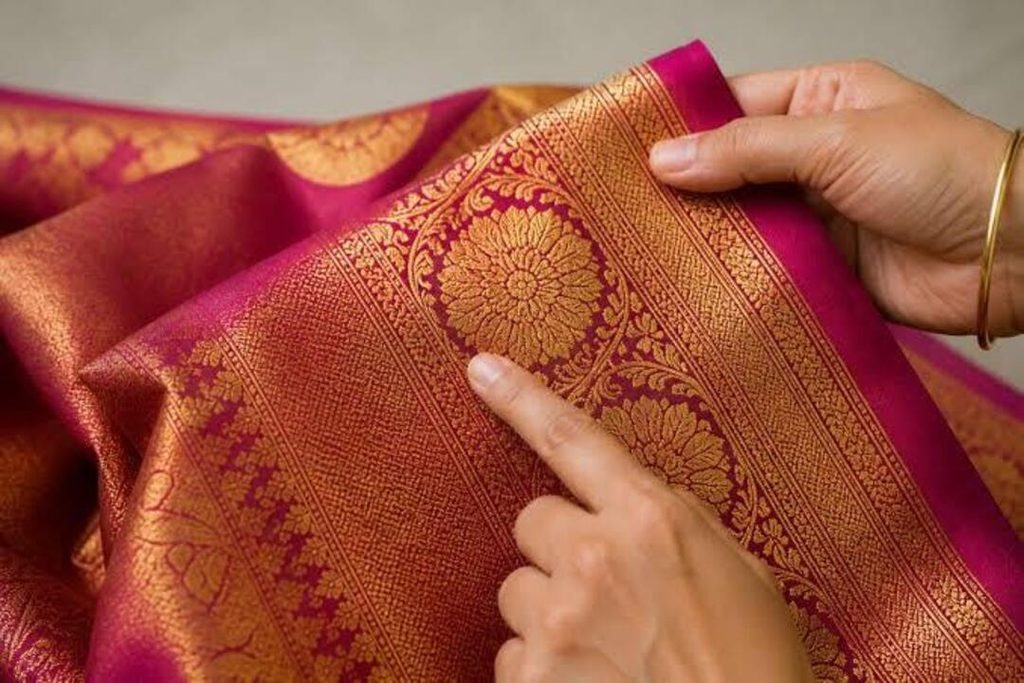
- The Non-Destructive Scrape Test: Gently untwist a loose zari fringe thread from the edge of the pallu and scrape the outer metallic foil with your fingernail. Authentic pure zari reveals a vibrant reddish or deep yellow silk core thread beneath the silver. If the core thread is stark white cotton or synthetic polyester, or if scraping reveals reddish copper underneath a silvery veneer, the garment features commercial tested zari.
- Tactile Drape and Thermal Conductivity: Authentic silver-and-gold zari carries substantial weight and feels cool to the touch upon initial contact due to the high thermal conductivity of real precious metals. Synthetic polyester metallic threads feel room-temperature, slippery, and noticeably plastic.
- The Burn Test Protocol: Sourcing a small unraveling thread from the inner hem allows for a decisive fiber test under the standards maintained by the Silk Mark Organisation of India. Pure silk burns slowly with a distinct odor of burning hair or keratin, extinguishing immediately when removed from flame to leave a brittle, crushable black ash. Polyester and nylon blends melt rapidly with chemical black smoke, leaving behind an uncrushable, hard synthetic bead.
Decoding the GI Tag, Silk Mark, and Weaver Traceability
Navigating third-party certifications requires understanding exactly what each label certifies—and what it omits. The Silk Mark, administered under the aegis of the Central Silk Board of India, is strictly a purity certification for silk fiber. A saree bearing a genuine Silk Mark label guarantees that the base textile consists of 100 percent natural silk rather than viscose, polyester, or rayon blends. However, a Silk Mark label does not guarantee handloom origin; a fully automated powerloom saree woven from pure Chinese or Indian mulberry silk can legitimately obtain a Silk Mark certification if its yarns are unadulterated.
To verify handloom authenticity and geographic origin, buyers must seek the Geographical Indication (GI) tag. Registered under GI Application No. 85 in the Indian registry, the Kanchipuram Silk Saree GI legally mandates that the saree must be produced within the geographical confines of Kanchipuram district, utilize authentic 3-ply mulberry silk, incorporate certified silver-and-gold zari, and employ the traditional korvai interlocking mechanism. Major state apex handloom federations, such as the Tamil Nadu Handloom Weavers’ Co-operative Society (Co-optex), have further strengthened consumer protection by introducing verifiable QR codes on genuine weaver tags. Scanning these digital identifiers reveals the cooperative society registry number, the master weaver’s identification, the yarn specification lot, and the date of production.
| Certification Authority | What It Verifies | What It Does Not Verify | Digital Verification Mechanism |
|---|---|---|---|
| Silk Mark (SMOI / CSB) | 100% natural silk fiber composition; absence of synthetic or artificial blends. | Does not verify handloom versus powerloom; does not certify zari metal purity. | Holographic label with high-security alphanumeric code verifiable on official SMOI portal. |
| Geographical Indication (GI Tag) | Geographic origin in Kanchipuram; adherence to 3-ply silk, traditional korvai, and real zari. | Does not prevent counterfeit physical paper tags from being attached by unauthorized dealers. | GI registration number linked to authorized weaver cooperative societies in Tamil Nadu. |
| Handloom Mark (Development Commissioner) | Authentic manual loom production; supports artisan weaver welfare and traditional technique. | Does not specify minimum silver or gold alloy content in decorative zari work. | Unique serial number and optical security device verifiable via national handloom database. |
Preserving Heirloom Value Through Technical Discernment
The enduring prestige of a Kanchipuram silk saree does not rest on superficial sheen or promotional tags; it resides in the irreplaceable human choreography of the pit loom. When two weavers spend upwards of three weeks synchronizing their shuttles across thousands of warp threads, they are creating a living piece of cultural sculpture designed to withstand decades of ceremonial wear and be passed down through generations. In an era where automated industrial blends can easily masquerade as artisanal luxury, developing a technical understanding of korvai interlocks, petni warp splicing, and metallurgical zari composition is the modern collector’s greatest asset. By insisting on structural authenticity and demanding transparent artisan provenance, connoisseurs ensure that their investment honors true craftsmanship while preserving India’s most revered handloom legacy.