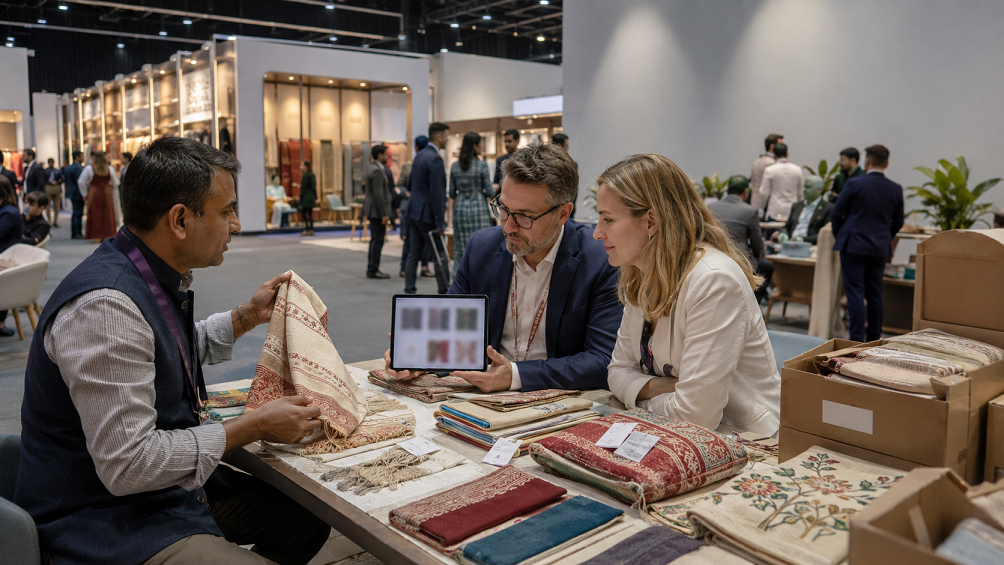
Bharat Tex 2026 gave India’s textile sector a headline number that small handmade sellers should not ignore: about ₹14,300 crore in investment commitments and roughly $2.8 billion in business enquiries. For large mills, state textile parks, exporters, apparel manufacturers, and technical textile companies, those figures point toward scale. For small handmade textile sellers, the lesson is different but just as important. Global buyer demand is not only looking for volume. It is looking for clarity, sourcing confidence, material proof, production reliability, and textile stories that can survive beyond a trade-show booth.
The 2026 edition of Bharat Tex was held in New Delhi and positioned as India’s flagship global textile event. Bharat Tex’s official post-event update said the show covered more than 16 lakh square feet, brought together 1,647 exhibitors, nearly 95,000 business visitors with more than 20,000 repeat visits, 11,315 buyers including 6,090 international buyers, and 3,461 delegates and participants from 138 countries through the Bharat Tex 2026 business momentum report. That scale matters because it shows how global textile interest is becoming more organized, more comparative, and more demanding. A handmade seller does not need to copy a factory. They need to understand what buyers came to compare.
Why The Investment Wave Matters For Handmade Sellers
The ₹14,300 crore investment wave is not a direct payday for every small textile seller. Many of those commitments will likely move into manufacturing capacity, textile infrastructure, processing, apparel production, technology, and state-level industrial expansion. Small sellers should not misread the number as instant demand for every handwoven dupatta, block-printed runner, or embroidered cushion cover.
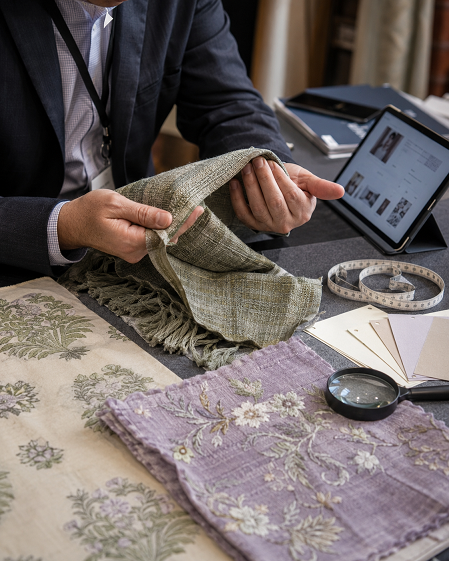
The useful lesson is buyer confidence. When an event produces major investment commitments and large-scale business enquiries, it suggests that India’s textile ecosystem is being watched more seriously by international buyers. That creates a wider demand environment in which handmade sellers can benefit if they present their products professionally.
Economic Times reported that Bharat Tex 2026 generated about $2.8 billion in business enquiries and attracted ₹14,300 crore in textile investment commitments across states, with global interest linked partly to India’s trade positioning and expanding free trade agreement network through the Bharat Tex investment report. For handmade sellers, the signal is not “become a large exporter overnight.” The signal is “get ready to be found, compared, trusted, and contacted by buyers who care about supply stories.”
That means the smallest seller’s product page now has to do more work. It should explain origin, material, technique, dimensions, care, delivery limits, batch size, and handmade variation. Global demand rewards sellers who make buying easier without flattening craft identity.
What Global Buyers Actually Need To See
A global buyer at a textile event is rarely looking only at beauty. They are also assessing consistency, documentation, material quality, lead time, sustainability claims, pricing logic, and whether a seller can communicate clearly after the fair ends. Handmade textile sellers need to translate that same thinking into online product pages.
A handwoven scarf may be beautiful, but a buyer still needs to know fibre content, weave type, size, weight, color accuracy, wash care, production time, and whether the seller can repeat the design in small batches. A block-printed table runner may photograph well, but the page should clarify base fabric, printing method, dye type where verified, expected irregularities, and whether each piece has slight motif variation. A hand-embroidered cushion cover should mention backing fabric, closure type, insert size, thread type, and whether custom colorways are possible.
This is where handmade sellers often lose demand. They assume craft value is self-evident. Buyers, especially international buyers, need proof. The page must make the textile legible.
Bharat Tex’s official opening coverage said the event brought together manufacturers, handloom cooperatives, traditional artists, technology ventures, Indian enterprises exploring global markets, and overseas companies assessing Indian opportunities through the Bharat Tex 2026 opportunity note. That mix is important. Handmade sellers are not outside the textile economy. They are one part of a larger value chain where story and specification need to work together.
Why Trade-Show Interest Must Become Product-Page Discipline
A trade-show booth gives handmade sellers an advantage that online pages do not: direct human explanation. A seller can unfold a saree, show the border, point to the weave, explain how long the motif takes, and answer questions in the buyer’s language of concern. Online pages have to recreate that confidence without the seller standing beside the product.
That requires discipline. The first image should show the whole product. The second should show texture. The third should show scale. The fourth should show the product in use. The fifth should show a close-up of weave, print, embroidery, tassel, border, edge, or finish. If the item is wearable, include drape, size, and styling context. If it is home textile, include room context and measurement clarity.
A strong handmade textile page should include a short craft story, but the story should not replace buying information. Buyers need emotional value and practical confidence. A page that says “made with love by artisans” is weaker than a page that says “hand block-printed cotton table runner from Rajasthan, 180 cm x 35 cm, natural irregularities expected, cold wash separately, small-batch production of 25 pieces.”
Shimply has covered this same digital shift in its guide to digital marketplaces for Indian handicrafts, where online visibility depends on heritage, product clarity, marketplace trust, and contemporary buyer use cases. Bharat Tex 2026 adds a bigger signal: buyers are not only browsing craft stories. They are comparing India’s textile supply readiness.
How Small Sellers Can Read The Buyer Numbers
The buyer data from Bharat Tex 2026 should be treated as a map of demand maturity. Bharat Tex reported 11,315 buyers, including 6,090 international buyers, and participation from 138 countries. Those numbers show that textile sourcing interest is no longer limited to a few familiar export corridors. It is more distributed, more competitive, and more open to differentiated product categories.
For small handmade sellers, that does not mean chasing every market at once. It means segmenting products more clearly. A naturally dyed stole might suit boutique fashion buyers. A handloom table linen collection might fit home decor stores. A compact textile gift set might work for corporate gifting. A premium saree might need wedding, festive, or collector positioning. A small embroidered accessory might work better as an entry-level handmade product for overseas buyers.
| Bharat Tex Signal | What It Means For Small Sellers | Product Page Response |
|---|---|---|
| 6,090 international buyers | Global curiosity is real but competitive | Use clear English product specs and export-friendly descriptions |
| ₹14,300 crore investment commitments | Textile capacity is becoming more professional | Show process, reliability, and batch limits |
| $2.8 billion business enquiries | Buyers are actively comparing suppliers | Make contact, pricing range, MOQ, and lead time easier to understand |
| 1,647 exhibitors | Product choice is crowded | Differentiate through origin, craft method, material, and use case |
| 138-country participation | Buyer needs vary by market | Explain climate use, care, gifting, sizing, and shipping expectations |
This table shows why small sellers should not only celebrate the headline number. They should use it to improve how their products appear when buyers search later.
Why Handmade Textile Sellers Should Avoid Mass-Market Mimicry
A small handmade seller may see Bharat Tex’s scale and think the answer is to look more industrial. That can be a mistake. Handmade textiles win when buyers understand what makes them different: human skill, regional identity, limited batches, material texture, slower production, and visible variation.
The goal is not to pretend a handloom seller has factory capacity. The goal is to present handmade production professionally. That means being honest about lead times, minimum order quantities, repeatability, color variation, and custom limits. A buyer may accept slower production if the page makes those boundaries clear.
This matters because global buyers are often managing risk. They need to know whether a seller can produce 20 pieces, 200 pieces, or only one-of-a-kind items. A boutique buyer may love limited editions. A larger retailer may need consistent sizing and repeat orders. A gift buyer may need packaging and delivery by a specific date. Each buyer type needs a different promise.
Small sellers should not overclaim. Do not say “export quality” without explaining quality checks. Do not call a textile organic, natural-dyed, handwoven, GI-linked, or artisan-made unless that claim is verified. Do not use fake certifications, invented cooperative names, or vague sustainability language. Trust is the real export product.
How Sustainability Claims Need Better Proof
Bharat Tex 2026’s positioning emphasized resilient, sustainable, and innovation-driven textile value chains. That language matters because sustainability is now a global buying filter. Yet handmade sellers need to be careful. A craft product is not automatically sustainable because it is handmade.
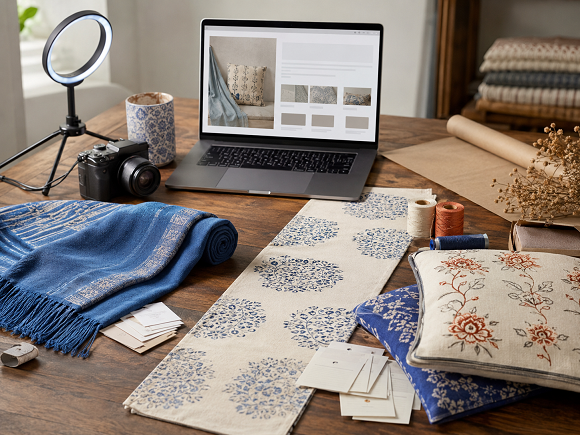
A seller should identify what can be proven. Is the fibre cotton, silk, wool, linen, jute, banana fibre, or recycled textile? Are dyes natural, low-impact, azo-free, or simply unspecified? Is the packaging plastic-free? Is the product made in a small batch? Is the artisan paid directly? Is there a cooperative or enterprise model? Each claim needs clarity.
The Ministry-backed Bharat Tex ecosystem described the event as a platform for globally competitive, resilient, and sustainable textile value chains through a Press Information Bureau release. Small handmade sellers can use that same language only when they support it with product-level details.
A strong sustainability paragraph for a handmade textile page should be factual, not decorative. It can say, “This item is made in small batches using hand block printing, which means motif placement may vary slightly. The seller uses recyclable paper packaging. Dye details are provided only where confirmed.” That is more trustworthy than a broad claim that the product is “eco-friendly and ethical” with no evidence.
Why Product Naming Is A Global Demand Tool
A global buyer cannot buy what they cannot understand. Product naming is one of the simplest ways small sellers can improve demand. Many handmade textile pages use poetic names that sound attractive but fail in search. A title such as “Meera Dream Cloth” may be beautiful, but it does not help a buyer looking for a handwoven cotton stole or block-printed table runner.
A better structure combines craft, material, product type, and use case. Examples include “Hand Block-Printed Cotton Table Runner For Dining Decor,” “Handwoven Tussar Silk Stole With Natural Texture,” “Kalamkari Cotton Dupatta With Floral Motif,” or “Small-Batch Embroidered Cushion Cover For Living Room Styling.” These titles are not glamorous, but they are findable.
For AI-assisted search and marketplace discovery, entity clarity matters. A product page should state the craft form, material, region, product type, buyer use, and limitation. That lets search systems and human buyers understand the item quickly.
Bharat Tex attracted buyers who were comparing a wide textile value chain, from apparel and home textiles to handlooms, innovations, and supply partnerships. A small seller’s title has to compete in that wider information environment. The more precise the language, the easier it is for the right buyer to find the product.
How Sellers Can Turn Trade Interest Into Repeat Demand
The first order is not the whole opportunity. A small handmade textile seller should think in terms of repeat demand. If a buyer likes one handwoven cushion cover, what is the next product? If a customer buys one stole as a gift, is there a matching story card, gift box, or festive collection? If a boutique asks about table linens, can the seller offer a coordinated runner, napkin, and placemat set?
Bharat Tex’s global buyer activity suggests that demand may come through collections rather than isolated products. Small sellers can prepare by grouping textiles into buyer-friendly ranges: festive gifting, premium scarves, natural home linens, wedding textiles, small decor accents, corporate gift sets, and limited craft drops.
Those collections should not erase craft specificity. A “summer home textile collection” can still mention hand block printing, cotton base, regional motifs, and handmade variation. A “premium gift stole collection” can still explain weave, fibre, and artisan process. The collection is a buying pathway; the craft story is the reason it matters.
The strongest handmade sellers will connect three things: product beauty, buying clarity, and repeatable storytelling.
What Small Handmade Textile Sellers Should Do Next
The lesson from Bharat Tex 2026 is practical. Small sellers do not need to match the event’s scale, but they should match its seriousness. Global buyers are looking at India’s textile story with more attention. Handmade sellers need online pages that look ready for that attention.
Start with the top 10 products that already receive the most buyer questions. Rewrite their titles. Reshoot their photos. Add dimensions. Add material details. Add care instructions. Add production time. Add batch-size truth. Add origin context. Add a short section explaining handmade variation. Add a clear contact or order pathway.
Then build product clusters. Do not list 50 disconnected items if five strong categories would make buying easier. A buyer should be able to understand whether the seller is strongest in handloom scarves, block-printed home textiles, embroidered accessories, sarees, textile gifts, or custom small-batch work.
The investment wave at Bharat Tex 2026 is a reminder that India’s textile sector is moving through a larger phase of visibility. Small handmade sellers should not stand outside that movement. They should use it to upgrade how they communicate.
Why The Real Opportunity Is Trust, Not Hype
Bharat Tex 2026’s ₹14,300 crore investment commitments and $2.8 billion in business enquiries are large numbers, but small sellers should avoid turning them into vague optimism. The real opportunity is not hype. It is trust.
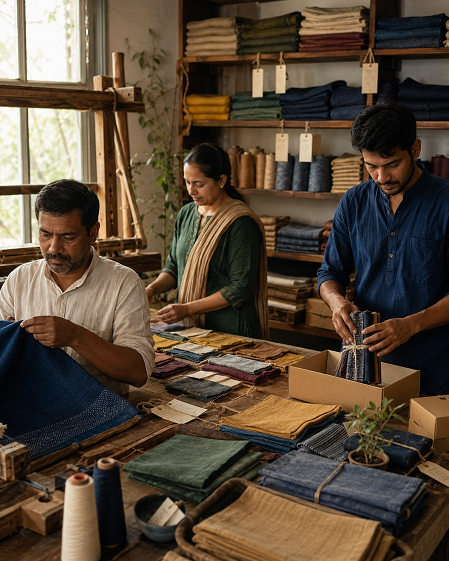
Global buyer demand will reward handmade sellers who can show what they make, where it comes from, how it is produced, how it can be used, what limits exist, and how a buyer can order with confidence. The more professional the page, the easier it becomes for handmade textiles to move from festival admiration to real demand.
A small seller may never exhibit at Bharat Tex. They can still learn from it. Buyers want range, sourcing confidence, sustainability clarity, textile stories, and product information that reduces risk. Those are not only trade-show requirements. They are online product-page requirements.
Bharat Tex showed that India’s textile value chain has global attention. The next question is whether small handmade textile sellers can make their own products visible enough, trustworthy enough, and clear enough to benefit from that attention.