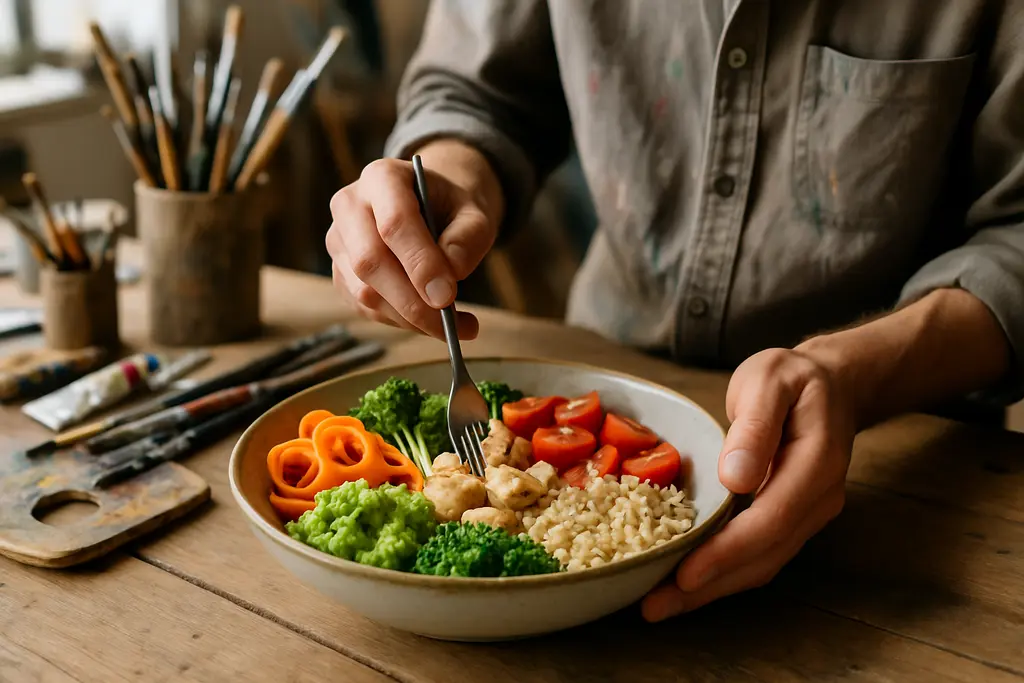
Artist Nutrition for an OBJECTS: USA exhibition opening should be treated as practical studio support, not as a promise that food alone can improve artistic work. Preparing for an opening can mean long hours, indoor work, installation tasks, social attention, irregular breaks, and pressure to stay present with visitors, collaborators, and objects. A cautious nutrition plan can help artists maintain steadier energy while respecting the deeper purpose of the event: the work, its material context, and the community gathered around it.
The aim is not to prescribe a single diet or turn an opening into a performance test. Artists differ in health needs, income, schedules, sensory preferences, food access, and cultural food practices. The evidence points to a modest but useful starting place: balanced meals, planned snacks, regular fluids, and attention to risks that can affect people who spend many hours indoors.
Why Artist Nutrition Belongs In Opening Prep
An exhibition opening sits at the meeting point of studio labor and public attention. For artists working with objects, craft, design, installation, or material culture, the days before an opening may include packing, lifting, labeling, documenting, speaking with organizers, and handling last-minute adjustments. Food planning belongs in that preparation because irregular meals can make already demanding schedules harder to manage.
Respecting The Work Without Treating Food As A Cure
Nutrition should not be framed as a cure for stress, a shortcut to creativity, or a moral test of discipline. That kind of language can flatten the lived conditions of artistic work. A better frame is care: a practical set of decisions that helps the artist remain steady enough to do the work, answer questions, and protect attention. This is especially relevant for handmade and object-centered exhibitions, where the maker may need to explain materials, process, repair, function, and cultural context in real time.
For those interested in art, sound, and event preparation, Robsonic highlights the importance of balancing pace with intensity during public creative events. Shimply has also covered the exhibition from a craft education angle in its note on OBJECTS: USA family craft days, which pairs well with a nutrition plan that supports calm, respectful public engagement.
Steady Meals During Installation Days
Artist Nutrition For Long Studio Hours
Balanced meals are the most practical anchor. The research notes for performance professionals emphasize meals that include enough protein, complex carbohydrates, healthy fats, fruits, and vegetables to support focus, stamina, and immune health. For an artist preparing for an opening, that might mean eating before the installation day becomes too crowded, rather than waiting until hunger is already distracting.
Artist Nutrition should be framed around consistency. A simple pattern is three meals plus planned snacks during long studio or installation days. The research notes suggest a meal one to two hours before a work period, with a light snack 30 to 60 minutes before if needed. During breaks, a portable protein-and-carbohydrate pairing can be more useful than relying only on caffeine or sweet foods. Examples may include yogurt and fruit, hummus and bread, eggs and rice, beans and tortillas, nut butter and toast, or cheese and whole-grain crackers, depending on access and dietary fit.
Avoiding Restriction During High-Demand Weeks
The research notes also warn against under-fueling during periods of intense physical or creative load. In artistic and performance contexts, restrictive eating has been associated with concerns involving lean muscle, bone health, injury prevalence, and Relative Energy Deficiency in Sport among artistic athletes. An exhibition opening is not the same as a sports season, but the caution is still relevant: long days, standing, lifting, travel, and social pressure are poor conditions for experimenting with severe restriction.
Short-term fasting is also not a clear cognitive advantage. The research notes describe a September 2026 pilot randomized controlled trial of four weeks of 16:8 time-restricted eating; the fasting group did not show a specific working-memory or attentional-control benefit compared with controls, although BMI fell in the fasting group. That does not mean every artist must avoid time-restricted eating. It means an opening week is not the best moment to start a new pattern for the sake of focus unless a clinician has advised it for personal reasons.
Hydration And Artist Nutrition Evidence
Hydration Before Social And Installation Demands
Hydration has a clearer connection to short-term attention than many opening-week rituals. In one randomized controlled trial involving adults after 12 hours without fluids, about 58% of young adults were dehydrated; modest water intake improved some mental-arithmetic and symbol-search task results, as reported in the water-intake trial. For artists, the useful lesson is modest rather than dramatic: do not wait until the reception, talk, or install session is underway to start drinking fluids.
A practical approach is to keep water visible during studio packing, transport, and gallery preparation. Some artists may need electrolytes or food with fluids during very long days, but the research notes do not support one universal formula. The safer recommendation is regular access to water, paired with meals or snacks, and extra caution if the day includes heat, heavy lifting, travel, or long conversations under gallery lighting.
- Begin the day with breakfast or a familiar first meal rather than delaying food until the venue is busy.
- Carry a snack that combines carbohydrate and protein for breaks between installation tasks.
- Keep a refillable water bottle within reach during packing, travel, and setup.
- Avoid testing a new restrictive diet, supplement, or fasting pattern during opening week.
- If food access is uncertain, plan low-cost staples before the highest-pressure days.
Indoor Work, Vitamin D, And Food Access
Vitamin D Awareness For Studio-Based Artists
Many artists work indoors for long stretches, whether in studios, shared workshops, home spaces, or exhibition settings. A systematic review found that indoor workers had mean serum 25-hydroxyvitamin D levels of about 40.6 nmol/L, compared with about 66.7 nmol/L among outdoor workers; about 77.5% of indoor workers were vitamin D deficient under the review threshold of less than 50 nmol/L, according to the occupation review. This does not prove that every studio artist is deficient, and it is not a reason to self-prescribe high-dose supplements.
The cautious takeaway is to treat vitamin D as a health topic worth discussing with a qualified clinician, especially for artists with limited sun exposure, darker winter schedules, covered clothing, medical conditions, or dietary limits. Food choices may contribute some vitamin D depending on diet, but blood testing and medical advice are the safer route for deficiency concerns.
Food Security Is Part Of Creative Labor
The research notes also connect food insecurity with anxiety, poorer task performance, lower work engagement, and reduced collaboration. This matters because artists often prepare for exhibitions under financial stress. Nutrition advice can sound hollow if it assumes unlimited time, money, refrigeration, transport, or kitchen access. A respectful plan should include low-cost and portable options, shared meal coordination where appropriate, and realistic venue-day planning.
Community trust in creator commerce is not only about the object for sale. It is also about the conditions around the maker. If an artist is expected to install, speak, sell, document, and socialize without real breaks, the opening structure itself needs care. Organizers can support that by allowing clear break times, access to water, and realistic setup schedules. Artists can support themselves by planning familiar meals rather than relying on whatever is available after the room is full.
OBJECTS: USA Opening Artist Nutrition
For OBJECTS: USA opening preparation, the strongest nutrition plan is ordinary, repeatable, and culturally flexible: eat enough, use balanced meals, carry familiar snacks, drink water before attention drops, and avoid major experiments during high-pressure days. Artist Nutrition is not a substitute for fair pay, good installation planning, medical care, or community support. It is one part of a wider ethic of care around the making, handling, and public sharing of objects.
The most respectful plan is the one an artist can actually follow. A bowl of rice and beans, a sandwich, yogurt and fruit, leftovers, soup in a thermos, or a packed snack can all serve the same purpose if they support steadier energy and reduce decision strain. For makers preparing to meet the public around handmade or object-based work, that steadiness can help protect what matters most: clear attention to the art, honest conversation with visitors, and care for the body doing the work.