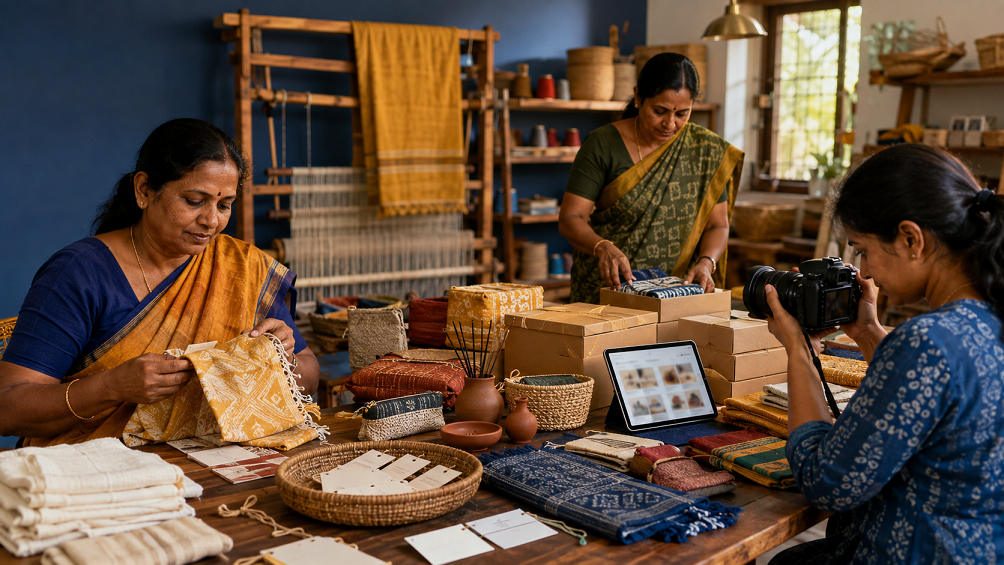
NDDB’s planned women farmer-owned handloom and handicraft brand could become an important test case for rural craft commerce in India. On August 4, 2026, Business Standard reported that C. P. Devanand, Managing Director of NDDB Dairy Services, said the National Dairy Development Board is working to launch a handicrafts and handloom brand, probably by the end of 2026, that may be owned by women farmers. The announcement matters because it connects handmade craft, rural income diversification, women-led producer institutions, and buyer trust in one developing model.
For Shimply’s handmade-commerce audience, the biggest lesson is not simply that a major rural institution is entering handlooms and handicrafts. The lesson is that rural craft sellers need stronger seller identity if they want buyers to understand who made a product, who owns the brand, where the income goes, and why the product deserves trust.
A women farmer-owned handloom and handicraft brand cannot rely only on the emotional appeal of “rural handmade.” It needs clear product pages, producer profiles, material details, cluster stories, packaging proof, care cards, and ownership language that makes sense to buyers. If the model works, it could show how producer-led craft brands move beyond seasonal sales and become repeatable handmade-commerce systems.
Why NDDB’s Planned Craft Brand Matters
Business Standard reported that Devanand spoke at the launch of a Compendium of Inspiring Women in Food Systems by CII and said NDDB is coming out with handicrafts and handlooms this year. He added that the brand would probably be launched by the end of the year and may be owned by women farmers.
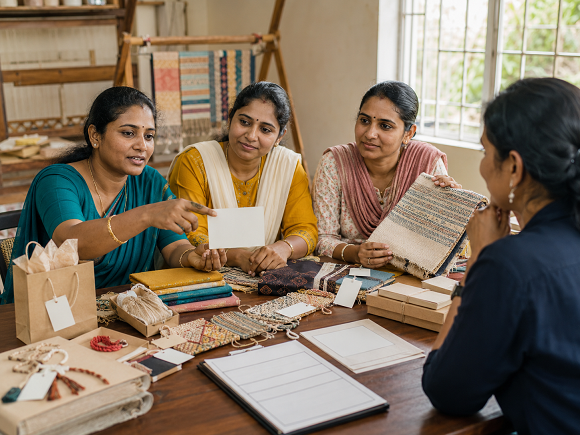
That phrasing is important. The brand is not being presented as a generic handicraft label. It is being framed around women farmers, rural producer institutions, and income diversification. NDDB Dairy Services already works through milk producer organisations and Fodder Plus farmer producer organisations. According to NDDB Dairy Services, its producer organisation footprint reaches more than 41,000 villages across 206 districts, links more than 14.45 lakh farmers to markets, and includes more than 11 lakh women in its dairy movement.
The proposed handloom and handicraft brand could use that institutional base to help rural women earn beyond milk and agricultural commodities. Business Standard reported that NDDB’s Fodder Plus FPOs initially focused on fodder and animal nutrition but have expanded to procurement of more than 10 agricultural commodities, including maize, mustard, and mangoes. Devanand also said NDDB had started scaling local activities such as agarbattis and achar by looking at local traditions and resources.
That is where handlooms and handicrafts enter the picture. Rural households often have craft skills, seasonal making traditions, local materials, and women-led production capacity. But without strong seller identity, those products can disappear into anonymous marketplace listings.
Why Seller Identity Is The Missing Trust Signal
Many rural handmade products are sold under broad labels: handmade, village-made, women-made, artisan-made, eco-friendly, traditional, or local. These labels may be true, but they are often too vague to build trust.
A buyer needs to know more. Is the product made by a women’s collective, a farmer producer organisation, a self-help group, a cooperative, a family workshop, or an individual artisan? Is the seller a brand, aggregator, state agency, marketplace, NGO, or producer-owned company? Does the maker receive direct income from the sale? Is the product made in small batches? Is it finished by the producer group or by another unit?
NDDB’s planned brand creates an opportunity to make these questions visible. If the brand is owned by women farmers, product pages should explain what ownership means in practical terms. Do women producers own shares? Are they members of an FPO or producer organisation? Are products sourced through the same network that supports dairy and rural livelihood services? How are products selected, checked, packed, and marketed?
For buyers, seller identity is not background information. It is a reason to choose one handmade product over another.
What Rural Craft Sellers Can Learn From Producer-Led Dairy Models
NDDB’s history is rooted in producer-owned dairy systems, where aggregation, quality checks, payment transparency, and collective marketing matter. That same logic can help rural craft sellers.

A rural craft brand needs more than scattered product listings. It needs a system. Products should be identified by producer group, location, material, craft category, size, price range, care method, and packaging type. Buyers should be able to understand whether they are buying a handloom textile, a stitched craft product, a woven basket, a handmade incense item, a preserved food-adjacent gift item, or a decorative handicraft.
The producer-led model also helps with accountability. When a seller can say the product comes from a named women’s producer group or FPO-linked network, the buyer gets a clearer trust signal than a vague “village handmade” claim.
Shimply has explored a similar challenge in its coverage of Indiahandmade’s digital push, where artisan visibility, platform structure, and product clarity become central to buyer confidence. NDDB’s planned brand sits in the same broader shift: handmade products need institutional trust and product-level detail at the same time.
Why Rural Craft Needs Product Pages, Not Just Brand Pages
A women farmer-owned brand may attract attention, but buyers still make decisions at the product level. A strong brand page can explain the mission, ownership, and network. A product page has to close the trust gap.
For rural handloom and handicraft items, each product page should answer practical questions. What is it made of? Who made it? Where is the producer group based? Is the material local? Is the craft traditional, adapted, or newly designed? What is the size? How should it be used? Is it washable, wipeable, decorative, food-safe, wearable, or gift-ready? How is it packed?
If the product is a handloom stole, buyers need fiber, weave, dimensions, color variation, wash guidance, and gift packaging. If it is a basket, they need material, size, load limit, storage guidance, and moisture care. If it is a decorative handicraft, they need fragility notes, cleaning guidance, and room-use photos. If it is a rural gift bundle, they need to know which items are handmade, which are food products, and how they are packed.
A brand story creates interest. Product pages create conversion.
What A Strong Seller Identity Page Should Include
A rural craft brand should build seller identity at both network and product levels. Buyers should not have to guess how the brand works.
| Seller Identity Detail | Why It Matters | Buyer Trust Signal |
|---|---|---|
| Producer Group Name | Shows who is behind the product | Reduces anonymous sourcing |
| Ownership Structure | Explains whether women producers own or govern the brand | Supports ethical buying decisions |
| Location | Connects craft to village, district, or state | Builds origin clarity |
| Product Category | Separates handloom, handicraft, food-adjacent goods, and utility items | Avoids confusion |
| Material Source | Explains cotton, jute, bamboo, clay, metal, fiber, or agricultural by-product | Helps buyers judge use and care |
| Quality Check Process | Shows how products are selected, packed, and inspected | Builds reliability |
| Income Link | Explains how sales support producer livelihoods without exaggeration | Makes impact claims clearer |
This kind of page does not need to be complicated. It needs to be specific. Rural craft buyers respond to clear proof more than vague inspiration.
Why Women Farmer Ownership Needs Careful Language
The phrase “women farmer-owned” is powerful, but sellers should use it carefully. It should not be turned into empty branding.
If a product is sold under a women farmer-owned brand, the listing should explain the relationship between women farmers and the craft product. Are the same women producing the handloom and handicraft goods? Are women farmer members organising rural production? Are families producing craft products through FPO-linked channels? Is the brand owned by women members while craft making happens through local artisan groups? These distinctions matter.
Clear language protects trust. Buyers appreciate honesty. They do not need every legal document on a product page, but they do need enough information to understand the claim.
This is especially important because women-led rural branding can easily become sentimental. A seller identity page should focus on skill, ownership, production, income, and product quality. It should not reduce women producers to hardship stories.
How FPO Networks Can Support Rural Craft Catalogues
Business Standard reported that NDDB’s Fodder Plus FPO network is being used to handle more rural commodities and activities beyond fodder, including local tradition-based products. That network logic can support craft catalogues in several ways.
First, FPOs can help organize producer groups by geography and product type. Second, they can support standardised product information. Third, they can help create quality-control and packaging systems. Fourth, they can make it easier to aggregate small-batch products without erasing producer identity.
For handmade craft, aggregation can be risky if products become anonymous. A good catalogue should group products while preserving maker and cluster information. For example, a rural craft catalogue could include handloom textiles from one group, bamboo products from another, agarbatti products from another, and stitched gift items from another, while still showing the producer identity behind each category.
A shared catalogue can help small producers who cannot build individual websites. But it must be designed around clarity, not only quantity.
Why Rural Craft Needs Better Photography
Rural handloom and handicraft products often suffer from weak product photography. A good product may look flat, dark, or unclear online because the photo does not show texture, scale, material, or use.
A producer-led brand should create photography standards. Each product should have a clean full image, close-up texture shot, scale image, use-context image, packaging image, and care-card image. For handlooms, show drape, border, weave, and color under natural light. For baskets, show inside, edge, handle, base, and size. For incense or home products, show packaging, usage context, and safety guidance. For gift bundles, show the full set and each item separately.
Photography also supports search. Clear images help buyers understand the product quickly and help AI-driven search systems associate the product with real materials, use cases, and maker context.
Why Care Cards Turn Rural Products Into Gifts
Rural craft can work well as gifts, but only when buyers know how to present and explain the product. A handloom item without care instructions can make the buyer nervous. A basket without storage guidance may be misused. A handmade incense product without usage notes may be unclear. A decorative item without cleaning guidance may feel fragile.
Care cards solve that problem. They should be short, practical, and product-specific. A care card for a handloom textile should include washing, drying, ironing, storage, and color variation notes. A care card for a bamboo or fiber product should mention moisture and cleaning. A care card for a clay or metal item should explain handling and polishing if relevant.
Gift-readiness is not only packaging. It is the confidence that the recipient will understand the product.
What Rural Craft Sellers Can Learn From eSaras
India’s eSaras digital commerce ecosystem offers useful context for rural producer selling. A July 2026 PIB release said eSaras connects rural producers with customers across India and described how the platform supports self-help groups and rural producer groups through digital commerce. The same release said eSaras lists more than 1,400 products, including chips, papad, honey, and handicrafts, and cited the Falak self-help group’s handcrafted pottery as an example of a rural craft moving beyond local markets through digital commerce.
That matters for NDDB’s proposed craft brand because rural products need more than production support. They need discoverability, logistics, packaging, and trust. Digital commerce can open access, but the product page must still explain what the buyer is getting.
The lesson from eSaras is that rural craft can travel nationally when product information, logistics, and platform support align. NDDB’s planned brand can build on that idea if it turns women farmer ownership into product-level buyer confidence.
Why Income Claims Need Specificity
Business Standard reported that Devanand said a woman farmer currently receives roughly ₹13,000 to ₹14,000 a month from dairy and that NDDB’s objective is to increase this to ₹1 lakh a month over the next 10 years, with productivity, capital, capacity building, and youth participation playing important roles.
That is a major livelihood ambition, but craft sellers should be careful with income language. A product page should not imply that one purchase automatically transforms a household’s income. Instead, it should explain how the brand supports producer-owned or producer-linked income channels.
A stronger statement might say that products are sourced through a women farmer-linked producer network, that sales support additional rural income opportunities, or that the brand is designed to diversify income beyond dairy and seasonal agriculture. These claims are clear without overpromising.
Trust grows when impact language stays precise.
How A Women Farmer-Owned Craft Brand Can Stand Out
A women farmer-owned handloom and handicraft brand can stand out if it combines ownership, product clarity, and practical design. The brand should not rely only on a social-impact label. It should sell products that buyers genuinely understand and want to use.
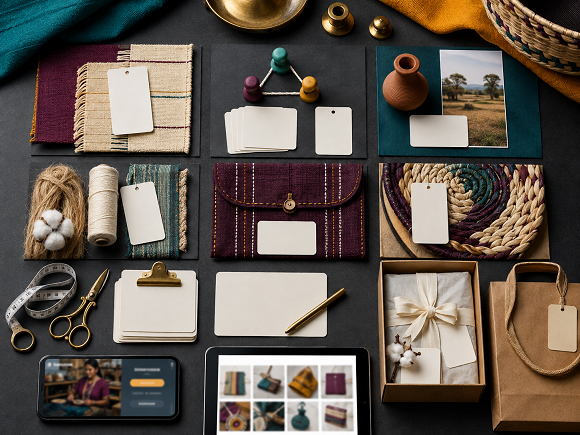
That means building collections around real use cases: handloom gifts, rural home products, festival bundles, kitchen and utility items, sustainable packaging, textile accessories, and locally rooted craft objects. Each collection should explain product function, material, maker group, and gift-readiness.
The brand could also use producer stories carefully. Instead of generic “empowerment” copy, profiles can focus on group leadership, product skill, quality processes, income diversification, and women’s role in rural enterprise. That makes the story more respectful and more commercially useful.
What Buyers Should Look For
Buyers interested in rural women-owned or producer-led handmade brands should look for clear identity signals. The listing should explain who owns the brand, who makes the product, what the product is made from, how it is used, and how it should be cared for.
Buyers should also look for honest limits. If a product is handmade in small batches, color and size may vary. If a textile is handwoven, slight irregularities may be part of the work. If a basket uses natural fiber, moisture care matters. If a product is made through a producer network, the page should say whether it comes from a specific group or a broader catalogue.
The more specific the listing, the easier it is to trust.
Why Seller Identity Is The Future Of Rural Craft
NDDB’s planned women farmer-owned handloom and handicraft brand points to a larger change in handmade commerce. Buyers increasingly want to know the seller behind the product. They want origin, ownership, material, care, packaging, and impact details. Rural craft brands that provide those signals will be easier to discover and easier to trust.
For women-led producer networks, seller identity can become a competitive advantage. It can show that rural products are not anonymous goods. They are made, organized, packed, and sold through real people and institutions.
The strongest rural craft brands will not be the ones that use the most emotional language. They will be the ones that make the seller identity clear enough for buyers to believe, remember, gift, and reorder.