
Jharkhand’s six GI-tagged handlooms at Bharat Tex 2026 show why regional textiles need more than exhibition visibility. They need stronger online product pages that explain origin, material, use, care, packaging, and buyer trust. At Bharat Mandapam in New Delhi, Jharkhand Industries Minister Sanjay Prasad Yadav inaugurated the state pavilion showcasing Tassar Silk, Kuchai Silk, Bhagaiya Saree and Fabric, Tumka Chadar, Bhoya Saree and Fabric, and Pancho Saree and Fabric before national and international textile buyers.
For Shimply readers, the story matters because a GI tag can bring attention, but attention does not automatically convert into sales. A buyer may discover a Jharkhand textile at Bharat Tex, admire the weave, hear about its origin, and then search online later. If the product page is vague, poorly photographed, or missing care and packaging details, that discovery can disappear. Regional textiles become stronger gift products when sellers make them searchable, understandable, and trustworthy after the exhibition ends.
Why Jharkhand’s Bharat Tex Showcase Matters
Bharat Tex 2026 gave Jharkhand a global textile platform. The event was held from July 14 to 17 at Bharat Mandapam in New Delhi and covered the full textile value chain, including fibre, yarn, fabric, apparel, home textiles, technical textiles, handlooms, and handicrafts. That setting matters because Jharkhand’s handlooms were not displayed as isolated heritage items. They were placed in a national and international trade environment where buyers compare design, quality, origin, price, production capacity, and export readiness.
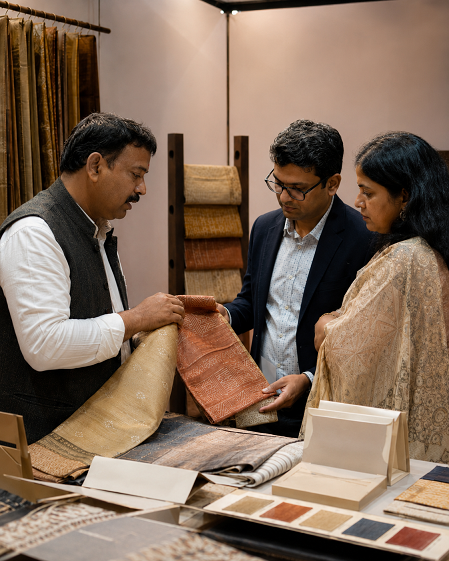
Jharkhand’s pavilion highlighted six GI-tagged products: Tassar Silk, Kuchai Silk, Bhagaiya Saree and Fabric, Tumka Chadar, Bhoya Saree and Fabric, and Pancho Saree and Fabric. The Jharkhand GI handloom showcase positioned these textiles as part of the state’s effort to present traditional craftsmanship and artisan skill to domestic and international buyers.
That combination of GI identity and global buyer visibility is important. A GI tag gives a textile a stronger claim to place-based authenticity. A trade fair gives it a stage. A product page gives it a future. Without that last step, even a strong showcase can become a short-lived news moment.
For online sellers, Jharkhand’s Bharat Tex appearance is a reminder that regional handlooms need digital follow-through. A buyer who hears “Tassar Silk” at a pavilion still needs a clear page explaining what the product is, how it differs from other silks, how it should be styled, how it is packed, and why the seller is trustworthy.
Why GI Tags Need Better Product Translation
A Geographical Indication tag can help buyers identify products linked to a specific region and reputation. India’s official Geographical Indications framework says GI registration promotes the economic prosperity of producers of goods produced in a geographical territory. That Geographical Indications introduction explains the protection logic, but sellers still have to translate that logic for ordinary buyers.
A buyer may not know the difference between Tassar Silk and Kuchai Silk. They may not understand why Tumka Chadar, Bhoya Saree, or Pancho Saree should be treated as specific regional textile products rather than generic handmade cloth. This is where product pages often fail. They mention a GI name but do not explain what the name means in buyer terms.
A good product page should answer five questions early: what is the textile, where is it from, what material or weave defines it, how can it be used, and how should it be cared for? If the product is giftable, the seller should also show packaging, size, and occasion fit.
Shimply’s guide to GI-tagged Indian crafts by state follows the same buyer logic. Region and craft name help shoppers make better choices only when the seller explains them clearly.
A GI tag can attract attention, but clarity converts attention into trust. That is the difference between a textile being admired and a textile being ordered.
What The Six Jharkhand Handlooms Teach Sellers
The six textiles showcased at Bharat Tex 2026 cover different buyer needs. Some are likely to attract saree buyers. Others can work as fabric, chadar, home textile, gift textile, or cultural keepsake. A seller should not describe all of them with the same generic language.
Tassar Silk needs material storytelling. Buyers want to know texture, sheen, drape, weight, occasion, and care. Kuchai Silk needs similar clarity, with region and textile identity explained carefully. Bhagaiya Saree and Fabric should be presented with both wear and fabric-use possibilities. Tumka Chadar needs use-case clarity: is it for warmth, gifting, display, daily use, or ceremonial presentation? Bhoya Saree and Fabric and Pancho Saree and Fabric need accurate naming, styling photos, care details, and regional context.
| GI-Tagged Jharkhand Textile | Buyer Question | Product Page Lesson |
|---|---|---|
| Tassar Silk | What makes this silk different? | Explain texture, drape, use, and care |
| Kuchai Silk | Where is it from and how should it be worn? | Add region, material, styling, and occasion notes |
| Bhagaiya Saree And Fabric | Is this a saree, fabric, or both? | Separate product type and use case clearly |
| Tumka Chadar | Is it wearable, decorative, or giftable? | Show scale, styling, and care instructions |
| Bhoya Saree And Fabric | What makes it region-specific? | Explain origin and textile identity |
| Pancho Saree And Fabric | How can buyers use it? | Add drape, fabric detail, and gift packaging photos |
This table shows why sellers should avoid one-size-fits-all product copy. Each textile needs its own buyer pathway.
A saree buyer needs drape photos, blouse details where relevant, length, width, fabric feel, and care. A fabric buyer needs cut length, width, repeatability, and customization limits. A gift buyer needs packaging and recipient guidance. A collector or cultural buyer needs origin and maker context.
Why Bharat Tex Exposure Must Lead To Searchable Listings
Bharat Tex 2026 brought more than 6,000 buyers from over 130 countries and over 1.3 lakh trade visitors to a single textile platform. That kind of exposure is valuable, but it also raises buyer expectations. A global buyer who sees a Jharkhand textile pavilion may later search for product names, state agencies, artisan groups, exporters, gift options, or online catalogues.
If sellers do not have searchable product pages, they lose the post-event demand. A buyer may remember “Jharkhand Tassar Silk” but not the stall name. They may remember a Tumka Chadar but not know how to spell it. They may search “GI tagged Jharkhand handloom saree” or “Jharkhand silk gift product.” Product pages should be built for those real search behaviors.
A strong title might say “GI-Tagged Jharkhand Tassar Silk Saree With Natural Texture And Gift Packaging” if every claim is true. A weak title would say “Beautiful Traditional Indian Saree.” The first helps the buyer understand material, origin, certification context, product type, and gift readiness. The second disappears into a crowded marketplace.
Searchable does not mean keyword-stuffed. It means specific. Sellers should use product type, material, region, craft name, occasion, and care language naturally. A product title and opening paragraph should help both search engines and human buyers understand the textile quickly.
How Regional Textiles Become Giftable Products
A regional textile becomes giftable when the seller reduces uncertainty. Buyers want to know whether the product suits a wedding, housewarming, festival, corporate gift, travel gift, cultural keepsake, or personal wardrobe purchase. They also need confidence that the recipient will understand the product.
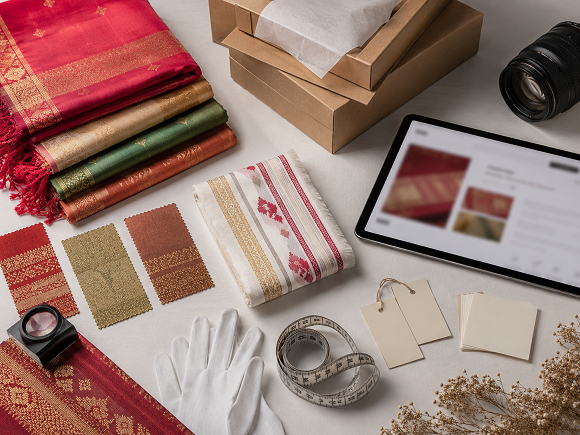
For a Jharkhand handloom, that means the packaging should support the story. A gift-ready product might include a clean fold, protective wrap, care card, origin note, and simple explanation of the textile. A buyer giving Tassar Silk or Kuchai Silk as a gift should be able to pass along more than the item. They should be able to pass along its place and purpose.
This is especially important for international buyers. A buyer in Singapore, London, Toronto, Dubai, or New York may value a GI-tagged Jharkhand textile but need help understanding how to present it. The product page should explain whether it can be worn, displayed, framed, styled on a table, used as a wrap, or gifted as fabric.
Product photos should support those choices. Show a full-length image, folded image, close-up weave image, scale image, packaging image, and a use-case image. For sarees, show drape and border. For chadars, show size and texture. For fabrics, show fall, thickness, and color accuracy.
Giftability is not created by calling something premium. It is created by making the buying decision easier.
Why Care Instructions Are A Trust Signal
Care instructions are often treated as an afterthought, but for handloom textiles they are a major trust signal. Silk, handwoven fabric, regional dyes, and delicate finishing can all require careful handling. A buyer who does not know how to store or wash a textile may hesitate to purchase.
Sellers should include care instructions directly on the product page and inside the package. The wording should be simple: dry clean only, air after use, avoid direct sunlight, store folded in cotton cloth, do not use harsh detergents, or follow the specific care suitable for the product. Sellers should not invent care rules if they are unsure. They should confirm with the weaver, cooperative, or producer group.
Care instructions also reduce returns and complaints. A buyer who understands handmade variation, color behavior, fabric texture, and storage needs is less likely to be surprised. This protects both the seller and the artisan.
For GI-tagged textiles, care cards can also reinforce authenticity. A small note explaining the region, textile name, and care method can make the product feel more professional and gift-ready.
What Sellers Should Photograph Before Leaving An Expo
A trade event is a powerful content opportunity. Sellers should not wait until they return home to think about product photos. The pavilion, display table, buyer interactions, folded textiles, packaging, and close-up details can all become digital assets.
Before leaving an expo like Bharat Tex, sellers should capture clean photos of each product category, close-ups of weave and border, packaging setups, stall displays, and lifestyle-style compositions where possible. They should also record buyer questions. If several buyers ask whether Tassar Silk is suitable for summer, the product page should answer that. If buyers ask whether Tumka Chadar can be used as home decor, the listing should include a styled photo.
Photography should be honest. Do not use AI-generated textile images in place of real product photos. Do not over-smooth weave texture. Do not use misleading color correction. Handloom buyers want accuracy because color, texture, and drape are central to the purchase.
A strong post-expo product page should feel like a careful extension of the pavilion: same products, clearer details, better buying path.
Why Regional Textile Sellers Need Stronger Seller Profiles
A seller profile matters because buyers need to know who stands behind the product. Is the seller a weaver, cooperative, state-backed platform, artisan collective, boutique, reseller, or exporter? Each role can be legitimate, but the buyer should understand it.
For GI-tagged products, the distinction matters even more. Sellers should avoid implying they are authorized producers if they are only resellers. If a product is sourced from a cooperative, say that. If it is made by a specific artisan group, say that. If the seller works with weavers but handles packaging and online sales, explain the role.
This kind of transparency builds trust. It also helps buyers understand price. A handloom textile with proper sourcing, packaging, care support, and seller accountability may cost more than a vague listing. The product page should explain enough for the buyer to see why.
A seller profile should include region, product focus, sourcing method, packaging standards, and contact or reorder options. For export-focused buyers, it should also mention whether the seller can handle bulk inquiries, gift packaging, or made-to-order timelines.
How Jharkhand Can Turn Pavilion Visibility Into Repeat Demand
Jharkhand’s Bharat Tex pavilion can become more valuable if the visibility leads to repeat demand. That requires organized digital follow-up. Every showcased product should have a product code, photo set, description, dimensions, care note, packaging information, and contact pathway.
A buyer who saw Tassar Silk at Bharat Tex should be able to find it later. A boutique buyer interested in Kuchai Silk should receive a catalogue. A gift buyer interested in Tumka Chadar should see packaging options. A textile researcher or collector should be able to understand the GI context and maker background.
The strongest follow-up does not need to feel corporate. It needs to feel clear. A PDF catalogue, marketplace collection, website page, WhatsApp catalogue, or social media highlight can all work if the information is complete and accurate.
Bharat Tex gives regional textiles a stage. Online product pages turn that stage into sales memory.
What Buyers Should Ask Before Purchasing GI-Tagged Jharkhand Handlooms
Buyers should treat GI language as a starting point for better questions. Ask what the product is, where it is from, what material it uses, whether it is handwoven, how it should be cared for, and whether the seller can explain the GI-linked identity.
For sarees and fabrics, ask for dimensions, blouse details where relevant, color accuracy, texture, and return policy. For chadars, ask for size, warmth, use, and storage. For gift purchases, ask whether packaging and a care card are included.
Be careful with listings that use many famous textile names together. A product page that mentions Tassar, Kuchai, Bhagaiya, Bhoya, Pancho, and other terms without explaining one specific product may be using craft names as traffic bait. Trustworthy listings are specific.
Buyers should also look for real photos. A GI-tagged textile should show weave, edges, folds, and scale. If a seller only provides heavily stylized images, ask for additional photos before buying.
Why Better Product Pages Protect Regional Textile Value
Jharkhand’s six GI-tagged handlooms at Bharat Tex 2026 show that regional textiles have strong market potential, but the next step is digital clarity. A GI tag can protect origin. A pavilion can attract buyers. A product page has to close the trust gap.
For sellers, the lesson is practical. Use accurate craft names. Explain the region. Show real photos. Add dimensions and care. Describe packaging. Clarify seller identity. Build collections around use cases such as wedding gifts, housewarming textiles, cultural keepsakes, premium sarees, travel wraps, or home decor.
For buyers, better product pages make regional textiles easier to support. They help shoppers choose genuine products, avoid vague claims, and understand why a Jharkhand handloom deserves attention beyond the exhibition floor.
Bharat Tex 2026 gave Jharkhand’s GI-tagged handlooms a global stage. The sellers who turn that stage into searchable, gift-ready, well-documented product pages will give those textiles a longer commercial life.