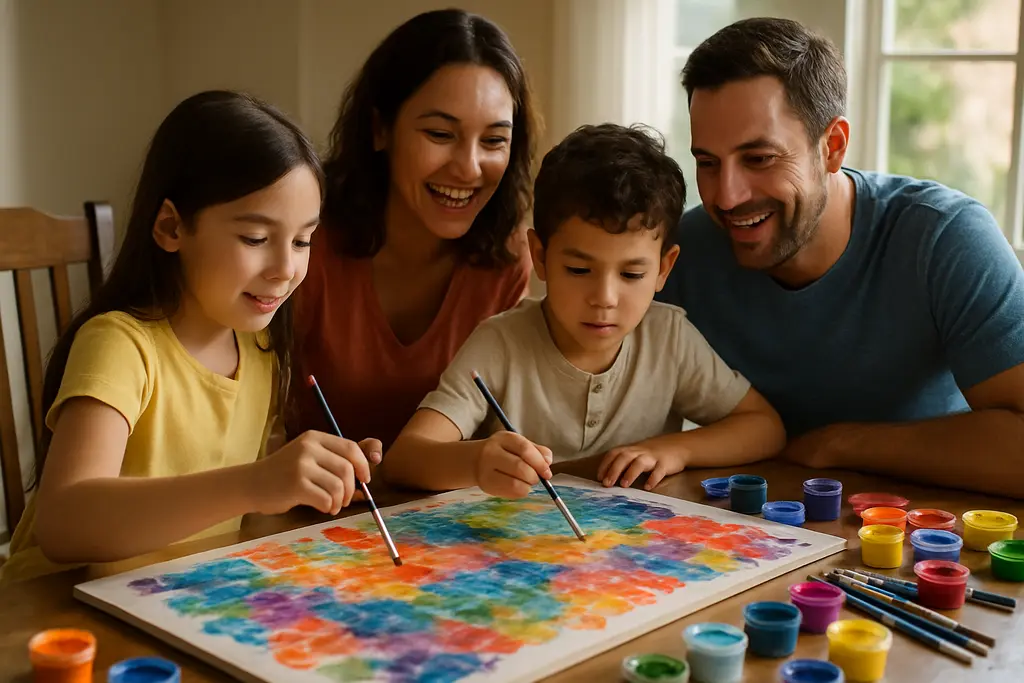
Rebecca Moses’s The Art of Observation offers a useful model for family art activities because it treated seeing, making, and conversation as connected practices. The exhibition ran through August 31, 2026, at the Southampton Arts Center at 25 Jobs Lane in Southampton, New York. Its reported hours were noon to 5 p.m., Thursday through Monday, and it was framed as part working studio, part performance, and part conversation. Since the exhibition has now ended, the most practical question for families is not whether to visit, but how to adapt its slower habits of looking into respectful, low-pressure wellness routines at home, in classrooms, or in community art spaces.
Why Family Art Activities Fit This Exhibition
Moses’s Hamptons exhibition was built around observation rather than passive viewing. Visitors could see the artist paint in real time and engage with her personally, which makes the project a strong reference point for families. A child watching an artist make decisions about line, posture, gesture, color, or facial expression is learning that art is not only a finished object. It is also a process of attention.
That matters for family wellness because attention is often the first step in shared activity. A parent, grandparent, or caregiver does not need to turn a drawing session into a formal lesson. The stronger approach is quieter: look closely, move gently, ask what changed, and give each person enough time to notice something different. For community-driven nutrition and family wellness, this same habit is familiar. Sustainable routines usually work best when they are repeatable, relational, and not built on pressure.
Family Art Activities As Observation Practice
Family art activities inspired by Moses’s project should begin with observation rather than copying. Families might choose a household object, a flower arrangement, a jacket on a chair, or a person sitting in profile. Each participant can spend two minutes looking before anyone draws. Then the family can sketch for five minutes, stand and stretch, and return to the same subject from another angle.
This structure respects artistic context. It does not ask families to imitate Moses’s personal style or reproduce a specific work. It borrows a broader method: sustained attention. That distinction is useful for handmade creators and family craft sellers as well. Inspiration is strongest when it studies process, materials, and questions, rather than treating an artist’s signature visual language as a template for commercial use.
What The Education Data Suggests
The strongest family evidence in the available research does not say that one exhibition-based activity will improve health outcomes. It does show that many families already use arts participation at home. In a 2019 U.S. Department of Education survey, 28% of elementary students had visited an art gallery, museum, or historical site with parents in the previous month, while 75% had done arts and crafts with parents in the previous week, according to the National Center for Education Statistics.
Those figures are helpful because they separate two forms of access. Museum and gallery visits are valuable, but home-based making is more common. For families who missed Moses’s exhibition before August 31, 2026, this is reassuring. The core habits of looking, making, moving, and talking can still be practiced without travel, admission planning, or a formal art background.
Museum Visits And Home Making
Arts participation also extends beyond children. A U.S. scoping review reported that, in the 2017 Survey of Arts Participation, 54% of adults attended creative, arts, or cultural activities; 54% created or performed art; and 74% used electronic media to consume art, as summarized in a scoping review on arts and wellbeing. The review supports a cautious reading: arts engagement is widespread, and arts-based settings may connect with wellbeing, but specific health claims need careful evidence.
For families, that means the goal should be modest. Family art activities can support connection, light movement, and shared attention. They should not be marketed as treatment, therapy, or a guaranteed fitness solution. This caution protects families and respects the art itself.
Movement Ideas With A Cautious Wellness Lens
Because the exhibition centered on observation, the fitness angle should stay gentle. A family does not need intense exercise to connect art and movement. The better fit is light activity that helps the body notice what the eyes are studying: posture, balance, reach, distance, rhythm, and rest. This is especially useful for mixed-age groups where children, parents, and older relatives may have different mobility levels.
Family art activities can be framed as short cycles: observe, move, make, pause, and discuss. This keeps energy balanced and avoids turning art into a performance test. It also gives caregivers natural check-in points for fatigue, frustration, or sensory overload.
Slow Looking Walks
A slow looking walk can happen in a hallway, yard, park, community center, or gallery-like room at home. Each person walks for three to five minutes and chooses one visual detail: a shadow, a color pairing, a fabric fold, a hand gesture, or the shape of a chair leg. After the walk, each person sketches that detail from memory. The movement is light, but it changes the way the family observes.
For safety, the route should be uncluttered, well lit, and suitable for the youngest or least mobile participant. The goal is not steps counted or calories burned. The goal is shared perception. Families can repeat the activity with seasonal foods on a kitchen table, handmade objects from local makers, or textiles already in the home, while avoiding claims that the activity itself changes nutrition or medical outcomes.
Pose, Sketch, And Reset
A second activity is pose, sketch, and reset. One person holds a comfortable pose for 30 seconds, such as seated profile, hands folded, standing with weight on one foot, or reaching toward a shelf. Others make a quick line drawing. Then everyone resets with shoulder rolls, ankle circles, or a slow breath before switching roles.
This approach is useful because it links visual arts with body awareness without forcing athletic competition. Children can learn that bodies communicate through angle, tilt, and gesture. Adults can model consent by asking whether a pose feels comfortable. Older relatives can participate while seated. If any pose causes discomfort, the family should stop and choose a smaller movement.
Creator-Commerce Lessons For Handmade Families
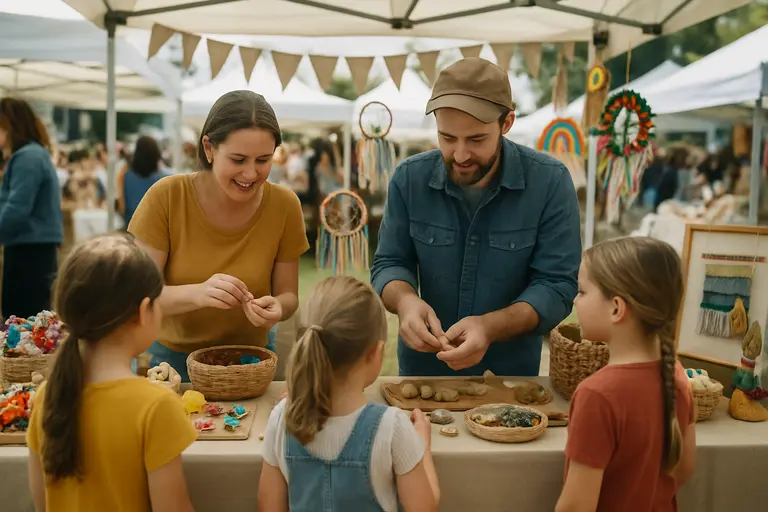
Moses’s exhibition also offers a useful reminder for handmade sellers, family craft educators, and creator-commerce communities: trust grows when the process is visible. The exhibition’s working-studio element let visitors see art as labor and decision-making, not only as a finished surface. Sellers and educators can adapt that principle ethically by showing process, materials, and care, while avoiding imitation of a living artist’s distinctive style for commercial deception.
For families who make crafts together, this can become a simple practice. Label materials honestly. Explain which objects are personal exercises and which are original products. Credit exhibitions, artists, or community traditions as inspiration without implying endorsement or licensing. A related Shimply discussion of family art events makes a similar point: community trust depends on clear context, not just attractive craft outcomes.
Respectful Inspiration, Not Imitation
Respectful inspiration might mean asking, “How did the exhibition teach us to observe?” rather than “How can we make work that looks like this artist’s work?” That shift protects artistic integrity. It also gives families more creative freedom. A child might focus on how a face changes during conversation. A parent might notice clothing, posture, or room arrangement. A grandparent might connect the act of portrait looking with memory.
For creator-commerce, the same restraint matters. Handmade sellers can offer observation journals, family sketch kits, or movement-and-drawing prompts without using an artist’s name to imply an authorized product. This is not legal advice; it is a cautious trust practice. If a seller is unsure about rights, permissions, or likeness issues, they should seek qualified guidance before selling a related product. Readers interested in exploring more community arts coverage across similar platforms can visit Robsonic for culture-focused reading and related discussions.
Rebecca Moses Family Art Activities At Home
The most useful legacy of Moses’s The Art of Observation, after its August 31, 2026 close, is a family practice of attention. Families can choose one evening a week for a 20-minute session: five minutes of looking, five minutes of drawing, five minutes of gentle movement, and five minutes of conversation. This is small enough to be realistic and flexible enough for different ages.
A sample session might begin with a bowl of fruit, a handmade cup, or a favorite garment placed on a table. One person describes shapes without naming the object. Another sketches the outline. A third person changes viewpoint by standing, sitting, or stepping to the side. The group ends by naming one thing they noticed only after slowing down. If food is part of the still life, families can keep nutrition claims simple and accurate: the activity may support conversation around food, but it does not replace dietary guidance.
Family art activities work best when they are generous rather than perfect. The drawing can be awkward. The movement can be brief. The conversation can be quiet. What matters is that the family practices seeing together. Moses’s exhibition gave that practice a public setting in Southampton; families can now carry the same careful attention into kitchens, living rooms, community centers, and craft tables without overstating what art can do or separating it from the people who make it meaningful.