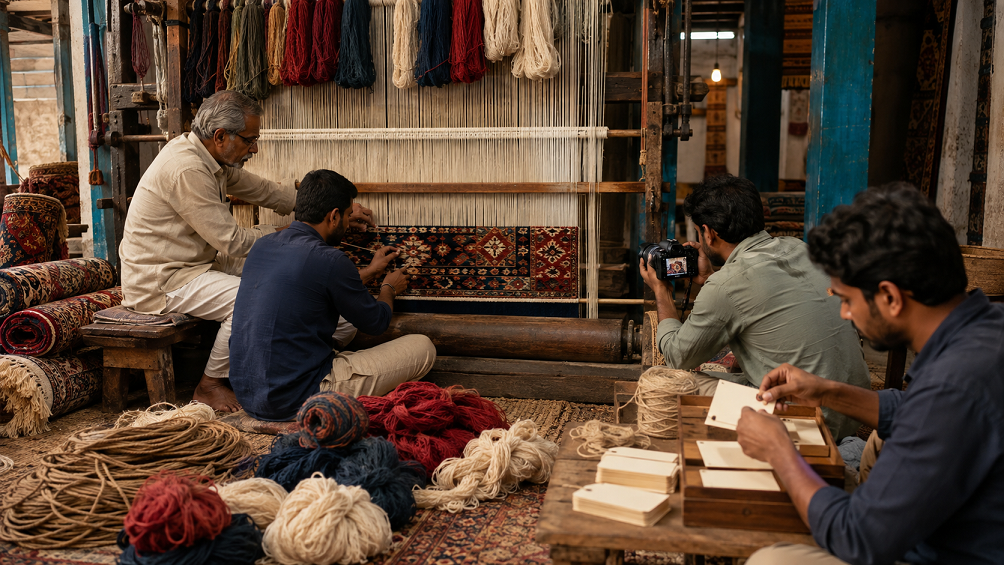
Eluru’s handmade carpet revival is not only a local craft story. It is a reminder that legacy crafts need better online storytelling if they are going to reach modern buyers who discover handmade products through search, social media, catalogues, government portals, and gift guides. In July 2026, a New Indian Express report described how Eluru’s handmade carpet industry in Andhra Pradesh is slowly rebuilding after years of decline, with artisans in Tangellamud, Shanivarapupeta, and Adivarapeta working with wool, cotton, and jute to revive carpets known for quality, durability, and intricate design.
For Shimply’s handmade-commerce audience, the lesson is clear. A legacy craft cannot survive online through nostalgia alone. Buyers need to understand what the product is, where it comes from, how it is made, how it should be used, why it costs more than a machine-made carpet, and how to care for it. Eluru’s carpet revival has the raw material for a strong digital story: Persian roots, local weaving lanes, artisan memory, export history, new products, women and youth training, improved looms, and government-backed cluster planning. What it now needs is sharper product-page storytelling.
Why Eluru’s Carpet Revival Matters For Handmade Sellers
Eluru’s carpet identity has deep roots. The New Indian Express report said the lanes of Tangellamud, Shanivarapupeta, and Adivarapeta once echoed with looms as artisans transformed wool, cotton, and jute into handmade carpets. It also reported that Eluru carpets travelled to the USA, Australia, Germany, and England, supporting thousands of families and giving the city a distinct craft identity.
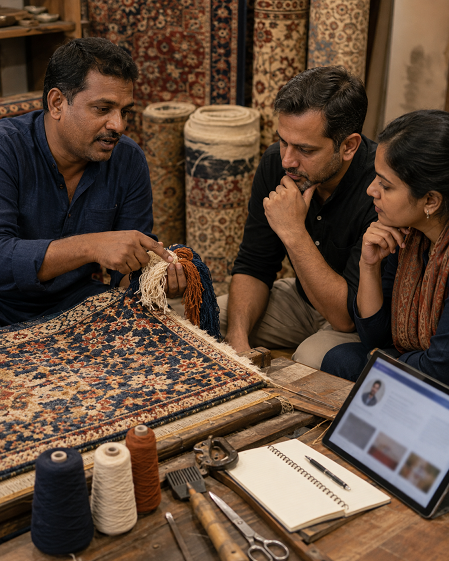
That export memory matters because it gives sellers a strong origin story. But online buyers do not automatically understand why that history should affect a purchase. A product page needs to translate the legacy into buyer-facing proof: materials, weaving method, design language, durability, size, use case, care, and artisan profile.
The revival report named Abdul Nayeem of Hafeez Carpets, who recalled that Eluru was once immediately associated with carpets and said nearly 1,000 families once depended on the craft. It also quoted artisan Jayprakash Morya, who came to Eluru from the Bhadohi-Varanasi region in 1986, saying that the skill is still alive and only needs opportunity.
Those details are valuable because they make the revival human and specific. A seller page that says “traditional handmade carpet” is forgettable. A seller page that explains Eluru’s weaving clusters, materials, family knowledge, and revived artisan participation gives buyers a reason to remember the product.
Why Legacy Craft Needs More Than A Heritage Label
Many handmade listings rely on the word “heritage,” but heritage by itself is not enough. A buyer needs to know what makes a carpet different from a decorative rug, a machine-made floor covering, a printed mat, or a mass-produced import.
Eluru’s carpet revival has several features sellers can explain. The New Indian Express report described quality, durability, intricate designs, revived training, new products such as Double-Sided Pile Hanging Carpets and Dari with Pile Design, improved metal-frame looms, better workspaces, and renewed participation from women and younger artisans. The Eluru District ODOP page describes carpet weaving as a craft with Persian influence that Eluru adopted through artisans who migrated to the Deccan region, with cotton yarn and locally hand-spun wool regularly used.
That is the kind of specificity buyers need. A carpet product page should not stop at “handmade.” It should explain whether the product is wool, cotton, jute, or a blend. It should say whether the piece is a floor carpet, wall hanging, durrie-style product, pile carpet, or decorative textile. It should show thickness, texture, edge finishing, backing, weight, and scale in a real room.
Legacy craft becomes easier to buy when the seller removes guesswork.
What Eluru Carpet Product Pages Should Explain
A strong Eluru carpet product page should treat the buyer as someone who wants both beauty and practical confidence. Carpets are not small impulse gifts. They involve space, cleaning, durability, shipping, and style decisions. Buyers need more information than they would need for a small textile accessory.
| Product Page Detail | Why It Matters | Buyer Trust Signal |
|---|---|---|
| Carpet Type | Floor carpet, wall hanging, durrie, pile design, or decorative textile | Helps buyers understand use |
| Material | Wool, cotton, jute, or blended yarn | Explains texture, durability, and care |
| Size And Weight | Carpets must fit rooms, walls, and shipping limits | Reduces return risk |
| Weaving Method | Handwoven, hand-knotted, pile work, or durrie-style construction | Shows handmade value |
| Design Story | Persian influence, local patterns, geometric or floral motifs | Builds cultural memory |
| Care Instructions | Vacuuming, spot cleaning, sun exposure, storage, and moisture care | Helps the product last |
| Packaging Proof | Rolled, folded, wrapped, or protected for shipping | Supports online and gift orders |
This table is not just a checklist. It is the difference between admiration and purchase. A buyer may love the look of a handmade Eluru carpet, but if the listing does not explain size, weight, material, and care, the buyer may hesitate.
Why Online Storytelling Can Help Eluru Compete With Machine-Made Carpets
The New Indian Express report noted that Eluru’s carpet industry faced severe challenges from machine-made and Chinese carpets, declining orders, limited training and marketing opportunities, and the Covid-19 pandemic. Those pressures are familiar across handmade sectors. Machine-made products often win on price, speed, and consistency. Handmade products must win on story, material quality, human skill, and trust.
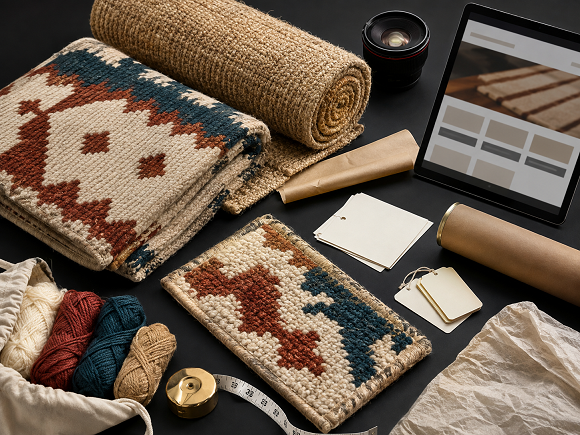
That does not mean sellers should romanticize hardship. It means they should explain value clearly. If a carpet is handmade, show the loom. If it uses wool, cotton, or jute, show the yarn. If the design is intricate, show a close-up. If the artisan needs days or weeks to finish a piece, explain the process. If the product is durable, show use context and care guidance.
The phrase “legacy craft” should not be a vague emotional label. It should be backed by visible evidence.
This is also where Shimply’s buyer guide to ODOP and GI schemes in India becomes relevant. Regional craft identity helps buyers understand why origin matters, but sellers still need clear product details, authenticity signals, and practical guidance before buyers can compare options responsibly.
Why Material Transparency Matters For Carpet Buyers
Carpets are tactile products. Buyers care about feel, softness, weight, thickness, cleaning, durability, and where the product will sit in a home. A handmade carpet listing that does not identify materials creates uncertainty.
Eluru carpet sellers should explain whether a product uses wool, cotton, jute, or a combination. Wool suggests warmth, texture, and pile. Cotton may suggest flexibility and lighter handling. Jute may signal sturdiness and earthy texture. Blended products need especially clear descriptions because buyers may not know what to expect.
Material transparency also helps with care. A buyer may treat a wool carpet differently from a cotton durrie or jute-heavy product. Sellers should explain whether the carpet should be vacuumed gently, spot cleaned, professionally cleaned, kept away from damp floors, rotated for even wear, aired in shade, or stored rolled.
Care guidance is not a minor detail. It is part of the value of a handmade carpet. A buyer who knows how to care for the product is more likely to keep it longer and recommend the seller.
How Product Photography Should Change For Legacy Carpets
Legacy carpet storytelling depends heavily on photography. A single flat product shot is not enough. Buyers need to see the carpet as a textile object, a home product, and a handmade craft.
A strong photo set should include the full carpet from above, an angled room-view image, a close-up of pile or weave, the edge finishing, the reverse side, a hand-for-scale image, a rolled shipping image, and a photo showing the carpet in a real interior. If the carpet is a wall hanging, show it on a wall. If it is a floor carpet, show it under furniture or beside seating. If it is a smaller giftable piece, show packaging and size clearly.
Photography should also avoid misleading color editing. Carpets are often bought for color and pattern harmony. If product photos over-saturate reds, blues, greens, or yellows, the buyer may feel misled. Sellers should use natural light, accurate color notes, and close-up detail images.
For Eluru carpets, the story is in texture. The camera should show that.
Why Artisan Profiles Should Be Skill-Focused
The New Indian Express report included named artisans and owners, including Abdul Nayeem of Hafeez Carpets and Jayprakash Morya, whose remarks emphasized identity, decline, survival of skill, and the need for opportunity. Online storytelling can use this kind of human detail, but it should remain respectful and skill-focused.
A good artisan profile should explain the artisan’s role, craft experience, product specialty, materials, loom type, and design approach. It should not reduce the artisan to hardship. Buyers should come away understanding expertise, not only struggle.
For example, a carpet seller profile could say that the artisan works in Tangellamud or another Eluru weaving area, specializes in pile carpets or durrie-style designs, uses wool and cotton yarn, and participates in exhibitions or training programs. It could include workshop photos, loom details, and product categories.
This builds trust without turning craft revival into sentimental marketing.
Why New Products Need Clear Naming
The revival report noted new products and designs such as Double-Sided Pile Hanging Carpets and Dari with Pile Design. That kind of innovation is important because it shows the craft is not frozen in the past. But new product names need explanation.
A buyer may not understand what a double-sided pile hanging carpet is. Is it meant for walls? Can it be placed on floors? How heavy is it? Does it have a hanging sleeve or rod pocket? Is both-side visibility part of the design? How should it be dusted or stored?
A “Dari with Pile Design” also needs explanation. A seller should clarify whether it is flatwoven with raised design elements, how it differs from a standard durrie, and where it should be used.
Clear naming helps search engines too. Product titles should include craft origin, product type, material, size, and use case. A title such as “Eluru Handmade Wool-Cotton Pile Carpet, 4×6 Floor Rug” is more useful than “Traditional Carpet.” A title such as “Eluru Double-Sided Pile Wall Hanging Carpet” helps buyers understand both heritage and function.
How Eluru Sellers Can Use Exhibitions And Portals Better
The revival report said artisans have begun participating in trade fairs, buyer-seller meets, handloom and handicraft exhibitions, and promotional programmes through Lepakshi Industries. It also noted that modern marketing, social media promotion, and government handloom portals are helping artisans reach new customers.
Those channels are useful, but they work best when sellers bring strong digital assets. Every exhibition should produce product photos, buyer questions, price-range learning, packaging feedback, and catalogue updates. Every portal listing should include the same trust signals: material, size, origin, artisan profile, care, and shipping information.
If buyers ask at exhibitions whether carpets can be washed, how long they last, whether custom sizes are possible, or whether they can be shipped internationally, those answers should be added to product pages. Buyer questions are not interruptions. They are product-page research.
Eluru’s revival will be stronger if every offline event improves online storytelling.
Why The Proposed ₹10-Crore Cluster Needs Digital Strategy Too
The New Indian Express report said Central and State governments are preparing a Detailed Project Report for a ₹10-crore carpet cluster in Eluru. Artisans reportedly see the proposed cluster as an opportunity to revive a historic industry, create employment, and reconnect younger generations with the craft. They are also seeking training, modern machinery, design support, raw materials, and better access to exhibitions and craft fairs.
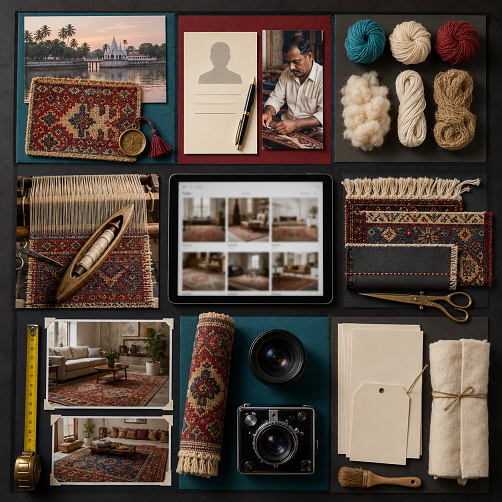
Infrastructure is important, but a cluster also needs digital structure. A carpet cluster should not only produce carpets. It should produce catalogues, product taxonomy, common photography standards, care-card templates, artisan profile formats, size charts, packaging standards, and export-ready product descriptions.
That is how a cluster becomes visible beyond its geography. If Eluru wants to reconnect with national and international buyers, digital storytelling must be treated as part of production, not an afterthought.
A shared catalogue could help small artisans who do not have individual marketing teams. It could list carpet types, materials, standard sizes, custom-order terms, lead times, care instructions, and artisan groups. It could also separate floor carpets, wall hangings, durrie-style products, and premium pile carpets so buyers can navigate the category more easily.
What Buyers Should Look For Before Buying Eluru Carpets Online
Buyers interested in Eluru handmade carpets should look for clear signs of product transparency. A trustworthy listing should identify the material, size, weight, weave type, intended use, origin, care method, and seller or artisan connection. It should show close-up photos and not rely only on heritage claims.
Buyers should ask whether the carpet is handwoven, hand-knotted, pile-based, flatwoven, or decorative. They should ask whether the material is wool, cotton, jute, or a blend. They should ask whether the piece is ready to ship or made to order. For larger carpets, buyers should ask how the product is packed and whether it can be returned if damaged in transit.
If the seller cannot explain these details, the buyer should proceed carefully. Legacy craft deserves respect, but respect should be supported by clear information.
How Better Storytelling Can Support The Revival
Eluru’s handmade carpet revival has all the elements of a powerful handmade-commerce story: place, history, decline, surviving skill, named artisans, export memory, improved looms, new products, government support, and younger participation. But online buyers need this story organized around their decisions.
A buyer wants to know why the carpet matters, but also where it will fit, how it will feel, how long it may last, how to clean it, how to gift it, and whether the seller can be trusted. Better online storytelling answers those questions without weakening the craft’s heritage.
For Eluru artisans, stronger product pages can help convert revival attention into actual orders. For buyers, clearer storytelling can make legacy carpets easier to discover, compare, buy, and preserve. For handmade marketplaces, Eluru’s revival is a reminder that heritage craft does not need generic promotion. It needs precise, buyer-ready storytelling that lets the craft speak in full detail.