
Zishta’s 650-artisan network shows why trust has become one of the most important assets in traditional craft commerce. In July 2026, The New Indian Express profiled Zishta’s 10-year journey, reporting that the company founded by Meera Ramakrishnan, Archish Mathe Madhavan, and Varishta Sampath now works with more than 650 artisans across 15 states while reviving more than 100 traditional crafts. For a handmade seller, those numbers are not only proof of scale. They are proof that traditional craft can become more searchable, teachable, and commercially viable when buyers understand who made the product, why the material matters, and how to use it correctly.
Zishta’s focus on traditional cookware, kitchenware, homeware, and craft-based utility products gives Shimply readers a useful case study. Buyers do not purchase a cast iron tawa, brass vessel, soapstone kalchatti, bronze utensil, Longpi pottery piece, wooden accessory, or traditional storage container in the same way they buy a generic home product. They need more trust. They need material clarity, artisan connection, use guidance, care instructions, maintenance details, and proof that the seller understands the tradition behind the object.
That is the central lesson: traditional craft sellers cannot rely only on beautiful photos or heritage language. They need trust systems.
Why Zishta’s 10-Year Milestone Matters
The New Indian Express report on Zishta’s decade-long journey framed the company as a craft-revival and traditional-knowledge brand rather than only a product seller. Meera Ramakrishnan described a journey that began with a small set of artisans and grew into a network across 15 states. Zishta’s official story page also says the brand sources directly from artisan clusters, works with more than 650 craftsmen, and positions each product as part of a living craft tradition.

For handmade sellers, that structure matters because it changes the buyer relationship. A buyer is not simply choosing between two utensils or two decor items. They are deciding whether to trust the seller’s claims about origin, material, usability, safety, care, and authenticity.
A traditional product often has a longer learning curve than a modern mass-produced alternative. A soapstone vessel may need seasoning. A cast iron pan needs maintenance. Brass and copper pieces may need kalai or careful cleaning depending on use. Clay and pottery items need handling guidance. Wooden products need moisture awareness. A seller who explains these details earns trust before the sale and reduces confusion after the sale.
What Traditional Craft Sellers Can Learn From Network-Based Trust
A 650-artisan network creates a different kind of responsibility. When a brand works across many craft clusters, buyers need to know that the seller is not using artisans as decorative marketing. They need evidence of direct sourcing, cluster knowledge, craft continuity, and product education.
That does not mean every small seller needs 650 artisans. The lesson is not scale for its own sake. The lesson is structure. Even a seller working with five artisans can build trust by clearly explaining who makes the product, what material is used, where the technique comes from, how the item should be used, and what the buyer should expect.
Zishta’s model points to a broader handmade-commerce principle: the more traditional or specialized the product, the more explanation it needs. A buyer who understands the product is more likely to value it, use it properly, and recommend it.
This is why product pages should not be treated as simple sales pages. For traditional craft, they are education pages, care guides, origin notes, and trust documents.
Why Buyer Education Is A Sales Tool
Traditional cookware and craft-based home products often require the buyer to change habits. A person moving from non-stick cookware to cast iron must learn seasoning and drying. A person buying soapstone cookware must understand heating, cooling, and handling. A buyer choosing brass, bronze, or copper needs clarity about food use, cleaning, and maintenance. A customer buying handcrafted storage or serving ware needs to understand whether the product is decorative, functional, food-safe, or ritual-use specific.
This education is not a barrier to selling. It is the reason buyers trust the seller.
A weak product page says “traditional handmade cookware.” A stronger page explains material, region, artisan cluster, use case, first-use preparation, daily care, storage, safety limits, and repair or maintenance options. The best page also answers common doubts before the buyer asks.
That level of clarity is especially important in online commerce, where buyers cannot touch the object, speak to the artisan, or inspect the material in person. The page must replace the workshop conversation.
What A Trustworthy Traditional Craft Product Page Should Include
Traditional craft sellers can build trust by turning product pages into practical buying guides. Each page should make the buyer more confident, not more confused.
| Product Page Detail | Why It Matters | Trust Signal |
|---|---|---|
| Artisan Or Cluster Source | Shows where the craft comes from | Reduces generic heritage claims |
| Material Details | Explains metal, clay, stone, wood, fiber, or finish | Helps buyers judge use and care |
| Craft Process | Shows handmade value and labor | Supports fair pricing |
| First-Use Guidance | Helps buyers prepare the product correctly | Reduces misuse |
| Care Instructions | Explains cleaning, drying, seasoning, polishing, or storage | Prevents damage |
| Use Limits | Clarifies what the product should not be used for | Builds honest expectations |
| Repair Or Maintenance Notes | Shows long-term product thinking | Encourages preservation |
This structure is useful beyond cookware. It applies to handloom textiles, carpets, lacquerware, leather puppetry, brass decor, wooden toys, pottery, baskets, handmade jewellery, and gift sets. The product page should teach the buyer how to keep the craft alive in daily use.
Why Direct Sourcing Needs Proof
Zishta’s official positioning emphasizes sourcing directly from artisan clusters. That phrase is powerful, but sellers should treat it carefully. “Direct from artisans” should not be a vague claim. Buyers need to know what it means.
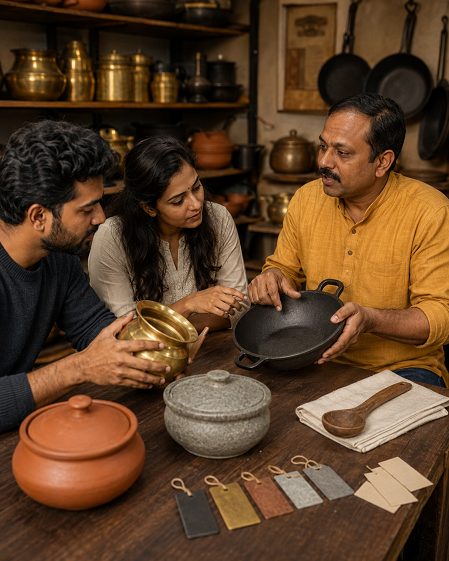
Does the seller buy from a family workshop? A cooperative? A cluster leader? A master artisan? A women’s collective? A craft development organization? A regional producer group? A marketplace aggregator? Each structure is different, and buyers appreciate transparency.
A small seller can build trust with a simple sourcing note: who makes the product, where the craft is practiced, how the seller works with the maker, and whether the product is made to order or ready stock. Sellers do not need to reveal private supplier details, but they should explain enough to show that the craft is not being stripped of origin.
Shimply has explored this same buyer-trust issue in its coverage of Indiahandmade’s digital push, where artisan visibility, platform trust, and product clarity become part of the buying decision. Zishta’s network offers another example of why trust signals must be built into the listing, not added as decorative copy at the end.
Why Material Literacy Helps Traditional Products Compete
Traditional products often compete against cheaper modern alternatives. A cast iron tawa competes with non-stick cookware. A brass storage vessel competes with steel or plastic. A handmade wooden accessory competes with factory-made kitchen tools. A clay or stone product competes with lightweight modern cookware.
The handmade seller cannot win only by saying “traditional.” The buyer needs material literacy.
Material literacy means explaining what the product is made from, how the material behaves, why it is used, how it changes over time, and how to maintain it. If a product darkens, patinates, seasons, absorbs oil, retains heat, needs drying, or requires polishing, the buyer should know before purchase.
This prevents disappointment. It also helps buyers value the product correctly. A traditional craft object is often meant to age, change, and be maintained. That is different from disposable modern goods, and sellers should explain that difference clearly.
How Traditional Craft Sellers Can Avoid Overclaiming
Trust also depends on restraint. Sellers should be careful with claims about health, purity, sustainability, or cultural authenticity. Traditional cookware and craft products may have long histories and practical benefits, but sellers should not make unsupported medical claims or promise results they cannot prove.
A safer approach is to explain tradition, material, use, and care without exaggeration. For example, a seller can say that a cookware form has been used in particular regional kitchens, that it requires seasoning, or that it retains heat well. But they should avoid claiming that it cures health problems or guarantees superior nutrition unless supported by credible evidence.
The same applies to sustainability. A handmade product may be durable, repairable, and made in small batches, but sellers should avoid broad claims such as “fully sustainable” or “zero impact” unless they have strong proof. Specific claims are stronger: handmade by a named cluster, made from a particular material, repairable, long-lasting with care, packed with reusable material, or produced in small batches.
Trust comes from precision.
Why Care Content Should Be Treated As Brand Content
Many sellers treat care instructions as an afterthought. For traditional craft, care content is part of the brand.
Zishta’s product categories, including traditional cookware and home essentials, depend heavily on use and maintenance. A customer who damages a product because instructions were unclear may not blame their own lack of knowledge. They may blame the seller. That is why care cards, videos, FAQs, and follow-up emails matter.
A strong care system can include first-use steps, daily cleaning, storage advice, seasoning instructions, polishing guidance, what to avoid, and when to seek repair. It can also include product-specific warnings: do not soak, do not use harsh detergents, dry immediately, avoid thermal shock, use low heat first, or keep away from prolonged moisture.
Care content also supports gifting. If someone gifts a traditional product to a recipient unfamiliar with the craft, a care card becomes part of the gift’s meaning. It tells the recipient: this object is handmade, useful, and worth learning.
What Sellers Can Learn From Trust Outside Craft Commerce
Trust is not only a handmade-commerce issue. Across the internet, people look for transparency, community signals, and clear information before making decisions in very different categories. Even unrelated spaces such as forums discussing trustworthy online slots show the same broad principle: users want visible signals that help them judge credibility before they act.
For traditional craft sellers, the lesson is not to copy another industry. It is to understand buyer psychology. Buyers want proof. They want context. They want warnings. They want real information instead of vague marketing. They want to know who stands behind the product.
That is why craft sellers should make their trust signals visible: artisan source, material, process, care, packaging, return terms, and post-purchase support.
How Small Sellers Can Build Their Own Trust Network
A small seller does not need to become a large brand to apply Zishta’s lessons. Trust can start with simple systems.
First, build consistent product pages. Every listing should include material, origin, use, size, care, and maker context. Second, create care cards for each product category. Third, photograph the product honestly from multiple angles. Fourth, explain variation instead of hiding it. Fifth, document artisan relationships respectfully. Sixth, collect buyer questions and turn them into FAQs.
A seller can also build trust through after-sale communication. Send a care guide after purchase. Ask whether the buyer understood the product. Offer repair or maintenance guidance where possible. Explain restock timelines for handmade items. Clarify whether custom orders are available.
These small details make a craft brand feel reliable.
Why Traditional Craft Trust Must Be Practical
The strongest part of Zishta’s example is that trust is tied to practical use. Traditional products survive when they become part of daily life, not when they are treated only as museum-like objects. A cookware piece has to cook. A storage container has to store. A wooden tool has to work. A handmade home product has to fit modern routines.
That means sellers must connect heritage with usability. A product page should explain both tradition and function. It should say where the product comes from and how to use it tomorrow morning. It should respect the artisan and serve the buyer. It should make the craft feel alive, not distant.
For Shimply’s handmade sellers, Zishta’s 650-artisan network is a reminder that trust is built through repetition: one clear product page, one honest material note, one useful care card, one respectful artisan profile, one good customer experience at a time.
Traditional craft does not need generic hype. It needs buyer-ready trust.