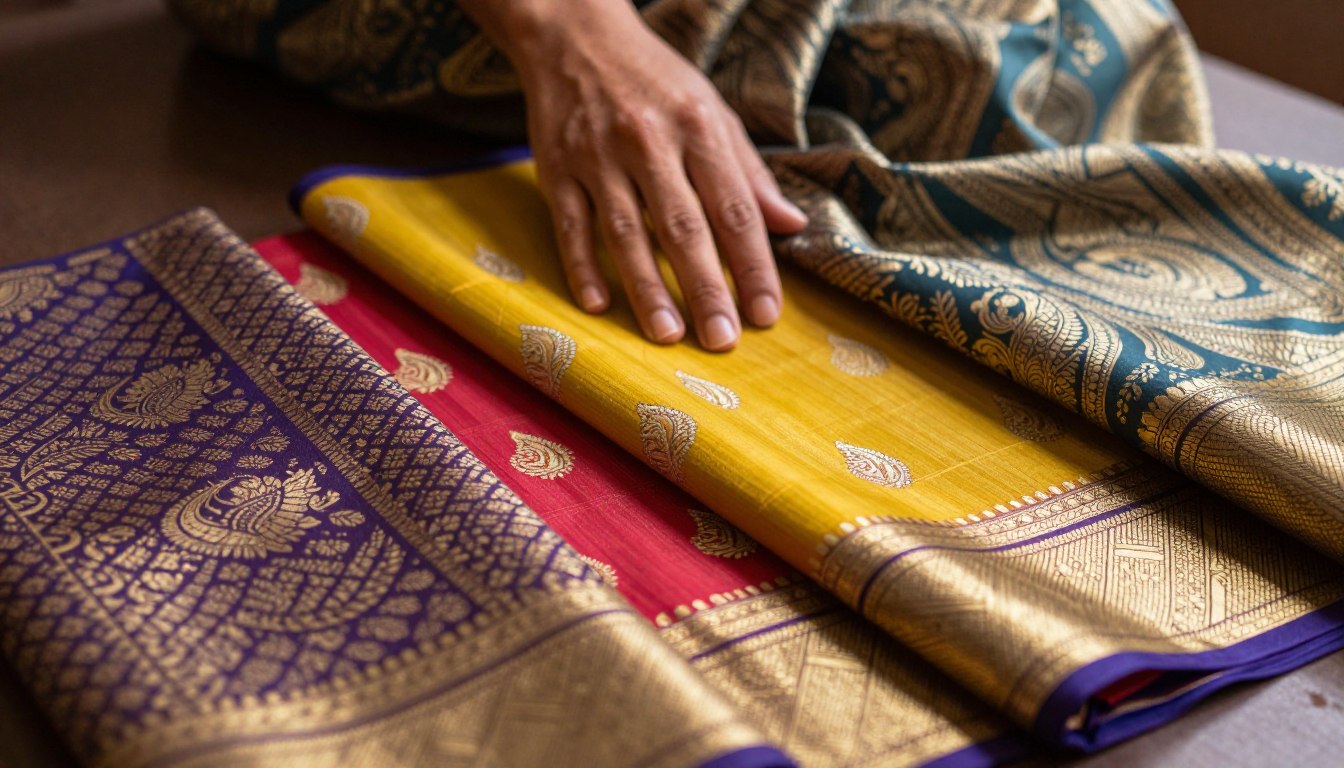
The luxury textile market can be confusing. Many beautiful shawls and saris claim heritage status but are actually clever imitations.
Choosing a counterfeit has real consequences. You risk significant financial loss and get an item of inferior quality. Most importantly, you miss the chance to own a genuine heirloom piece.
Simple tests, like the burn test for silk, are often misleading. They don’t provide the full picture needed for confident authentication.
This guide offers a better approach. We provide a definitive, comparative checklist to help you distinguish authentic textiles from counterfeits. Our method gives you actionable insights for savvy buying and investing.
Intro: Why these are most counterfeited
High prestige, complex artistry, and intense demand make Banarasi, Kanjivaram, and Pashmina prime targets for counterfeiters. These fabrics are more than just textiles; they hold cultural and luxury value. Their reputation attracts imitations in a market seeking to own a piece of that legacy.
The prestige value of these textiles is immense. A genuine Banarasi silk sari is key to wedding traditions. An authentic Kanjivaram is a family treasure. A real Pashmina shawl represents refined elegance. This emotional value leads to high prices, attracting counterfeiters who know buyers seek status.
Creating authentic textiles involves complex craftsmanship that’s expensive and time-consuming. Master weavers spend months on a single piece, using specialized techniques and high-quality materials. Fakes, on the other hand, use cheaper alternatives like polyester and synthetic zari. The high cost of genuine production creates a tempting gap for fraudsters.
Global demand, driven by the diaspora and luxury markets, fuels the cycle. Overseas buyers value these cultural symbols but often lack direct access to trusted weavers. This creates a vulnerability. Online marketplaces and some stores are filled with imitations, catering to this demand.
The economic incentive is clear. The profit margin for selling a fake as real is enormous. This scenario is compounded by a significant authentication knowledge gap. Many consumers, though passionate, lack the skills to scrutinize weave structure and fiber fineness. This makes it frustratingly easy for counterfeiters to operate.
Understanding this “why” is the first step toward empowerment. It shifts the conversation from frustration to practical action. By recognizing market forces, you become a more vigilant and informed buyer. The next sections will give you specific, actionable knowledge to close the authentication gap yourself.
At‑a‑glance matrix: Structure, materials, weave markers, price bands
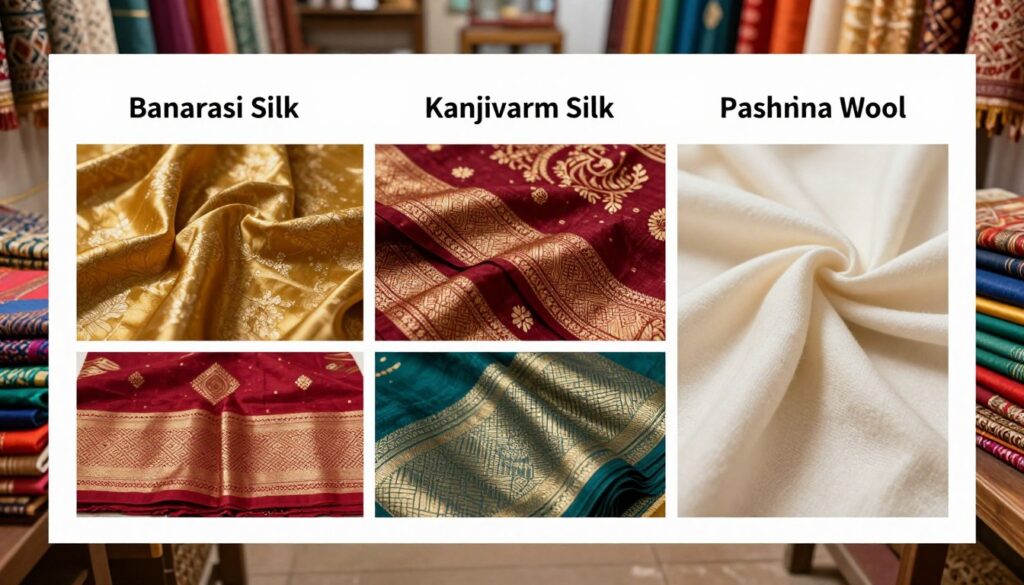
This matrix compares Banarasi, Kanjivaram, and Pashmina textiles. It highlights their structure, materials, and cost. Use it to understand the basics before diving deeper into each fabric.
| Textile | Structure | Materials | Weave Markers | Authentic Price Bands (USD) |
|---|---|---|---|---|
| Banarasi | Handloom brocade | Pure mulberry silk & real zari (silver/gold thread) | Dense, heavy brocade; intricat metallic patterns | $300 – $1000+ |
| Kanjivaram | Handloom, body & border woven separately | Mulberry silk & pure silver zari dipped in gold | Contrast border (korvai); temple motifs; crisp drape | $500 – $2000+ |
| Pashmina | Handloom twill weave | 100% Changthangi goat wool (cashmere) | Fine, lightweight twill; soft, warm hand-feel | $200 – $600+ for stoles |
Structure
Structure refers to how a textile is made. For these fabrics, handloom weaving is essential. It involves manually weaving threads on a wooden loom.
This method creates complex patterns and durable fabrics. Machine-made fabrics, like those from powerlooms, are often fake. They lack the unique feel of handwoven textiles.
Materials
Real materials are top-notch. Banarasi uses fine mulberry silk. Kanjivaram also uses mulberry silk, known for its shine. Pashmina is 100% cashmere wool from specific goats.
Materials like viscose or polyester mean it’s likely a fake.
Weave Markers
Weave markers show a fabric’s quality. A real kanjivaram has a perfect contrast border. Banarasi has heavy, raised brocade.
Pashmina has a diagonal twill pattern. These details are hard to fake on machines.
Price Bands
The prices in the table are key. A Banarasi saree for $50 is probably fake. It’s made with synthetic yarn and machine embroidery.
Real handloom weaving takes weeks. It’s expensive because of the artistry, materials, and labor. Prices below these ranges are suspicious.
Banarasi: Kadhua vs Cutwork, Tanchoi Signs, Float Management, Selvedge Cues, Motifs (Butidar, Jangla)
To truly appreciate a Banarasi silk, you need to understand its language. This includes threads, zari, and motifs. We’ll explore the specialist terms and physical signs that show a true handloom.
Learning these features makes you more than a casual buyer. You’ll know what to look for and why it matters.
Kadhua vs Cutwork
The way zari (metallic thread) is treated is key. There are two main techniques in Banarasi brocade: Kadhua and Cutwork.
Kadhua, or pure brocade, is the top choice. The zari thread is woven into the fabric’s base. This makes the design seamless and durable.
Cutwork or applied zari is quicker and cheaper. The zari is added to a pre-woven silk base. This can feel raised and is less durable.
| Feature | Kadhua (Inlaid Zari) | Cutwork (Applied Zari) |
|---|---|---|
| Technique | Zari woven into the fabric during creation. | Zari embroidered onto finished fabric. |
| Appearance & Feel | Seamless, flat, and integrated. Design is part of the cloth. | Pattern can feel raised. May have a “stuck-on” look. |
| Durability | Highly durable. Pattern won’t peel or snag easily. | More prone to wear; zari can loosen or fray. |
| Reverse Side | Shows a negative of the pattern with clean floats. | Shows backing stitches and knots. |
| Price Indicator | Commands a premium price due to skill and time. | Generally more affordable. |
Tanchoi Signs
Tanchoi is a special weave type in Banarasi. It comes from Chinese influences. A true tanchoi saree has a smooth, satin-like finish on both sides.
The fabric is heavier and richer due to extra weft threads. It has a subtle sheen and soft drape. Unlike brocades, tanchoi designs are tone-on-tone, made with silk threads alone.
Float Management
Float management is a key clue to authenticity. On the reverse side of a genuine handloom Banarasi, you’ll see loose threads or “floats.” These are extra lengths of zari or silk behind the pattern on the front.
Don’t mistake these for defects. In machine-made copies, the back is often too neat or has a synthetic backing. Visible float management is a signature of the handloom process. It shows the brocade was woven, not printed or embroidered.
Selvedge Cues
The selvedge is the finished edge of the saree. Handloom selvedges are often imperfect. Look for slight variations in width, minor thread irregularities, or a slightly wavy line.
Machine-made sarees have laser-straight, perfectly uniform edges. A neat but not flawless selvedge suggests human craftsmanship. It’s a subtle sign that points away from mass production.
Motifs (Butidar, Jangla)
Traditional motifs are cultural signatures. Recognizing them helps verify a saree’s authentic design roots.
- Butidar: This refers to “scattered” motifs. Think of small, individual floral or geometric patterns (butis) dispersed across the field of the saree. They are often set in a grid-like formation.
- Jangla: This means “jungle.” Jangla motifs are intricately woven floral vines that create a dense, all-over network of leaves, flowers, and stems. It represents a more complex and continuous design.
These motifs are woven, not printed. Run your fingers over them. You should feel the texture of the weave, not flat ink. Authentic Banarasi silks proudly carry these historic patterns.
Mastering these details—from the type of kadhua work to the nature of the selvedge—empowers you to make confident, informed choices. You’re not just buying a saree; you’re investing in a piece of woven heritage.
Kanjivaram: Korvai, Temple Motifs, Real Zari, and Weight-Drape Balance
To spot a real Kanjivaram, look for four key signs: the korvai border, temple motifs, real zari, and how it drapes. These saris are famous for their quality but are often faked. Knowing these signs helps you find true craftsmanship.
Korhvai (Contrast Borders)
The korvai technique is what makes a Kanjivaram special. It’s a way to weave the sari’s body and border together seamlessly. This is done by weaving each part separately and then joining them.
Fake Kanjivarams have borders that are glued or stitched on. To check if it’s real, look at the back of the border. It should be smooth, without any glue or extra threads.
A real korvai border moves with the sari’s body. If it’s stiff or doesn’t move, it’s likely fake.
Kanjivaram designs are inspired by South Indian temples. They include symbols like peacocks and lotuses. These motifs have deep cultural meanings.
Real saris have these motifs woven into the fabric. They should be clear and symmetrical. If they’re printed or stitched on, they’re probably fake.
Each motif has its own meaning. Peacocks symbolize grace, and lotuses represent purity. They should be sharp and clear when you look closely.
Real Zari Construction
Zari is the metallic thread that gives Kanjivaram its gold and silver look. Real zari has a silver core wrapped in gold. But many fakes use synthetic threads instead.
Don’t try the “burn test” that some online suggest. Instead, use these safer ways to check for real zari:
- Examine the luster: Real zari shines with a warm, deep glow that’s not too shiny.
- Check flexibility: Genuine zari threads are soft and flexible, not stiff.
- Look for certification: The Silk Mark and Handloom Mark labels prove the sari is made of pure silk and is handwoven.
The Silk Mark certification is your best proof of quality when buying.
| Characteristic | Real Zari | Fake Zari |
|---|---|---|
| Composition | Silver thread wrapped in gold | Polyester, copper, or synthetic metals |
| Luster | Deep, warm, subtle glow | Overly shiny, plastic-like appearance |
| Flexibility | Supple, moves with fabric | Stiff, may crack or break |
| Certification | Silk Mark & Handloom Mark available | No authentic certification |
| Zari Test Method | Visual inspection, flexibility check | May pass visual test but fail on closer inspection |
Weight-Drape Balance
The weight and how it drapes are key signs of a real Kanjivaram. They use high-quality silk that’s dense and heavy. Yet, the sari drapes smoothly and gracefully.
This balance comes from the silk’s quality and the weaver’s skill. The fabric should feel heavy but flow well. It should hold pleats without being stiff.
Fake Kanjivarams often get this wrong. They might be too light or stiff. To test, hold a part of the sari in your hand. It should feel heavy but fold smoothly.
This balance is hard to fake. It needs top-quality materials and generations of skill.
Pashmina: Fiber fineness, twill weave, lightness‑warmth, label norms; safe alternatives to “burn test”
To know if a authentic pashmina is real, look beyond myths. Focus on what you can see and feel. This luxury fabric from Kashmir has specific qualities and legal marks. Knowing these helps you avoid fakes.
Fiber Fineness
Pashmina comes from the undercoat of the Changthangi goat. Its quality is measured in microns, the size of a single fiber. Real fibers are very fine, between 12 and 16 microns.
For comparison, a human hair is about 75 microns. This makes Pashmina incredibly soft. Blends or fakes have thicker, coarser fibers.
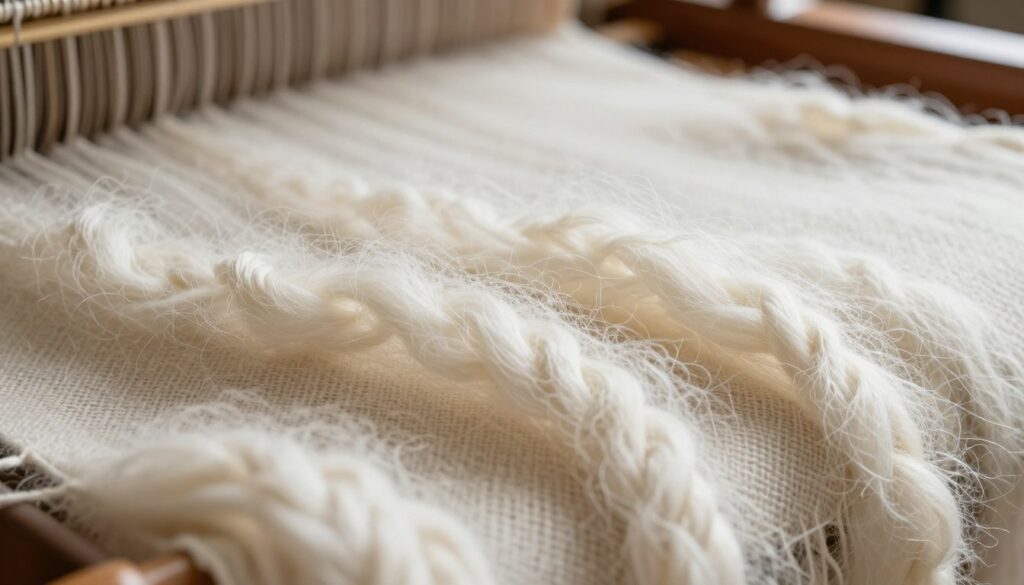
Pashmina shawls are woven in a special twill pattern. This creates a diagonal rib on the fabric’s surface. You can see and feel this by holding the cloth at an angle to the light.
This diagonal line shows quality handloom weaving. Cheap fakes have a plain weave without this texture.
Lightness-Warmth
The lightness-warmth test is key. A real Pashmina shawl feels light but warms you quickly. This is because its fine fibers trap air.
Fakes are either too heavy or don’t insulate well. They fail this important test.
Label Norms
A proper label is a strong sign. Real Pashmina from Kashmir has a Geographical Indication (GI) tag. Look for a label that says “Kashmir Pashmina” and has the GI logo.
A gi pashmina label proves origin and quality. Without it, beware, as it’s a big warning sign.
Safe Alternatives to “Burn Test”
The “burn test” is not safe. It can damage your shawl and is not reliable with modern blends.
Instead, use these safe ways to check if it’s real:
- The Ring Test: Try to pull the entire shawl through a wedding ring. Genuine Pashmina should go through easily.
- The Nap Test: Rub the fabric gently. Real Pashmina has a soft, fuzzy nap. If it’s smooth or pills too much, it’s likely fake.
- Price-Point Analysis: Real handwoven Pashmina is expensive. If it’s too cheap, it’s probably fake. Know the market prices.
Here’s a quick guide to safe verification methods:
| Test Name | How to Perform | What to Look For | Reliability |
|---|---|---|---|
| Ring Test | Pass the shawl through a small ring. | Fabric should pass through smoothly without force. | High for pure, fine wool. |
| Nap Test | Gently rub fabric between fingers. | Development of a soft, natural bloom or nap. | Medium-High; indicates natural fiber. |
| Label Check | Inspect for official GI certification. | Presence of a gi pashmina label from Kashmir. | Very High (legal proof). |
| Price Analysis | Compare seller’s price to known market rates. | Price aligns with luxury handwoven goods ($200+). | High; extreme discounts signal fraud. |
By using these checks, you can buy with confidence. A real piece is a treasure with subtle, superior qualities.
Photo Cues to Request from Sellers (Macro Shots, Reverse Side)
When shopping for luxury sarees online, your most powerful tool isn’t your credit card—it’s your right to request detailed photographs. I always advise my clients to move beyond the beautiful, staged gallery images. To verify authenticity, you must become a visual detective. This means knowing exactly which photo cues to demand from a seller before committing to a purchase.
Turning our earlier knowledge into action, this guide focuses on two non-negotiable image requests: extreme close-ups and clear shots of the fabric’s back. These simple requests separate confident buyers from those who gamble on a product’s description.
Macro Shots: Seeing the Unseen
Macro photography refers to extreme close-up shots that reveal details invisible to the naked eye from a distance. For saree verification, these images are indispensable. Don’t be shy—politely ask the seller for macro shots of three specific areas.
First, request a close-up of the weave structure. An authentic handloom weave will show slight, natural irregularities in the thread spacing. A powerloom fake often appears mechanically perfect and uniform.
Second, ask for a detailed shot of the zari work. Real zari, made from silver thread coated with gold, has a subtle depth and may show slight tarnishing or a non-plastic texture. Synthetic zari looks flat, overly shiny, and plastic-like under magnification.
Third, demand a macro shot of a primary motif or border. Authentic embroidery or woven motifs have clean, finished edges on both sides and the threads are integrated into the base fabric. Printed or glued-on motifs will look fuzzy at the edges or sit on top of the cloth.
This is your most revealing verification step. Always, always ask for a clear photograph of the saree’s reverse side. As noted in our guide on how to spot an authentic Kashmiri Pashmina saree, the back of a handloom textile tells the true story.
Flip the saree and look at the back of the motifs. On an authentic piece, the reverse will show the float management—the longer threads that “float” across the back to create the pattern on the front. These floats are neat and part of the integral weave.
In contrast, a powerloom imitation often has a too-clean back where motifs are cut and glued, or the threads are snipped short. The reverse side may also reveal poor thread integrity and loose ends, which are red flags for mass production.
| Photo Cue to Request | What to Ask For | Authentic Handloom Sign | Powerloom Fake Warning Sign |
|---|---|---|---|
| Weave Macro Shot | Extreme close-up of plain field area | Subtle, natural irregularities in thread spacing | Mechanically perfect, uniform grid pattern |
| Zari Macro Shot | Detailed image of gold/silver work | Metallic depth, possible slight tarnish, non-plastic feel | Flat, overly bright, plastic-like reflection |
| Motif Macro Shot | Close-up of a border or buta design | Clean, woven edges; threads integrated into fabric | Fuzzy printed edges or appliqué sitting on top |
| Reverse Side Shot | Full view of the back of a patterned section | Visible, neat float threads; motif shape discernible | Too clean, cut threads, glue residue, or plain back |
Use this table as a quick checklist when reviewing seller photos. If a seller hesitates or provides blurry, insufficient images, consider it a major red flag. A reputable vendor proud of their authentic craftsmanship will happily supply these photo cues. This visual evidence empowers your purchase decision and turns you from a passive browser into an informed collector.
Price and policy red flags
Professional buyers know that price and seller policies show more about a saree’s authenticity than any visual cue. These factors are your last check before buying. Ignoring them can make a dream purchase very costly.
One rule is clear. If a saree looks expensive but is very cheap, it’s likely powerloom. Real handloom sarees take hundreds of hours to make. They cost a lot because of pure silk, real gold or silver zari, and pashmina fiber. A price way below market value is a big red flag.
Also, watch out for vague product descriptions. Terms like “art silk,” “mixed silk,” or “blend” often hide synthetic fibers or fake zari. A real seller will say “pure silk,” “handloom,” and “real zari” proudly.
Seller transparency is key. A red flag goes up if a vendor won’t give clear details on the saree’s origin, weaving, or materials. Evasive answers about where it was made or who made it are big warnings.
Lastly, check the store’s policies. Bad or non-existent return policies for authenticity claims are risky. A good seller backs their product’s genuineness. They offer a fair inspection time and a clear return process if it’s not as promised.
Seeing these red flags isn’t being cynical; it’s professional due diligence. It lets you avoid bad deals with confidence. This way, your investment is in a real piece of heritage craftsmanship.
Diaspora checklist: customs declarations, returns, repairs
For those in the global Indian diaspora, getting an authentic heirloom textile is more than just spotting fakes. It’s about mastering international logistics. Once you’ve found a genuine Banarasi, Kanjivaram, or Pashmina, you must get it to your doorstep and care for it abroad. This guide focuses on the important steps to protect your investment.
Customs Declarations
Accurate customs paperwork is key to avoid delays, extra fees, or seizure. Don’t mislabel a handwoven silk sari as a generic “garment.” Always declare the full, honest value for insurance. Under-declaring risks voiding coverage if the package is lost.
Work with your seller to ensure the commercial invoice is detailed. It should include:
- Precise Description: e.g., “Handwoven pure silk Banarasi sari with real zari work.”
- Harmonized System (HS) Code: This classifies the item for tariffs. For most silk saris and fine wool shawls, codes fall under Chapter 50 or 62. A reputable seller should know this.
- Material Breakdown: Listing “55% silk, 45% zari (metal thread)” is more transparent than just “silk.”
- Country of Origin: Clearly stated as India.
Be prepared to pay applicable duties and taxes. Factor this into your total cost. Remember, a proper declaration is proof of your item’s legitimate value, which is essential for any future insurance claim.
Returns
International return policies are complex. Before buying, check the seller’s terms. Many small, authentic weavers’ collectives have strict no-return policies for customized or sale items. Larger retailers may offer returns but with significant conditions.
You will likely be responsible for the high cost of return shipping and insurance. Some sellers deduct a restocking fee of 15-30%. The return window is often shorter for international orders—sometimes just 7 days from receipt. This makes the “photo cues to request from sellers” step from earlier absolutely critical. Thorough pre-purchase vetting is your best alternative to a smooth return.
Repairs
A pulled zari thread or a minor tear doesn’t mean your heirloom is ruined. Finding a specialist for textile conservation in your country is key. Look for conservators affiliated with museums or historical societies, as they often have experience with delicate silks and metal threads.
For routine maintenance, never dry clean a Banarasi or Kanjivaram unless the cleaner has specific experience with heavy zari work. For Pashmina, hand wash in cold water with a mild wool detergent. Store all pieces wrapped in clean, breathable cotton cloth, away from direct sunlight and moisture.
Building a relationship with a local expert gives you peace of mind. Your treasured piece can be preserved and worn for generations, no matter where you call home.
Quick printable checklist + internal links
Take this final summary with you. It combines the key signs of real Banarasi, Kanjivaram, and Pashmina.
Banarasi Silk Authentication
- Seek the kadhua weave with continuous threads.
- Examine the selvedge for clean, dense edges.
- Motifs like butidar should be raised and detailed.
Kanjivaram Silk Authentication
- The korvai border must be woven separately for contrast.
- Real zari has a metallic core, not plastic.
- Feel the weight; it should be heavy with a smooth drape.
Pashmina Shawl Authentication
- Confirm fiber fineness (under 16 microns).
- Genuine Pashmina is feather-light but exceptionally warm.
- The fabric should show a diagonal twill weave pattern.
This printable checklist helps you verify quality in stores or online. It turns complex details into simple checks.
You now have the tools to identify authentic craftsmanship. For deeper care instructions, explore our guide on preserving fine silks. If buying internationally, review the key points on customs declarations and repairs.
We focus on sharing knowledge so you can invest in heirlooms with certainty.