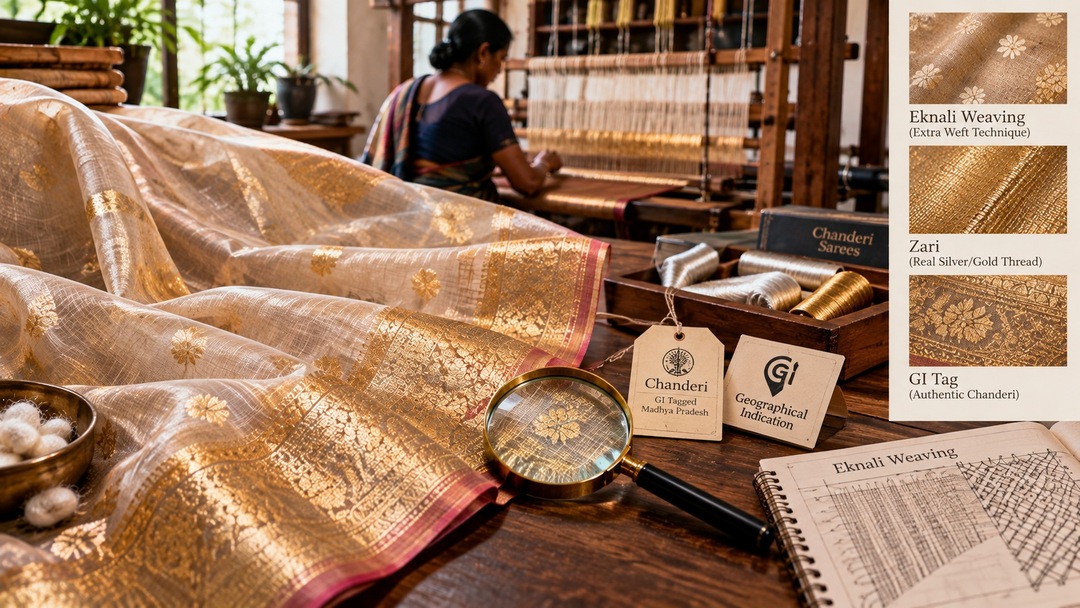
Nestled among the Vindhyachal hills of the Ashoknagar district in Madhya Pradesh, the historic town of Chanderi has cultivated one of the most refined handloom textile traditions in Indian history. Renowned as “woven air” by chroniclers of the Mughal court and patronized extensively by the royal houses of Scindia and Holkar, genuine Chanderi fabric is characterized by an ethereal gossamer transparency, featherlight drape, and lustrous metallic motifs. The classic handwoven Chanderi saree represents a meticulous synthesis of un-degummed raw silk warps, gossamer cotton wefts, and electroplated silver zari. Yet the commercial popularity of this regal textile has made it an attractive target for industrial mass reproduction.
Today’s retail marketplace is heavily saturated with high-speed powerloom fabrications, polyester organza imitations, and synthetic viscose blends that mimic the translucent shimmer of authentic Chanderi while eliminating the human craftsmanship required to weave it. Much like the disciplined connoisseurship necessary when collectors study Southern Indian pit-loom techniques by reviewing how to authenticate handloom Kanchipuram silk sarees, separating an authentic handwoven Chanderi from an industrial facsimile demands a structural understanding of loom mechanics, yarn tension, and metallurgical integrity. Learning how master artisans construct authentic Chanderi textiles safeguards cultural heritage and ensures that collectors acquire genuine heirloom investments.
The Anatomy of Chanderi Transparency: Degummed Silk and Fine Cotton
The distinctive crispness and luminous transparency of Chanderi originate from its specific yarn engineering and raw material pairing. Unlike heavily weighted silks that rely on multi-ply twisted yarns, an authentic Chanderi saree features an un-degummed or partially degummed mulberry silk warp (measuring 20/22 denier) paired with a superfine handspun or mill-spun cotton weft ranging from 100s to 120s count, or up to 300s count in museum-grade vintage revivals.
Silk filaments in their natural state are coated with sericin, an organic protein gum that shields the cocoon fibers. In most silk-weaving traditions, yarns undergo chemical degumming prior to warping, which removes the sericin to make the threads limp, soft, and receptive to deep dyestuffs. Chanderi weavers deliberately retain this natural sericin gum during warp preparation. When stretched tightly across a traditional pit loom, the gummed silk threads maintain rigid, spring-like structural stability. Interweaving fine cotton wefts through this gummed grid creates an open, porous plain-weave architecture that allows ambient light to refract through the gaps, creating the legendary sheer “tissue” transparency that never collapses into limpness.
Industrial powerlooms cannot manage delicate 20-denier un-degummed raw silk without snapping threads under rapid mechanical shuttling. To operate at high speeds, powerloom mills substitute continuous synthetic filaments, such as monofilament polyester, nylon, or mercerized rayon. While synthetic blends feel slick, they produce a glassy, artificial glare rather than the soft, powdery luminescence of genuine gummed silk and natural cotton. Furthermore, synthetic fabrics do not breathe, trapping perspiration and body heat, whereas natural handwoven Chanderi maintains crisp thermodynamic breathability even in humid tropical climates.
The Eknali and Donali Weaving Mechanics
The foundational marker of artisan Chanderi production is the manual extra-weft brocading technique used to execute ornamental butis (motifs) across the body and pallu. Traditional Chanderi pit looms employ throw shuttles operated by foot treadles, utilizing either the Eknali (single shuttle) or Donali (double shuttle) weaving system:
- The Eknali Technique: In an authentic Eknali weave, a single artisan manages the main cotton body weft and manually guides the supplementary zari spool across individual motif sheds. Each floral motif, swan (hans), gold coin (ashrafi), or peepal leaf is interwoven directly into the fabric ground, producing dense, sculpted, three-dimensional embroidery with razor-sharp borders.
- The Donali Dual-Shuttle System: In Donali weaving, two shuttles operate in close coordination, allowing for intricate multi-colored motifs and balanced border transitions that preserve absolute fabric sheer without creating puckering or structural tension on adjacent yarns.
- The Telltale Reverse Architecture: When inspecting an authentic handloom Chanderi motif on its reverse side, the extra-weft zari threads are tied off neatly or trimmed close to the motif edge by hand, leaving clean, breathable spaces between individual designs.
In contrast, automated powerloom and computerized jacquard machines produce motifs via continuous mechanical cutwork. A mechanized shuttle carries metallic polyester thread continuously across the full width of the fabric bolt, after which automated shears clip the intermediate strands on the reverse side. Flipping over a commercial powerloom imitation reveals a bristling field of sheared synthetic whiskers and frayed ends that catch on jewelry, irritate the skin, and quickly unravel with regular wear.
Diagnostic Comparison: Authentic Handloom Versus Powerloom Imitations
Distinguishing an authentic handwoven Chanderi from an industrial facsimile requires a structured audit of four physical textile dimensions. The table below details the essential diagnostic criteria:
| Structural Dimension | Authentic Handloom Chanderi | Commercial Powerloom / Jacquard Blend | Physical Verification Method |
| Fabric Texture & Hand-Feel | Subtle, paper-like crispness with soft powdery sheen; breathes effortlessly | Slick, slippery, or synthetic stiffness; glossy plastic sheen that traps heat | Gently compress fabric in palm; genuine Chanderi forms soft, structured creases without harsh crumpling |
| Motif Border Definition | Sculpted, three-dimensional relief; micro-indentations from manual needle spools | Flat, mechanically stamped surface; identical mathematical uniformity across all motifs | Inspect under a 10x jeweler’s loupe; look for organic tension variances along motif borders |
| Selvedge Edge Character | Organic, soft woven selvedge; subtle pin-marks from loom tension reeds | Rigid, knife-sharp edge; machine overlock stitching or melted heat-sealed synthetic edges | Examine lateral borders; machine pins or synthetic melt lines confirm automated factory weaving |
| Reverse Motif Finishing | Clean anchor points; minimal loose floating yarn; no clipped thread stubble | Dense field of sheared cutwork ends (whiskers) across non-motif areas | Invert saree pallu; check whether reverse is smooth or covered in sharp sheared thread fringes |
The selvedge edge provides an immediate baseline for inspection. Because a pit loom operates through rhythmic human arm movements, shuttle turnarounds leave an organic, supple woven edge where weft threads loop naturally. Commercial powerlooms run on continuous multi-meter rolls that are mechanically sliced and heat-sealed or surged with tight overlock stitching to prevent synthetic thread fraying. Any saree exhibiting heat-sealed edges or overlocked lateral hems is an industrial imitation.
Zari Testing: Real Silver Alloys Versus Metallized Plastic
Traditional Chanderi textiles owe their regal brilliance to the delicate incorporation of genuine metallic thread. Known historically as Kalabattu, authentic Indian zari consists of a core of natural silk or fine cotton wrapped in a flattened electroplated silver wire containing a minimum of 50 to 57 percent pure silver, finished with a microscopic micro-bath of 24-karat gold.
Modern mass production has largely abandoned precious metals in favor of “Tested Zari” and “Synthetic Metallic Plastic” (Lurex). Tested zari wraps a bleached rayon or cotton core in copper wire that is electroplated to simulate silver or gold. While copper mimics true metallic sheen initially, it oxidizes aggressively in humid conditions, turning dark greenish-black within a few years. Synthetic metallic yarn utilizes hair-thin slit polyester film coated with aluminum vapor, producing a harsh, reflective shine that lacks the warm, mellow candlelit radiance of genuine silver-gilt thread.
Collectors can deploy two reliable, non-destructive field tests to evaluate zari authenticity:
- Thermal Conductivity Contact Test: Real silver is one of the most thermally conductive elements on earth. Touching an authentic pure zari border with the back of a finger draws heat away instantly, feeling noticeably cold upon initial contact. Plastic or polyester metallic threads feel room-temperature, slippery, and distinctly synthetic.
- Non-Destructive Fringe Scrape Examination: Isolate an unraveling fringe thread from the inner corner of the pallu and scrape the outer metallic foil with a fingernail under direct sunlight. Authentic real zari exposes bright silver underneath, wrapped around a natural yellow or white silk core. If scraping reveals reddish copper or a stark white synthetic nylon thread, the textile is constructed with commercial tested zari.
Geographical Indication (GI) and the Chanderi Weaver Cooperatives
To curb rampant industrial imitation and protect over 20,000 artisan families across Ashoknagar, the Government of India granted the Chanderi saree official Geographical Indication (GI) protection under Application No. 24 of the Geographical Indications of Goods (Registration and Protection) Act of 1999. The statutory GI framework stipulates that genuine Chanderi must be handwoven within the geographic boundaries of Chanderi municipality and surrounding villages, utilizing designated un-degummed silk and fine cotton counts on traditional handlooms.
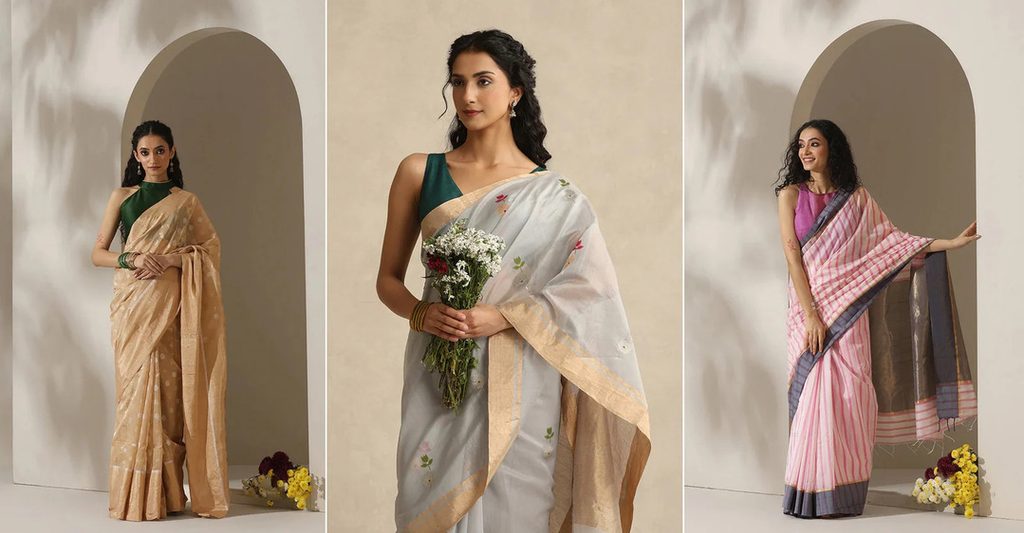
To verify authenticity, discerning buyers must look beyond generic marketing labels and demand official state certifications. Genuine handloom Chanderi sarees carry the India Handloom Brand label and the verified GI logo, which feature trackable holographic alphanumeric codes issued by registered apex weaver cooperative societies like the Chanderi Bunkar Vikas Sanstha. Scanning these digital registry codes verifies the master weaver’s identity, the cooperative society ledger, the yarn sourcing batch, and the loom registration number.
Safeguarding Heirloom Textiles Through Informed Patronage
Investing in a genuine handloom Chanderi saree is a direct commitment to preserving India’s living artistic traditions. The breathtaking beauty of a Chanderi drape does not stem from mechanical speed or synthetic flash; it lives in the rhythm of the pit loom, the patience of the master weaver guiding extra-weft spools across thousands of silk filaments, and the natural physics of un-degummed silk and fine cotton.
By understanding the mechanics of Eknali brocading, recognizing natural selvedge behaviors, conducting rigorous zari assessments, and demanding verifiable GI provenance, collectors can acquire authentic textiles with confidence. In an era dominated by rapid synthetic fashion, informed connoisseurship remains the single most effective shield protecting traditional weaver livelihoods and ensuring that India’s handwoven heritage endures for future generations.