
Let’s be honest. The phrase “indoor recess” can trigger a parental panic attack sharper than a missed coffee.
But what if I told you that corralling that boundless energy inside your four walls isn’t a crisis? It’s a strategic opportunity. I’m not just talking about preventing drywall casualties. I’m analyzing the data.
Science confirms that getting children moving does far more than burn calories. It fuels their brains. Research shows physical activity supercharges blood flow to the brain, boosting thinking skills and memory.
It also builds a healthier cardiovascular system, reduces stress, and strengthens bones and muscles. Think of it as an essential investment in your child’s mental and physical portfolio.
This isn’t about the old “just go play” mandate. It’s about purposeful movement. So, let’s move beyond the panic and into a list of 25 clever, energy-channeling solutions. Your sanity—and their cognitive ability—will thank you.
Age-Appropriate Activity Guidelines (2-5 years)
Creating exercise for 2-5 year olds is like being a master of disguise. The official guidelines say they need three hours of activity each day. But, getting them excited about it is like trying to make broccoli taste like cake.
The trick is to hide it in plain sight. The best children fitness games look like fun, not exercise. They’re games that teach kids about movement, friendship, and even science.
Toddlers love exploring with their senses. Bubble Bashing is a game that helps them learn to move their whole body. A simple sensory bin can teach them about digging and finding things.
Preschoolers learn by imitating. Animal Races teach them about how animals move. It’s not just fun; it’s a way to learn about the world.
The games don’t need fancy equipment. A bedsheet can be a parachute, teaching kids about teamwork. “I’ve Got Your Socks” is a game that improves agility and balance. The best part? It makes everyone laugh.
These games are more than fun. They help build the foundation for all future physical activities. They improve:
- Gross motor skills: Running, jumping, and climbing
- Spatial awareness: Knowing where their body is in space
- Social coordination: Learning to play nicely with others
- Kinesthetic intelligence: Discovering what their body can do
The games are based on what toddlers naturally enjoy. They love to run, hide, and make noise. The goal is to make playtime fun and educational.
It’s all about creating a playful environment. Add pillows for a course and music for dancing. The aim is to keep kids moving without them even realizing it.
For 2-5 year olds, the best exercise is the kind that feels like play. It should be a natural part of their day. These children fitness games are the key to making that happen.
Elementary Age Games (6-10 years)
If toddlers are chaos theorists, elementary-aged kids are the special forces of indoor recreation. They can follow complex rules and have enough energy to power a small city. These are the home activities kids will actually campaign for.
The developmental sweet spot between six and ten is fascinating. Kids transition from pure imitation to strategic thinking. They understand competition, relish challenges, and possess just enough patience for rule-based games. The trick is channeling that kinetic energy into structured fun.
Consider your living room reimagined as a tactical playground. Every cushion becomes an obstacle. Every hallway transforms into a bowling alley. The goal isn’t just movement—it’s purposeful movement with rules, objectives, and the sweet possibility of victory.
| Game | Energy Burn | Setup Time | Skills Developed |
|---|---|---|---|
| DIY Obstacle Course | High | 5-10 minutes | Agility, Problem-solving, Sequencing |
| Fitness Bingo | Medium-High | 2 minutes | Cardiorespiratory, Listening, Pattern Recognition |
| Strategic Scavenger Hunt | Medium | 5 minutes | Observation, Critical Thinking, Speed |
| Plank Race | High (Core Focus) | Instant | Core Strength, Endurance, Competition |
| Toy Minefield Clean-up | Medium | Instant | Speed Cleaning, Agility, Organizational Skills |
Let’s dissect the table’s star performer: the DIY Obstacle Course. This isn’t just jumping over pillows. We’re talking about creating sequences. “Crawl under the dining table, hop over three couch cushions, balance-walk along a tape line, then army-crawl to the finish.” You’re building executive function alongside cardiovascular health.
Fitness Bingo deserves its own analysis. Create bingo cards with exercises instead of numbers. “B-15” becomes “10 jumping jacks.” “O-72” transforms into “hold a plank for 30 seconds.” The genius here is psychological. Kids focus on completing the card, not on the exertion. They’re playing to win while incidentally conducting a full-body workout.
The Toy Minefield game addresses a universal parental pain point. Scatter toys across the floor. Set a timer. Children must retrieve items and deposit them in bins without touching the “floor lava.” Add variations: only using tongs, walking backward, or carrying items on a spoon. You’re conducting a special ops clean-up mission.
These home activities kids enjoy combine physical exertion with cognitive challenges. The Scavenger Hunt evolves at this age. Instead of “find a red object,” try “find something that starts with ‘B’ and fits in your pocket.” Or create rhyming clues that lead to the next location. You’re embedding literacy practice into cardiovascular pursuit.
Don’t underestimate the classic Freeze Dance with a strategic twist. Designate specific freeze poses that work different muscle groups. “Freeze in a superhero stance!” (isometric hold). “Freeze like a tree in the wind!” (balance challenge). The music provides the cardio; the freezes build strength and control.
Hallway Bowling repurposes domestic architecture beautifully. Empty water bottles become pins. A soft ball serves as your projectile. Keep score. Introduce handicaps for older kids. “You have to bowl with your non-dominant hand.” You’re teaching physics, math, and sportsmanship in one confined space.
The elementary years offer a golden opportunity. You’re not just burning energy. You’re installing software for strategic thinking, rule comprehension, and healthy competition. The living room becomes a laboratory for physical and cognitive development. Every game is a covert lesson in how to channel chaos into accomplishment.
Tween Activities (11-13 years)
Getting an 11-year-old to exercise indoors is not about giving orders. It’s about making it cool and fun. Tweens don’t like being told what to do. So, we make exercise seem like a game or a secret mission.
We’re not talking about boring exercises. We create indoor kids exercise that’s like a spy game or a thriller. The fun part is the exercise is just a bonus.
“Murder in the Dark” is a game where one person is the secret killer. The others have to guess who it is before they all get killed. It’s like a mix of Agatha Christie and tag.
“Stop the Bus” is a game where players race to think of words in different categories. The first one to think of all their words shouts “Stop the Bus!” and everyone has to freeze. It’s a fun mix of thinking and moving.
Here are some classic games with a tween twist:
- Paper Aeroplane Races: Players design and test their planes. It’s a fun way to learn about engineering and physics. Plus, it’s a great way to get some exercise.
- Sock Wars: Players try to steal each other’s socks while protecting their own. It’s a fun game that requires agility and strategy.
- The Minister’s Cat: Players take turns saying an adjective starting with the next letter of the alphabet. Each adjective must be matched with a physical pose. It’s a game that combines thinking and moving.
The Marshmallow Stack Challenge is all about STEM skills. Players use toothpicks to build the tallest marshmallow tower. It’s a game that requires precision and focus.
Even classic games can be made more exciting. Charades becomes “Movie Charades Under Duress” with a timer. Hangman becomes “Anatomy Hangman” using bone names or muscle groups. The goal is to make it so fun that players forget they’re exercising.
Tweens love to be independent and interact with others. The best activities, like those in this collection of indoor games, respect that. They’re not just about exercise. They’re about having fun and being part of a group.
Equipment-Free Movement Games
Forget the fancy fitness gear like Peloton bikes. The best equipment your child needs is their own body. Children fitness games without equipment go back to basics. They ask: what can we do with just our bodies and the laws of physics?
These games turn homes into obstacle courses. They make siblings into fun opponents. And they don’t need any delivery time, just a bit of chaos.
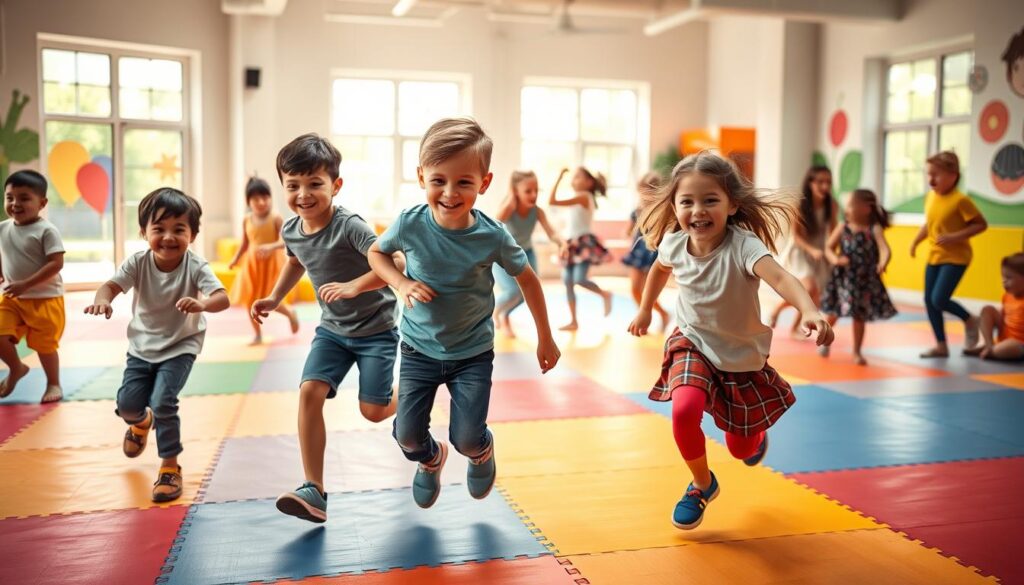
Let’s look at the chaos. Some games are all about moving freely. The Temper Tantrum game turns drama into a workout. Kids move wildly, releasing energy.
Headstands and Jumping Jacks are classics for a reason. They boost strength and heart health with simple moves. The popcorn variation of push-ups adds fun with its rhythm.
Then, there are games that need strategy and stealth. I’ve Got Your Socks is a fun game of agility and awareness. It’s like a game of flag football for the feet.
Charades and Two Truths and a Lie make you move and react fast. Guessing a charade might mean jumping like a kangaroo. Hearing a lie might make you sprint to a “lie spot.”
The games that mimic social actions are interesting. Follow the Leader games teach observation and coordination. TikTok Dances teach rhythm and sequence through digital learning.
Now, let’s talk about games that teach physics and consent. Little Ann, the butt-pushing game, teaches balance and leverage. It’s a real-life lesson in Newton’s third law.
Puppy Wrestling teaches safe roughhousing. Kids play-fight with clear rules: no hitting, no hurting, and a safe word. It improves communication and physical skills.
To help you explore these games, here’s a comparison. Each game develops different skills without any equipment.
| Game Name | Primary Skills Developed | Energy Level | Social Component |
|---|---|---|---|
| Temper Tantrum | Cardio, Dramatic Expression | High | Individual or Group Performance |
| I’ve Got Your Socks | Agility, Strategy, Defense | Medium-High | Competitive Pair Interaction |
| Little Ann (Butt-Pushing) | Balance, Core Strength, Leverage | Medium | Direct Physical Competition |
| Follow the Leader Exercises | Observation, Coordination, Imitation | Variable | Hierarchical Group Dynamics |
| Puppy Wrestling | Body Control, Communication, Consent | Medium-High | Trust-Based Pair Interaction |
The table shows what equipment-free play teaches. These children fitness games teach physics, social skills, and self-control. They turn any space into a place for learning.
The biggest benefit? Resilience. When the power goes out or Wi-Fi drops, these games keep going. They’re like the original software for kids’ physical growth.
This way of playing children fitness games makes a strong statement. The best gym is the one you carry with you. It needs no subscription, just creativity and a bit of silliness. In a world full of solutions, sometimes the best thing is nothing at all.
Simple Equipment Activities
The best home activities kids love are hidden in plain sight. They’re not in fancy catalogs but in your recycling bin. It’s about turning everyday things into fun.
This approach is all about using what you already have. It’s a clever way to make fitness out of nothing.
Take a simple sock. Pair it with a floor, and it becomes a fun ride. Sock skating is all about having fun and staying balanced. Add wax paper for less drag, and you’ve got a mini rink.
Empty water bottles can turn any hallway into a bowling alley. Use a soft ball or a sock to play. It’s a great way to learn about physics.
The balloon is another great tool. Inflated, it’s perfect for games like balloon volleyball or balloon ball. These games improve timing and reflexes.
Bubble wrap is more than just packaging. It’s a way to release stress. Bubble-Wrap Attack is a fun way to let kids jump and pop bubbles. It’s a great way to get kids moving.
For kids interested in space, straw rockets are a blast. They teach about aerodynamics. It’s a fun way to learn about science.
The hula hoop is another classic. It’s not just for waist circles. Try spinning it on arms or legs. It’s a great way to improve coordination.
The parachute game uses a bed sheet. It’s a fun way to work together. It also helps build upper body strength.
The key is to think creatively. These home activities kids love turn everyday items into fun. A balloon, a sock, or a bottle can be so much more.
You don’t need fancy equipment. Just a different way of looking at things. That’s all you need for a fun workout at home.
Rainy Day Energy Burners
When it rains, the living room turns into a place where kids have too much energy. Instead of just watching a movie, we need something that lets them release their energy. This is what true rainy day energy burners are all about.
We’re talking about creating controlled chaos. We want to get their hearts racing, make them laugh, and then feel tired but happy. This is how we make sure they’re not bored.
Let’s start with some classics, but with a twist. A Dance Party is more than just music. It’s a high-energy event that gets everyone moving. Freeze Dance adds a fun challenge by making them stop suddenly. It’s a mix of fun and brain training.
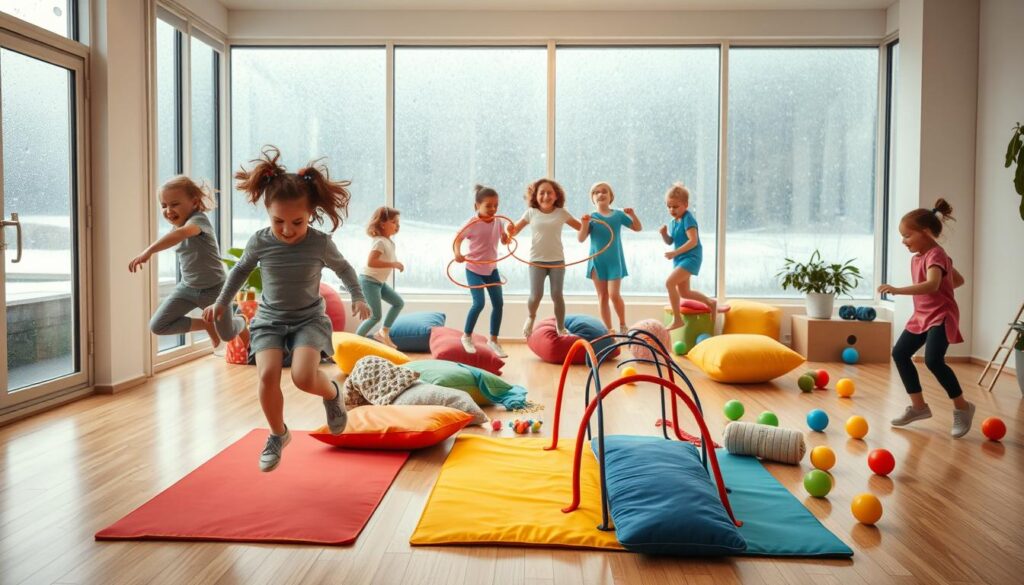
Pillow Fight is another great way to get kids moving. It’s like a fun fight with pillows. We make sure it’s safe and fun, teaching them about boundaries.
Then, we have games like Puppy Wrestling and Sumo Wrestling. These games are all about balance and control. They’re a fun way to learn about physics.
“Pushover Parents” is a game where kids try to knock you down. It’s a fun way to work on your core strength. It’s like a workout, but it feels like a game.
Plank Race is another favorite. It’s a race where you hold a plank position. It’s a great way to work your abs while having fun.
Tickle Tag is all about laughter. It’s a game where one person tries to tickle others. It’s a fun way to get everyone moving and laughing.
These activities are more than just fun. They help kids release their energy in a healthy way. This means you can have a calm afternoon too.
Educational Fitness Games
The best children fitness games do two things at once. They work on coordination and thinking skills. It’s like combining math homework with a fun race.
This is stealth learning at its best. Moving around helps kids focus better on mental tasks. For example, hopping to find the right square also helps with solving math problems.
The Cognitive Gymnasium: A Comparative Analysis
Not all educational fitness games are the same. Some improve speaking skills, others logic or memory. Here’s a look at how these games work.
| Game Name | Primary Cognitive Skill | Physical Action | Age Adaptability | Setup Complexity |
|---|---|---|---|---|
| Scavenger Hunt with a Twist | Linguistic Synthesis, Memory | Searching, Retrieving, Running | High (6-13 years) | Medium (requires clue prep) |
| Hopscotch Math | Arithmetic, Pattern Recognition | Hopping, Balancing, Throwing | Medium (5-10 years) | Low (chalk & stone) |
| Geographic Games (Last Letter) | Recall, World Knowledge | Quick Reactions, Tag-style Movement | Medium (8-13 years) | Very Low (none) |
| The Minister’s Cat | Vocabulary, Adjective Use | Performative Gestures, Quick Sits/Stands | High (4-10 years) | Very Low (none) |
| Stop the Bus (Categories) | Rapid Retrieval, Category Fluency | Sprinting, Stopping on a Dime | High (7-13 years) | Low (paper & pen) |
Deconstructing the Games
Scavenger hunts get a twist when you add words. Each item found is a word or phrase. The goal is to make a sentence from all the clues. For a challenge, make it a sentence in a foreign language.
Hopscotch math turns the game board into a calculator. Numbers or simple math problems are in the squares. To move forward, solve the math problem in the square you land on. Missing the answer? You lose your turn. This makes math more exciting and challenging.
Word games get a boost with movement. “The Minister’s Cat” is a Victorian game turned into a vocabulary drill. Players use different adjectives for the cat, each one requiring a specific action. It’s a fun way to learn new words.
“Geographic Games” and “Stop the Bus” test quick thinking and memory. In “Geographic,” players name countries starting with the last letter of the previous one. “Stop the Bus” is a race to write a word in a category before returning. It’s a mix of trivia and sports.
These games show that fitness and learning can go hand in hand. They improve blood flow to the brain, helping it work better. The games are fun and low-stakes, making learning a breeze.
When you mix mental and physical challenges, you’re not just burning energy. You’re building new brain paths. The right children fitness games turn your home into a place for learning. The result? Happy, tired, and smarter kids.
Screen-Time Balance Activities
The screen isn’t the enemy. It’s a strong competitor for your child’s attention. Our goal isn’t to ban screens completely. It’s to offer a better choice.
When a child picks the living room over YouTube, we win. These activities give them a choice. They offer something screens can’t.
Think about the sensory feedback. The pop of bubble wrap and the wobble of a balancing act. The laughter after a failed human pyramid. Screens give passive watching. These games need active participation.
We’re making memories that feel real, not virtual. A game of floor-is-lava builds problem-solving skills. A silly dance-off boosts social confidence, something no avatar can do.
Our mission is simple. Make the physical world more interesting. Fill your home with challenges, laughter, and joy. The best activities for kids don’t compete with screens. They make them seem less important, at least for a fun hour.
That’s the ultimate victory. When the tablet’s glow can’t compare to the spark in their eyes.