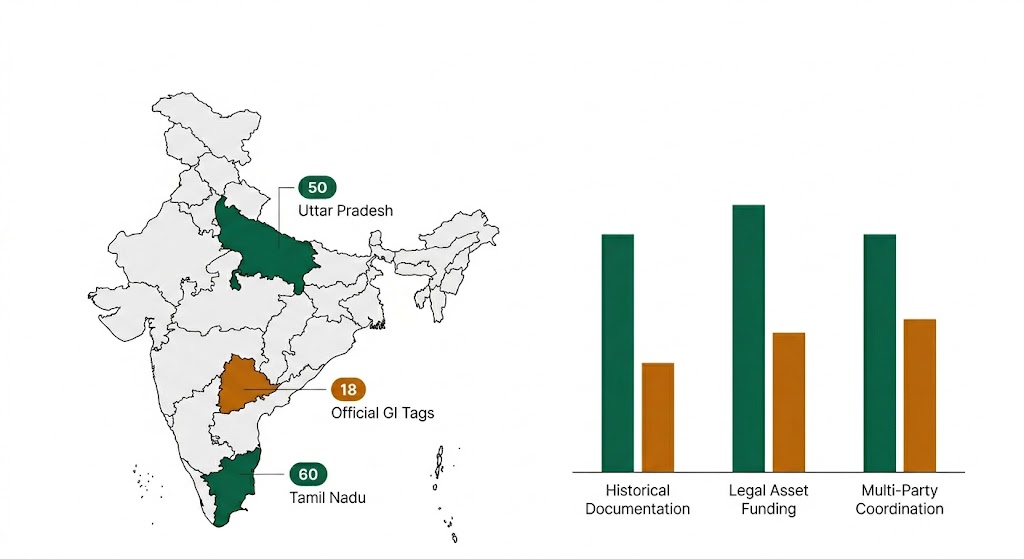
The quantitative distribution of Geographical Indication (GI) tags across India reveals a striking regulatory imbalance. While states like Tamil Nadu and Uttar Pradesh boast expansive intellectual property portfolios exceeding 50 to 60 registered tags apiece, other culturally rich regions operate with significantly smaller tallies. This disparity is not a reflection of a deficit in heritage or artistic skill. Instead, it highlights structural variations in state-level mobilization, legal documentation pipelines, and institutional funding.
Telangana provides a compelling case study for this regulatory phenomenon. Despite possessing thousands of decentralized weaving structures and ancient metalworking clusters across its 33 districts, the state has historically secured only 18 official GI registrations. For conscious consumers, interior designers, and textile collectors, this noticeable “GI gap” alters the conventional rules of procurement. When a region’s authentic output outpaces its official legal protections, buyers can no longer rely solely on a government stamp to verify origin. Navigating these lagging artisan markets demands a deeper, more technical understanding of regional supply chains and individual material indicators.
Decoding the Mechanics Behind the Registration Gap
Securing a entry within the national Geographical Indications Registry in Chennai is an intensely rigorous legal and historical undertaking. It is not an automatic administrative benefit. The gap between a state’s living craft reality and its actual legal protections typically stems from a bottleneck in multi-party institutional coordination.

The primary hurdle is the mandatory requirement for exhaustive historical documentation. A legal application must present undeniable proof of a craft’s specific regional continuity for at least 150 years. It must also provide empirical data connecting the product’s unique qualitative traits directly to local soil, water, or climate conditions. Gathering this evidence requires close collaboration among academic historians, intellectual property attorneys, and grassroots artisan cooperatives.
In regions where production remains highly decentralized—or where local trade associations lack the capital to retain specialized patent consultants—valuable crafts can languish in administrative pipelines for decades. Consequently, the official state leaderboard reflects bureaucratic infrastructure and legal funding rather than the true scope of India’s living cultural diversity.
The Chronological Realities of Telangana’s GI Portfolio
Telangana’s journey within the domestic intellectual property landscape demonstrates both early breakthroughs and prolonged regulatory pauses. The state achieved foundational milestones with iconic textiles like Pochampally Ikat in 2005 and historical luxury metalwork like Karimnagar Silver Filigree in 2007. However, the subsequent rate of registration slowed considerably due to institutional transitions and the complex administrative overhead of tracking rural clusters.
+------------------------------------------------------------+
|            TELANGANA GI REGISTRATION TIMELINE              |
+------------------------------------------------------------+
|  2005: Pochampally Ikat (Foundational Textile Milestone)   |
|  2007: Karimnagar Silver Filigree (Luxury Metalwork)       |
|  2008: Cheriyal Paintings (Scroll Art Preservation)        |
|  2010: Pembarthi Metal Craft / Hyderabad Haleem            |
|  2012: Gadwal Sarees / Siddipet Gollabhama                 |
|  2018: Adilabad Dokra / Warangal Durries                   |
|  2020: Puttapaka Telia Rumal (Oil-Cured Textile Masterpiece)|
|  2024: Hyderabad Lac Bangles (Resin Craft Authentication)  |
|  2026: 18th State GI Secured (Agricultural Milestone)       |
+------------------------------------------------------------+
As the timeline shows, major craft clusters like Adilabad Dokra and Warangal Durries had to wait until 2018 to receive formal statutory recognition. This slow pace occurred despite these communities practicing their distinct non-ferrous lost-wax casting and pit-loom weaving techniques for multiple generations. The state’s 18th official registration—secured in early 2026—underscores a renewed institutional push to clear pending applications. However, dozens of legacy handicraft techniques remain completely exposed to commercial exploitation without any formal legal protection.
The Unprotected Masterpieces: Sourcing the Pipeline
The direct consequence of this administrative delay is that many of Telangana’s finest heritage products currently exist in a legal vacuum. Collectors tracking unique craft investments must look beyond registered items to monitor high-value assets currently moving through the final stages of the approval pipeline.
| Vulnerable Pending Craft | Primary Geographic Cluster | Primary Material & Structural Indicators |
| Narayanpet Jewellery | Narayanpet District | High-purity silver/gold bases featuring delicate interlocking wire links and distinct religious filigree matrices. |
| Siddipet Batik Paintings | Siddipet Region | Complex wax-resist patterns executed on premium handloom cotton, marked by fine, organic “crackle” dye veins. |
| Banjara Needle Craft | Tribal Belts (Lambada Clusters) | Dense geometric embroidery incorporating upcycled cowrie shells, mirrors, and robust double-cross chain stitches. |
| Mahadevpur Tussar Silk | Jayashankar Bhupalpally | Coarse, resilient wild silk textiles woven from indigenous cocoons, featuring a distinct deep copper-gold luster. |
For buyers, these pending crafts represent a prime opportunity to acquire authentic regional artistry before official certification triggers a broader commercial demand and higher tier pricing. However, sourcing from an uncertified cluster means the buyer must personally shoulder the responsibility of verifying material authenticity.
The Implication for Buyers: Risks of the Legal Void
When a highly specialized craft lacks a registered GI tag, the market is almost immediately flooded with cheap industrial imitations. Mass-manufacturing factories routinely mimic the visual patterns of historic crafts using automated, synthetic processes, driving authentic hereditary artisans out of the market.
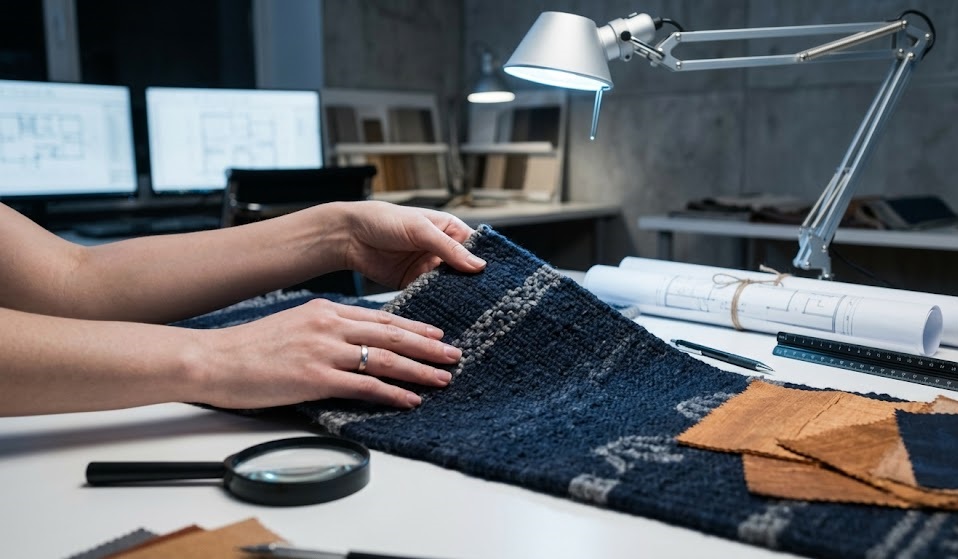
Consider the case of standard handloom design. For buyers evaluating complex structural weaves online, knowing how to identify genuine artisan production is essential. For example, understanding how authentic handloom textiles differ from industrial powerloom replicas can help consumers avoid cheap polyester blends that mimic traditional designs.
In an unprotected market, screen-printed synthetic sheets are frequently passed off as genuine block prints or hand-drawn resists. Similarly, machine-stamped brass pieces are regularly mislabeled as hand-cast tribal metalwork. Without the legal enforcement of a GI stamp, unscrupulous intermediaries can use traditional regional names with absolute impunity. This leaves consumers highly vulnerable to deceptive greenwashing and counterfeit luxury claims.
Technical Frameworks for Independent Verification
In the absence of an official Geographical Indication certificate, smart buyers must adopt a rigorous, multi-point inspection protocol. When sourcing premium handicrafts from emerging or lagging regulatory zones, look for specific physical indicators of authentic human craftsmanship:
- Symmetry Imperfections: Machine-made products exhibit flawless, identical repetition. In contrast, authentic hand-woven durries or hand-hammered Pembarthi brassware will always show minute variations in warp tension, individual knot alignments, or tool impact facets.
- Material Temperature and Weight: True lost-wax brass castings (like Adilabad Dokra) feature a dense clay core beneath the metal shell, making them significantly heavier than hollow, machine-stamped industrial brass.
- Reverse-Side Inspection: Turn textiles over to inspect the reverse side. Authentic hand-woven or hand-embroidered pieces display visible thread tie-offs, loose tension variations, and floating yarn floats. A perfectly clean, uniform reverse side typically points to automated machine manufacturing.
To better understand the minimum legal and material standards required for certified Indian products, buyers can reference the regulatory filing criteria maintained by the Intellectual Property India Office under the Ministry of Commerce and Industry. This official platform documents the exact geographical boundaries, historical affidavits, and raw material breakdowns submitted for active and pending registrations across the subcontinent.
Why Sourcing Lagger-State Crafts Matters Right Now
The current imbalance within the Geographical Indications Registry creates a distinct market window for insightful collectors. Crafts from lagging states like Telangana often retain highly traditional production methods precisely because they have not yet been modified for mass international tourism or altered by large-scale commercial export demands. Sourcing directly from these pending craft clusters allows buyers to acquire pure, unaltered heritage pieces at baseline valuations.
By learning to independently verify material metrics—such as testing the purity of Narayanpet metalwork or evaluating the fine wax-resist patterns of Siddipet Batik—discerning consumers can build highly authentic collections. In doing so, they provide essential economic support to vulnerable artisan communities long before the official state legal machinery catches up.