The landscape of Indian heritage shopping is experiencing a profound geographic expansion. While established craft epicenters like Jaipur, Varanasi, and Kanchi historically dominated luxury handicraft portfolios, a fresh wave of newly highlighted Geographical Indication (GI) registrations is shifting consumer attention toward previously overlooked rural clusters. These emerging handicraft regions are rapidly transitioning from localized, generational secrets into highly organized, internationally recognized creative industries.
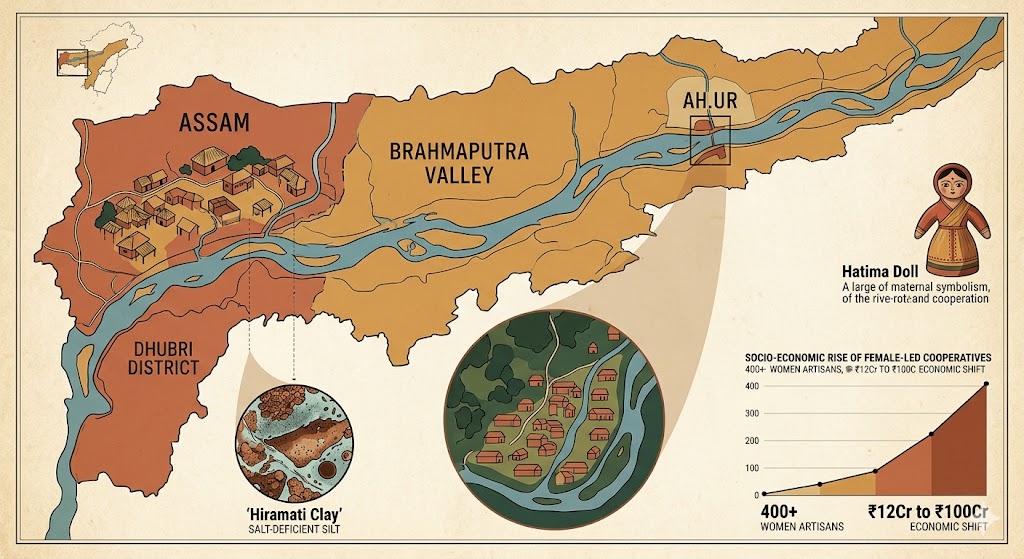
At the absolute forefront of this contemporary cultural renaissance is Asharikandi Terracotta. Nestled within the Dhubri district of Assam, this ancient riverine craft village represents India’s single largest concentrated cluster of traditional terracotta and pottery artisans. Long regarded as an understated regional folk art, the craft has captured widespread institutional interest following its official GI tag designation and a historic, high-profile showcase as the central theme of Assam’s national Republic Day tableau. For collectors and smart buyers, the commercial evolution of Asharikandi serves as a critical masterclass in how regional isolation, strict material purity, and grassroots institutional backing converge to define modern artisanal value.
The Micro-Regional Geography of Asharikandi
Understanding the physical origin of an emerging craft is foundational to verifying its long-term market value. Located approximately 14 kilometers from Dhubri town along the intricate riverine ecosystems of the lower Brahmaputra valley, Asharikandi’s entire artistic identity is structurally bound to its geography. The craft village is currently home to 134 specialized artisan households, encompassing an active creative workforce of approximately 700 traditional craftspeople.
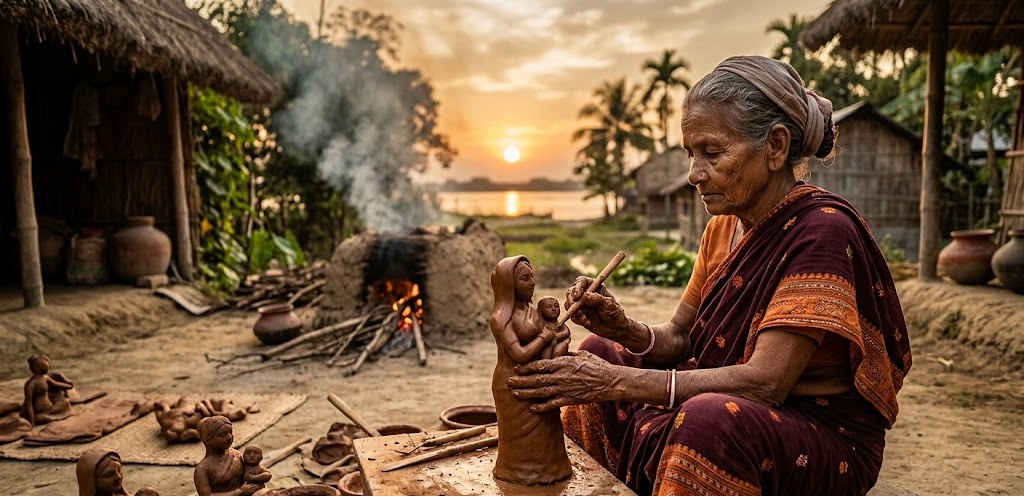
The roots of this specific cluster trace back to the early 19th century when a community of Kumbhakaras (traditional master potters) migrated to the region from East Bengal. They were drawn to the area by a rare convergence of highly favorable economic conditions, accessible internal waterways for macro-distribution, and most importantly, proximity to an irreplaceable natural asset: a localized geological deposit of an extraordinary, specialized craft clay known natively as Hiramati.
Hiramati Clay: The Structural Indicator of Purity
The definitive value of Asharikandi artwork lies almost entirely within the chemical and physical composition of its primary raw material. Unlike mass-produced ceramic alternatives or generic industrial clay products flooding online retail spaces, authentic Assamese terracotta demands the exclusive utilization of Hiramati.
- Mineral-Rich, Salt-Deficient Composition: Collected meticulously from the low-lying silt beds of local river tributaries, Hiramati is an alluvial clay that boasts an exceptionally high mineral concentration paired with an unusually low natural salinity. This specific chemical balance ensures that the clay remains uniquely elastic during the initial hand-molding phases.
- Exceptional Structural Density and Tensile Strength: The absence of coarse salt pockets prevents internal structural fracturing during the critical high-temperature baking phase in traditional, wood-fired outdoor kilns. The resulting material exhibits an incredibly dense, durable structure that yields a ringing, metallic resonance when lightly tapped.
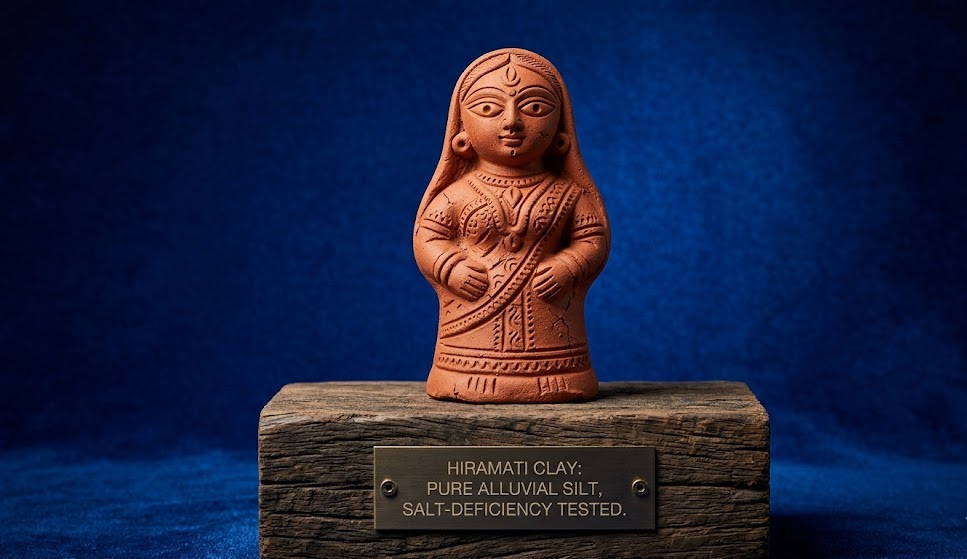
- The Characteristic Ochre Hue: Authentic Hiramati bakes into a deeply resonant, rich brownish-red ochre tone without requiring any artificial chemical pigments, synthetic slip washes, or industrial post-firing stains.
This natural finish serves as a vital diagnostic tool for smart collectors. Any item marketed as Assamese riverine terracotta that features an unevenly applied, flakeable surface paint or a powdery, pale pink base indicates an imitation made from non-indigenous, generic structural clay.
Iconography and the Legendary Hatima Doll
What elevates Asharikandi above standard functional pottery is its highly specialized, deeply symbolic folk iconography. The artistic philosophy of the cluster systematically blends ancient regional folklore, tribal creation myths, and riverine spiritual traditions into distinct sculptural forms.
The absolute crown jewel of this aesthetic framework is the iconic Hatima Doll. Originally brought to national prominence in 1982 when pioneer master artisan Sarala Bala Devi was honored with the prestigious President’s Award, the Hatima motif depicts a stylized mother figure adorned with large, circular, elephant-like ears, holding a child securely in her arms or within a suspended cradle.
| Core Asharikandi Motif | Traditional Symbolic Meaning | Modern Home Decor Application |
| The Hatima Doll | Matriarchal protection, universal lineage, maternal fertility | High-end interior focal sculptures, gallery mantel displays |
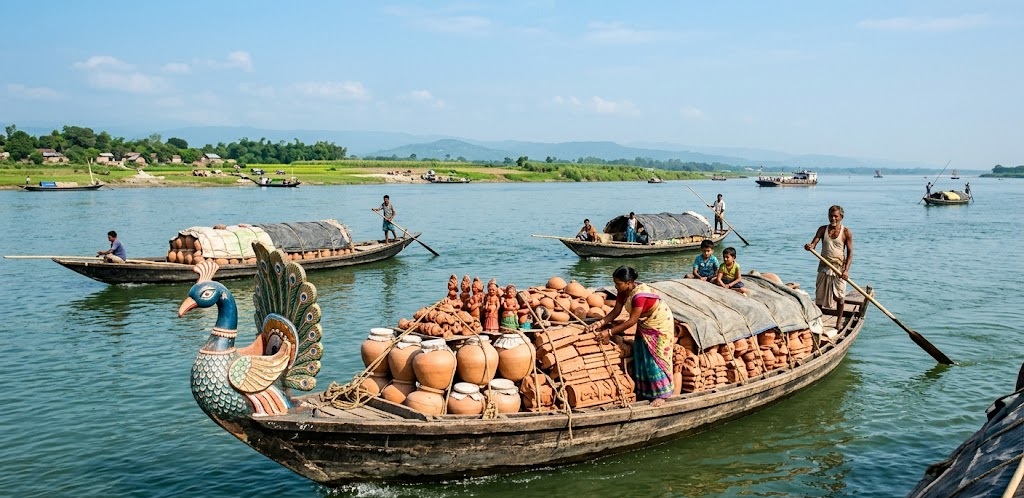
| The Mayurponkhi Boat | Historical river trade routes, ancestral exploration, safe passage | Linear dining table centerpieces, structural architectural accents |
| The Assam Rhinoceros | Regional ecological pride, raw earthly strength, grounding | Minimalist study desk weights, luxury corporate gifting assets |
The Silent Socio-Economic Revolution Led by Women
The modern commercial ascendance of Asharikandi is inherently tied to a profound, gender-driven structural shift within the village’s internal production matrix. Historically confined to assisting male potters with raw material preparation, women artisans have completely taken over the creative and entrepreneurial frontline of the cluster. Today, out of the 700 active village artisans, over 400 are women.
This structural evolution is managed cleanly through localized self-help groups and formal institutions like the specialized Asharikandi Doll Making Cooperative Society. Supported structurally by grassroots non-governmental organizations such as the North East Craft and Rural Development Organisation (NECARDO), these female-led collectives have turned a seasonal, informal livelihood into a resilient manufacturing industry. According to official trade records, the collective economic output of the cluster has scaled dramatically from a historical baseline of ₹12 crore annually to a projected developmental target of ₹100 crore, completely revitalizing the grassroots economy of the Dhubri district.
Sourcing Security: Navigating the GI-Tagged Craft Landscape
For contemporary buyers navigating digital trade platforms, the acquisition of authentic regional pottery requires a disciplined approach to verification. The assignment of the Geographical Indication tag protects the name “Asharikandi Terracotta” legally, mandating that any product bearing this title must be sourced entirely from the geographical limits of the Devitola development block.
Unscrupulous manufacturers frequently exploit the growing demand for rustic home accents by listing cheap, mold-cast industrial pottery under generic labels. Authentic Asharikandi pieces are exclusively hand-modeled or refined on manual potters’ wheels, meaning each sculpture preserves subtle variations in finger-pressure markings and asymmetrical decorative incisions.
Collectors looking to verify product credentials and explore broader regional context can consult our complete strategic index on how to spot authentic GI-tagged Indian crafts by state before finalizing high-value decorative purchases online. Furthermore, official production frameworks, developmental cluster grants, and comprehensive standard operating rules for these emerging MSME craft zones are fully documented directly by the Development Commissioner for Handicrafts under the Ministry of Textiles.
What Buyers Should Watch Next
The trajectory of Asharikandi Terracotta signals a massive paradigm shift in how the market values raw earthen decor. Following its historic appearance on the national stage at the January 2026 Republic Day parade on Kartavya Path—where millions witnessed its structural Moyurponkhi boat representations—the demand for this material is rapidly outstripping annual handcrafting capacities.
Conscious collectors should anticipate a steady shift toward premium tier pricing as the cluster integrates deeper with high-end architectural design streams. Moving forward, the true value of these emerging regional crafts will not rest in their ability to mimic mass-market minimalism, but in their absolute adherence to their unique soil chemistry, structural density, and uncompromising regional folklore.
At the absolute forefront of this contemporary cultural renaissance is Asharikandi Terracotta. Nestled within the Dhubri district of Assam, this ancient riverine craft village represents India’s single largest concentrated cluster of traditional terracotta and pottery artisans. Long regarded as an understated regional folk art, the craft has captured widespread institutional interest following its official GI tag designation and a historic, high-profile showcase as the central theme of Assam’s national Republic Day tableau. For collectors and smart buyers, the commercial evolution of Asharikandi serves as a critical masterclass in how regional isolation, strict material purity, and grassroots institutional backing converge to define modern artisanal value.
The Micro-Regional Geography of Asharikandi
Understanding the physical origin of an emerging craft is foundational to verifying its long-term market value. Located approximately 14 kilometers from Dhubri town along the intricate riverine ecosystems of the lower Brahmaputra valley, Asharikandi’s entire artistic identity is structurally bound to its geography. The craft village is currently home to 134 specialized artisan households, encompassing an active creative workforce of approximately 700 traditional craftspeople.
The roots of this specific cluster trace back to the early 19th century when a community of Kumbhakaras (traditional master potters) migrated to the region from East Bengal. They were drawn to the area by a rare convergence of highly favorable economic conditions, accessible internal waterways for macro-distribution, and most importantly, proximity to an irreplaceable natural asset: a localized geological deposit of an extraordinary, specialized craft clay known natively as Hiramati.
Hiramati Clay: The Structural Indicator of Purity
The definitive value of Asharikandi artwork lies almost entirely within the chemical and physical composition of its primary raw material. Unlike mass-produced ceramic alternatives or generic industrial clay products flooding online retail spaces, authentic Assamese terracotta demands the exclusive utilization of Hiramati.
- Mineral-Rich, Salt-Deficient Composition: Collected meticulously from the low-lying silt beds of local river tributaries, Hiramati is an alluvial clay that boasts an exceptionally high mineral concentration paired with an unusually low natural salinity. This specific chemical balance ensures that the clay remains uniquely elastic during the initial hand-molding phases.
- Exceptional Structural Density and Tensile Strength: The absence of coarse salt pockets prevents internal structural fracturing during the critical high-temperature baking phase in traditional, wood-fired outdoor kilns. The resulting material exhibits an incredibly dense, durable structure that yields a ringing, metallic resonance when lightly tapped.
- The Characteristic Ochre Hue: Authentic Hiramati bakes into a deeply resonant, rich brownish-red ochre tone without requiring any artificial chemical pigments, synthetic slip washes, or industrial post-firing stains.
This natural finish serves as a vital diagnostic tool for smart collectors. Any item marketed as Assamese riverine terracotta that features an unevenly applied, flakeable surface paint or a powdery, pale pink base indicates an imitation made from non-indigenous, generic structural clay.
Iconography and the Legendary Hatima Doll
What elevates Asharikandi above standard functional pottery is its highly specialized, deeply symbolic folk iconography. The artistic philosophy of the cluster systematically blends ancient regional folklore, tribal creation myths, and riverine spiritual traditions into distinct sculptural forms.
The absolute crown jewel of this aesthetic framework is the iconic Hatima Doll. Originally brought to national prominence in 1982 when pioneer master artisan Sarala Bala Devi was honored with the prestigious President’s Award, the Hatima motif depicts a stylized mother figure adorned with large, circular, elephant-like ears, holding a child securely in her arms or within a suspended cradle.
| Core Asharikandi Motif | Traditional Symbolic Meaning | Modern Home Decor Application |
| The Hatima Doll | Matriarchal protection, universal lineage, maternal fertility | High-end interior focal sculptures, gallery mantel displays |
| The Mayurponkhi Boat | Historical river trade routes, ancestral exploration, safe passage | Linear dining table centerpieces, structural architectural accents |
| The Assam Rhinoceros | Regional ecological pride, raw earthly strength, grounding | Minimalist study desk weights, luxury corporate gifting assets |
The Silent Socio-Economic Revolution Led by Women
The modern commercial ascendance of Asharikandi is inherently tied to a profound, gender-driven structural shift within the village’s internal production matrix. Historically confined to assisting male potters with raw material preparation, women artisans have completely taken over the creative and entrepreneurial frontline of the cluster. Today, out of the 700 active village artisans, over 400 are women.
This structural evolution is managed cleanly through localized self-help groups and formal institutions like the specialized Asharikandi Doll Making Cooperative Society. Supported structurally by grassroots non-governmental organizations such as the North East Craft and Rural Development Organisation (NECARDO), these female-led collectives have turned a seasonal, informal livelihood into a resilient manufacturing industry. According to official trade records, the collective economic output of the cluster has scaled dramatically from a historical baseline of ₹12 crore annually to a projected developmental target of ₹100 crore, completely revitalizing the grassroots economy of the Dhubri district.
Sourcing Security: Navigating the GI-Tagged Craft Landscape
For contemporary buyers navigating digital trade platforms, the acquisition of authentic regional pottery requires a disciplined approach to verification. The assignment of the Geographical Indication tag protects the name “Asharikandi Terracotta” legally, mandating that any product bearing this title must be sourced entirely from the geographical limits of the Devitola development block.
Unscrupulous manufacturers frequently exploit the growing demand for rustic home accents by listing cheap, mold-cast industrial pottery under generic labels. Authentic Asharikandi pieces are exclusively hand-modeled or refined on manual potters’ wheels, meaning each sculpture preserves subtle variations in finger-pressure markings and asymmetrical decorative incisions.
Collectors looking to verify product credentials and explore broader regional context can consult our complete strategic index on how to spot authentic GI-tagged Indian crafts by state before finalizing high-value decorative purchases online. Furthermore, official production frameworks, developmental cluster grants, and comprehensive standard operating rules for these emerging MSME craft zones are fully documented directly by the Development Commissioner for Handicrafts under the Ministry of Textiles.
What Buyers Should Watch Next
The trajectory of Asharikandi Terracotta signals a massive paradigm shift in how the market values raw earthen decor. Following its historic appearance on the national stage at the January 2026 Republic Day parade on Kartavya Path—where millions witnessed its structural Moyurponkhi boat representations—the demand for this material is rapidly outstripping annual handcrafting capacities.
Conscious collectors should anticipate a steady shift toward premium tier pricing as the cluster integrates deeper with high-end architectural design streams. Moving forward, the true value of these emerging regional crafts will not rest in their ability to mimic mass-market minimalism, but in their absolute adherence to their unique soil chemistry, structural density, and uncompromising regional folklore.