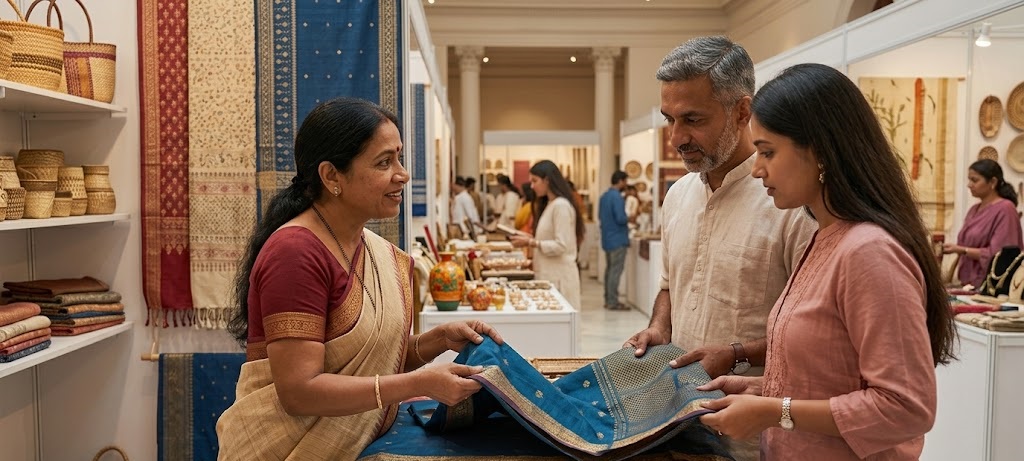
Indie Haat 2026 gives India’s handloom and handicraft sector a timely stage at a moment when handmade sellers are being asked to perform in two markets at once: the physical exhibition space and the digital marketplace. Union Textiles Minister Giriraj Singh was scheduled to inaugurate “Indie Haat – A Celebration of India’s Rich Handloom and Handicraft Heritage” on July 13, 2026, with the showcase running from July 10 to 19 at the National Crafts Museum & Hastkala Academy in New Delhi. The event is connected with Bharat Tex 2026, India’s large global textile event at Bharat Mandapam from July 14 to 17.
For Shimply readers, Indie Haat 2026 is more than an exhibition listing. It shows how artisans, weavers, design-led brands, and small online sellers can turn event exposure into lasting buyer trust. A buyer may discover a textile, painting, basket, jewellery piece, or handloom product at a showcase, but the relationship often continues through a website, marketplace page, WhatsApp catalogue, or repeat gifting order. The sellers who benefit most from Indie Haat-style visibility will be the ones who prepare for both moments.
Why Indie Haat 2026 Matters For Handmade Sellers
Indie Haat 2026 matters because it places handloom and handicraft products inside a wider national textile conversation. Reports on the event say it is being held at the National Crafts Museum & Hastkala Academy in New Delhi and is interwoven with Bharat Tex 2026, which is expected to attract international buyers, policymakers, global CEOs, industry leaders, and large visitor traffic. The Indie Haat 2026 showcase gives artisans a rare mix of cultural setting and commercial visibility.
That combination is important. A craft museum setting gives handmade products heritage context. A global textile event gives them buyer access. Online sellers should study that pairing because it reflects what strong craft commerce needs: story and market, origin and usability, tradition and sales readiness.
A handwoven textile, Dokra object, Pichwai painting, Muga silk product, Eri silk piece, Odisha Ikat, Gulabi Minakari work, or Jamdani saree can attract attention because of craft identity. The sale happens when the buyer also understands price, material, use, care, packaging, and seller reliability.
For small sellers, this is the first lesson. Exhibition visibility is valuable, but it is temporary. Digital trust lasts longer. Every product shown at a physical event should already have a digital path: product photos, dimensions, material details, care instructions, buyer contact, and a way to reorder.
What Event Footfall Can Teach Online Craft Sellers
Event footfall gives sellers feedback that online analytics cannot always capture. At a showcase, sellers can see which products people touch first, which colors stop visitors, which questions repeat, and which price points create hesitation. These observations should shape future product pages.
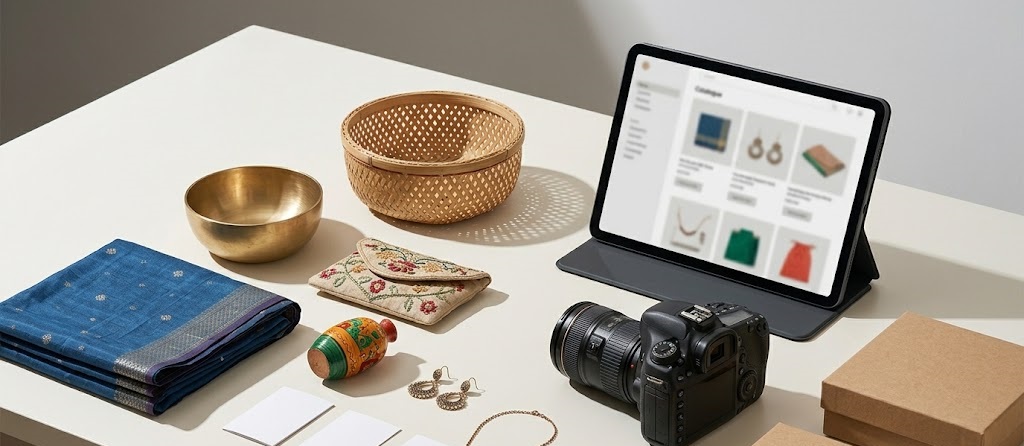
If buyers repeatedly ask whether a textile is washable, the online listing needs a care section. If they ask whether a metal object is decorative or functional, the seller needs to clarify usage. If buyers ask whether a product can be gifted internationally, the seller should show packaging and shipping notes. If people photograph one colorway more than others, that colorway may deserve a stronger hero image online.
This is where Indie Haat can help sellers think beyond event-day sales. A stall is a testing ground. The buyer questions collected there can become better listings, stronger FAQs, smarter bundles, and more useful product photography.
Shimply’s guide to Indian craft gift sets follows the same logic. A handmade product becomes easier to buy when the seller explains how it is packed, gifted, shipped, and used by the recipient. Indie Haat-style exposure can help sellers understand which details buyers need most.
For online sellers, the best event preparation starts before the event opens. Every featured product should have a simple digital record: name, craft category, region, material, dimensions, care, price, stock count, packaging option, and delivery timeline. A seller who can send that information quickly after meeting a buyer has a better chance of converting interest into an order.
Why Bharat Tex Linkage Changes The Audience
The Bharat Tex connection changes the stakes because it puts Indie Haat near a wider textile-business audience. Bharat Tex 2026 is not a small local fair. It is a major industry event where buyers, businesses, policymakers, and textile professionals are expected to gather in New Delhi. When Indie Haat is connected to that environment, handmade sellers get access to people who may think in terms of retail, sourcing, gifting, export, design collaboration, hospitality procurement, and boutique curation.
That does not mean every artisan should chase wholesale orders immediately. It means sellers should be ready for serious conversations. A buyer may ask whether a textile can be produced in multiple sizes. A design studio may ask about lead time. A boutique may ask about minimum order quantity. A corporate gift buyer may ask about packaging, personalization, and delivery reliability.
These questions require preparation. A seller should know which products are one-of-a-kind, which can be repeated, which can be customized, and which are best sold as limited pieces. Handmade sellers do not need to imitate mass production, but they do need honest capacity planning.
| Buyer Type At A Showcase | Likely Question | Seller Preparation |
|---|---|---|
| Gift Buyer | Can this be packed beautifully and shipped safely? | Show gift packaging and care notes |
| Boutique Retailer | Can this product be repeated in small batches? | Prepare batch capacity and lead time |
| Interior Stylist | How does this fit into a room or table setting? | Show lifestyle photos and size references |
| International Buyer | Is the product lightweight, durable, and export-ready? | Explain weight, materials, and packing layers |
| Craft Collector | What is the origin and process? | Share maker, region, technique, and documentation |
This table shows why physical showcases and digital commerce should not be separated. The questions asked at the stall reveal the information that should appear online.
What Indiahandmade Adds To The Indie Haat Conversation
Indie Haat also fits into India’s wider digital craft push. PIB describes Indiahandmade as a dedicated digital marketplace that connects artisans and weavers directly with buyers, supports livelihoods, and showcases handmade products including GI-tagged and ODOP items. PIB also states that India had an estimated 64.66 lakh handloom and handicraft artisans as of August 2025, with women making up 71% of handloom weavers and 64% of total artisans.
That scale matters because it shows why digital visibility cannot be casual. Millions of artisans and weavers are competing for attention across exhibitions, government platforms, private marketplaces, social media, boutiques, and direct selling channels. A seller who depends only on broad phrases like “authentic handmade product” will struggle to stand out.
Indiahandmade’s official handmade marketplace highlights buyer-facing trust signals such as authentic sellers, free shipping, easy returns, safe and secure payment, purchase protection, assured quality, and handcrafted products. Those features show what buyers want before they trust an online handmade purchase.
Indie Haat sellers can learn from that structure. A physical stall may create emotional connection, but the online page must recreate trust after the buyer leaves. The seller profile, return policy, packaging details, payment safety, product description, and photography all help carry the relationship forward.
How Sellers Should Turn Showcase Products Into Online Listings
A product that looks beautiful at Indie Haat still needs a strong online listing. The listing should not copy the event description word for word. It should answer buyer intent.
Start with the title. A vague title like “Traditional Handmade Decor” gives the buyer little information. A stronger title might say “Hand-Painted Pichwai-Inspired Wall Art For Festive Home Decor” if the piece is inspired rather than an original traditional work, or “Handwoven Muga Silk Stole From Assam” if the product and origin are accurate. Precision helps buyers search and compare.
The description should cover material, technique, region, size, care, use case, and packaging. If the product is suitable for gifting, say why. If it is fragile, say how it is packed. If it has handmade variation, explain that the buyer may receive small differences in texture, color, or finish.
Photos should do more than show the front view. Sellers need a clean hero image, a close-up of the material, a scale photo, a packaging photo, and a lifestyle image. For textiles, include drape and texture. For metalwork, include surface detail and scale. For paintings, show edges and display context. For baskets, show capacity and structure. For jewellery, show clasp, back side, and dimensions.
Indie Haat can supply many of these visual assets if sellers plan ahead. A stall display can become a lifestyle photo. A buyer interaction can reveal scale. Packaging at the event can become proof that the product is gift-ready.
Why GI, ODOP, And Craft Names Must Be Used Carefully
Indie Haat’s craft-rich setting can tempt sellers to use famous craft names too freely. That is risky. GI, ODOP, regional, and community-linked craft terms should be used only when accurate. A product should not be labeled Chanderi, Banarasi, Pashmina, Ikat, Dokra, Pichwai, Kalamkari, or any other recognized craft term unless the product genuinely fits the claim.
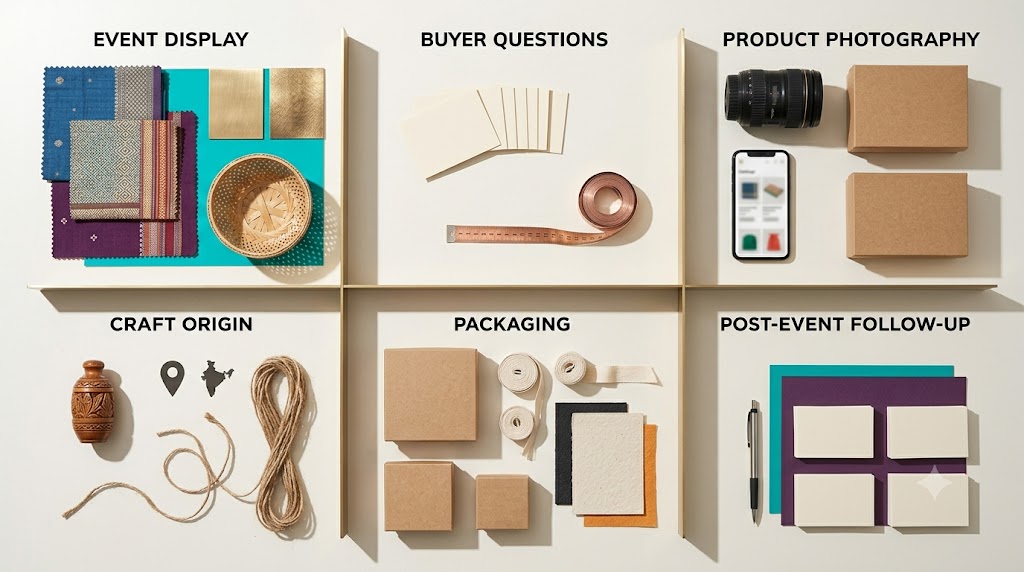
This matters because buyer trust is becoming more specific. A buyer searching for a GI-linked product or a regional craft expects origin, technique, and material clarity. If a seller uses a craft name loosely for search traffic, the listing may attract attention but lose trust.
A better approach is honest layering. If a product is made in the tradition, say so with accurate details. If it is inspired by a visual style, say “inspired by” and avoid implying certification or official origin. If it is a contemporary design using traditional techniques, explain which parts are traditional and which are modern.
For online craft sellers, this honesty can become a competitive advantage. Buyers are often overwhelmed by vague “ethnic” and “heritage” wording. Clear origin language feels more reliable.
What Design-Led Brands Can Learn From Indie Haat
Reports around Indie Haat 2026 mention participation by artisans, weavers, and NIFT alumni design-led brands. That mix is worth studying. It suggests that Indian handmade commerce is moving toward collaboration between traditional craft knowledge and contemporary design presentation.
Design-led brands can help translate craft into modern buyer contexts: table styling, wall decor, urban gifting, wearable accessories, boutique textiles, festive hampers, and international-friendly packaging. Yet the design layer should not erase the artisan story. The best collaborations preserve maker credit, regional identity, and craft process.
For online sellers, the design lesson is practical. A product does not need to look old-fashioned to be authentic. A handloom cushion, brass desk object, hand-painted tray, woven basket, or textile wall hanging can feel contemporary while still carrying craft value. The product page should explain that balance.
Sellers should avoid two extremes. One extreme is freezing craft in the past as if buyers only want museum-style objects. The other is stripping away origin until the handmade product looks generic. Indie Haat’s value is that it can show how heritage and modern presentation work together.
How Online Sellers Can Follow Up After A Showcase
The week after a major showcase is critical. Many sellers lose momentum because they return home, unpack, and wait. A stronger approach is to follow up quickly with buyers, post product photos, update listings, and build collections around the products that drew attention.
Sellers should sort leads into groups: retail buyers, gift buyers, designers, repeat customers, and casual visitors. Each group needs different information. Retail buyers may need a catalogue and wholesale terms. Gift buyers may need packaging photos and delivery options. Designers may need sizes, customization rules, and lead times. Casual visitors may need a simple product link.
A post-event digital catalogue should be easy to scan. It should include product names, prices, materials, dimensions, care, and availability. If a product sold out, sellers can mark it as made-to-order only if they can reproduce it realistically. Handmade scarcity should be explained honestly.
Social posts should not rely only on event photos. They should teach buyers what they saw: “how to care for handprinted textiles,” “why handmade metalwork varies,” “how to style a woven basket,” or “what makes this regional craft giftable.” Educational content builds trust after the event buzz fades.
Why Indie Haat Is A Search Lesson, Not Just A Showcase
Indie Haat 2026 shows that the future of handmade selling depends on both discovery and documentation. A buyer can discover a craft at the National Crafts Museum, but they will later search online for the product name, seller, region, material, or gift use. If the seller’s digital presence is weak, the discovery may disappear.
That is why online craft sellers should treat Indie Haat-style events as search research. Which words did buyers use? Did they ask for “home decor,” “gift set,” “handloom saree,” “wall art,” “wedding gift,” “corporate hamper,” or “sustainable craft”? Those words should guide product titles and collection pages.
The goal is not keyword stuffing. The goal is buyer-language accuracy. A seller should write the way a thoughtful buyer searches, while keeping craft names correct and respectful.
India’s handmade sector is large, diverse, and increasingly digital. Indie Haat 2026 gives artisans a physical platform, but its bigger lesson is digital readiness. The sellers who turn showcase attention into long-term trust will be the ones who document products clearly, use craft names responsibly, prepare packaging, answer buyer questions, and make every product easy to find after the event ends.