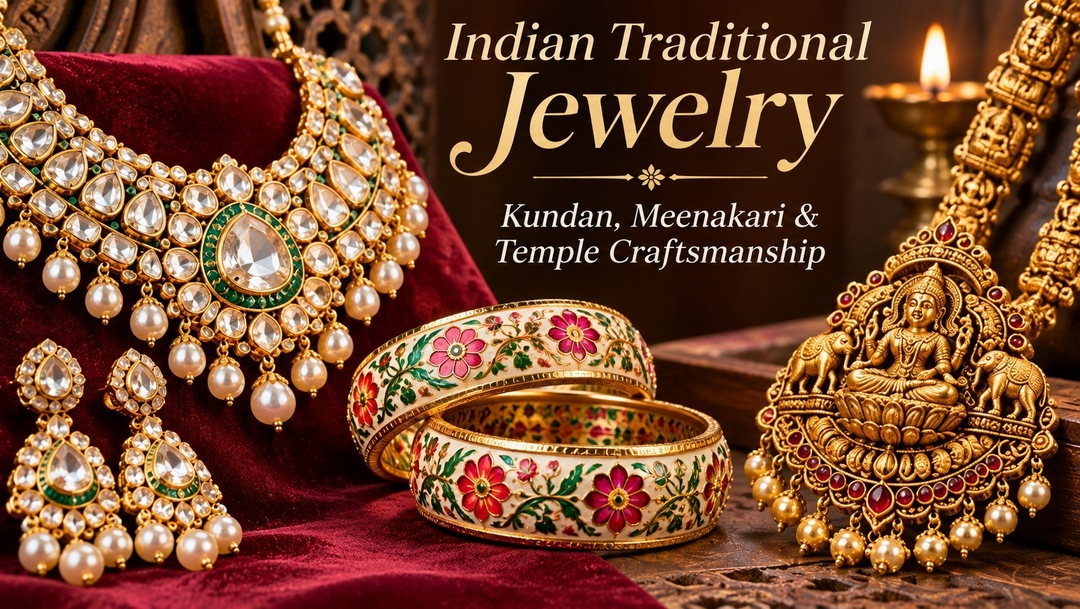
Throughout millennia of South Asian artistic history, Indian traditional jewelry has transcended personal ornamentation to serve as architectural miniature, spiritual devotion, and familial financial preservation. The subcontinent’s goldsmithing traditions encompass an extraordinary array of regional metiers, ranging from the vitreous enamels of Rajasthan to the repoussé sacred idols of Tamil Nadu. In consumer studies published by the World Gold Council, India consistently ranks as one of the world’s most sophisticated markets for fine jewelry, driven by generational connoisseurship that prioritizes artisanal metal manipulation over automated cast manufacturing. As contemporary consumers look to distinguish handcrafted heirlooms from industrial pressings, cultural platforms like Shimply illuminate the historic preservation, technical disciplines, and authenticity benchmarks behind these artisanal practices.
Unlike automated die-striking and computer-aided 3D wax casting, traditional Indian jewelry crafting relies on communal guilds of specialized artisans known as karigars. A single masterwork often traverses multiple distinct workshops: one family shapes the raw precious metal, another sculpts miniature settings, a third enamels delicate reverse patterns, and a final polisher sets untreated gemstones. This distributed specialization preserves ancient chemical recipes and metalworking techniques that define India’s sovereign jewelry taxonomy.
The Architectural Complexity of Kundan and Jadau Stone Setting
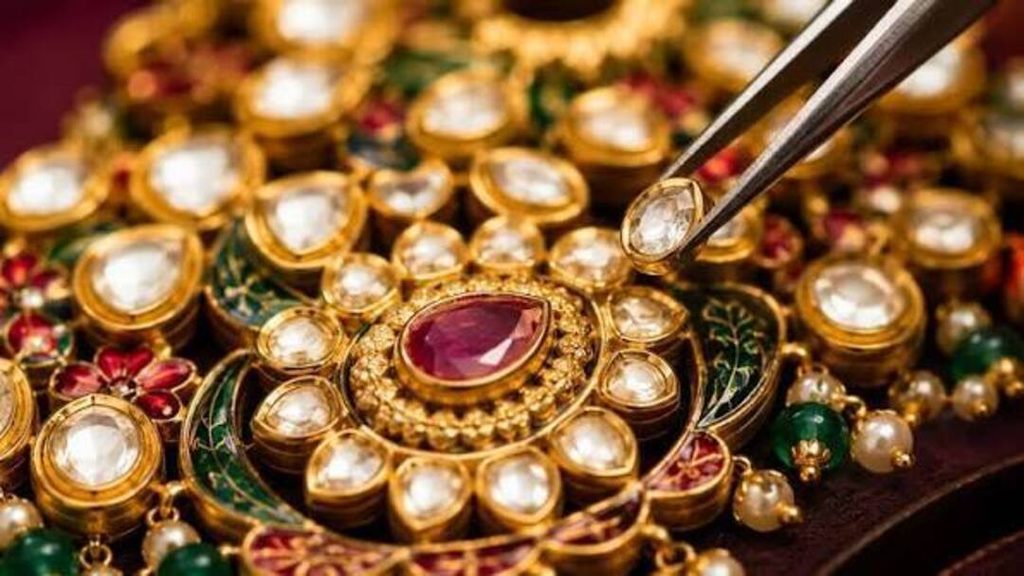
Rooted in the royal courts of the Mughal Empire and the Rajput principalities of Rajasthan and Gujarat, Jadau represents the overarching technique of embedding stones, while Kundan refers specifically to hyper-refined, 24-karat gold foil. In the classic Kundan process, gems are never gripped by conventional metal prongs. Instead, artisans create a foundational framework called the ghat, typically crafted in 22-karat gold, containing custom-chiseled cavities tailored to the precise contours of uncut polki diamonds, emeralds, or spinels.
Artisans fill the empty cavities with a natural tree resin known as pehal or lakh, which cushions the gem. The true masterstroke involves cold-welding wafer-thin sheets of purified 24-karat gold foil around the edges of the gemstone using specialized agate burnishing tools called salais. Because pure 24-karat gold is exceptionally ductile, molecular cohesion occurs at room temperature under manual pressure alone, locking the gem into a seamless, gleaming gold perimeter that no mechanical machine can replicate.
| Jewelry Craft Style | Geographic Cluster | Primary Metal & Medium | Defining Artistry Technique |
| Kundan / Jadau | Jaipur & Bikaner, Rajasthan | 24K Pure Gold Foil & Polki Diamonds | Cold-welded molecular foil setting without heat or claws |
| Meenakari | Varanasi & Jaipur | Gold, Silver & Vitreous Mineral Oxides | Champlevé trench engraving and high-temperature kiln firing |
| Temple Jewelry | Nagercoil & Madurai, Tamil Nadu | Unadulterated Yellow Gold / Silver Gilt | Nakashi repoussé and chasing of sacred divine iconography |
| Tarakasi (Filigree) | Cuttack, Odisha | High-Fineness Silver Wire | Microscopic wire drawing, crimping, and delicate soldering |
| Thewa Art | Pratapgarh, Rajasthan | 23K Gold Foil on Fused Glass | Miniature openwork gold motifs fused onto colored Belgian glass |
Meenakari: The Ancient Chemistry of Vitreous Enameling
Introduced to Rajasthan during the late 16th century under Raja Man Singh I of Amber, who brought master enamelers from Lahore, Meenakari transformed the reverse side of gold jewelry into an intimate art canvas. Traditionally, the backs of heavy Kundan necklaces were enameled to protect the wearer’s skin from sharp stone edges while adding an element of private luxury. The process follows the champlevé method, where the surface of the gold is painstakingly engraved with botanical grooves, peacocks, and geometric Arabesques.
Artisans grind mineral glass oxides—such as cobalt for blues, copper for greens, and colloidal gold for vibrant rubies—into microscopic powders mixed with essential oils. Each color carries a specific melting threshold. In the kiln, minerals are fired in descending order of temperature resistance, beginning with resilient whites and concluding with delicate translucent reds. The national regulatory framework enforced by the Bureau of Indian Standards provides mandatory hallmarking protocols that test base metal purity beneath these intricate enamel and resin layers, ensuring precious metal transparency for modern buyers.
Sacred Metalwork: Nakashi and South Indian Temple Jewelry
While northern craftsmanship evolved under Persian courtly influences, the southern peninsula cultivated Temple jewelry, an ancient metal art linked to Chola, Pandya, and Vijayanagara temple architecture. Originally conceived to adorn temple deities in sacred sanctums, this style was later adopted by classical Bharatanatyam dancers and royal dynasties. Centered around the historic craft hub of Nagercoil in Tamil Nadu, genuine Temple jewelry features distinctive motifs of Goddess Lakshmi, Lord Ganesha, temple towers (gopurams), and swan avatars (annapakshi).
Unlike Kundan’s reliance on foil packing, Temple jewelry relies on Nakashi—the classical sculptor’s art of repoussé and chasing. Artisans hammer sheet gold over a resilient bed of pitch and tree gum, raising three-dimensional reliefs from behind before refining facial expressions and decorative garments from the front with micro-chisels. The stones embedded in classical temple pieces are predominantly natural cabochon rubies and emeralds, traditionally secured with pure gold bezels rather than facet cuts.
Verifying Authentic Handcrafted Precious Heirlooms
With mass-market die-cast brass and electroplated synthetic alloy jewelry flooding international marketplaces, verifying authentic handmade Indian jewelry requires examining key structural hallmarks:
- Statutory BIS Hallmarking: Certified authentic gold items must bear the statutory three-symbol BIS hallmark: the triangular BIS logo, the karatage and fineness grade (such as 22K916), and a 6-digit alphanumeric Hallmark Unique Identification (HUID) code.
- Organic Lac Distribution: In genuine handmade Kundan, the natural lac bedding beneath the stone setting conforms organically to uncut gems, unlike rigid, uniform factory prongs found on cast imitations.
- Kiln Vitrification in Enamels: Genuine Meenakari shows hard, glass-like mineral gloss that resists fingernail scratches and maintains brilliant refraction over centuries, unlike synthetic cold epoxy paints that fade and soften.
- Hand-Chased Chisel Variations: True Nakashi temple ornamentation displays subtle, expressive variations in depth and chisel cadence along floral arabesques, proving human tool interaction across every contour.
Sustaining Guild Heritage in the Contemporary Marketplace
The survival of India’s classical jewelry traditions depends on preserving generational craft guilds against the encroachment of automated manufacturing. While industrial 3D printing and centrifugal casting can replicate exterior shapes at fraction of the cost, they lack the structural soul, tensile integrity, and cultural lineage embedded within manually cold-welded gold foil and hand-fired mineral enamels. When patrons invest in verified handcrafted jewelry, they provide direct economic sustainability to multi-generational communities of karigars, gem cutters, and enameling masters.
By connecting traditional master workshops directly with global collectors, authentic craft curation preserves an invaluable aesthetic language. Indian traditional jewelry remains not merely a celebration of material wealth, but a resilient testament to human dexterity, sacred geometry, and centuries of uncompromising artistic integrity.