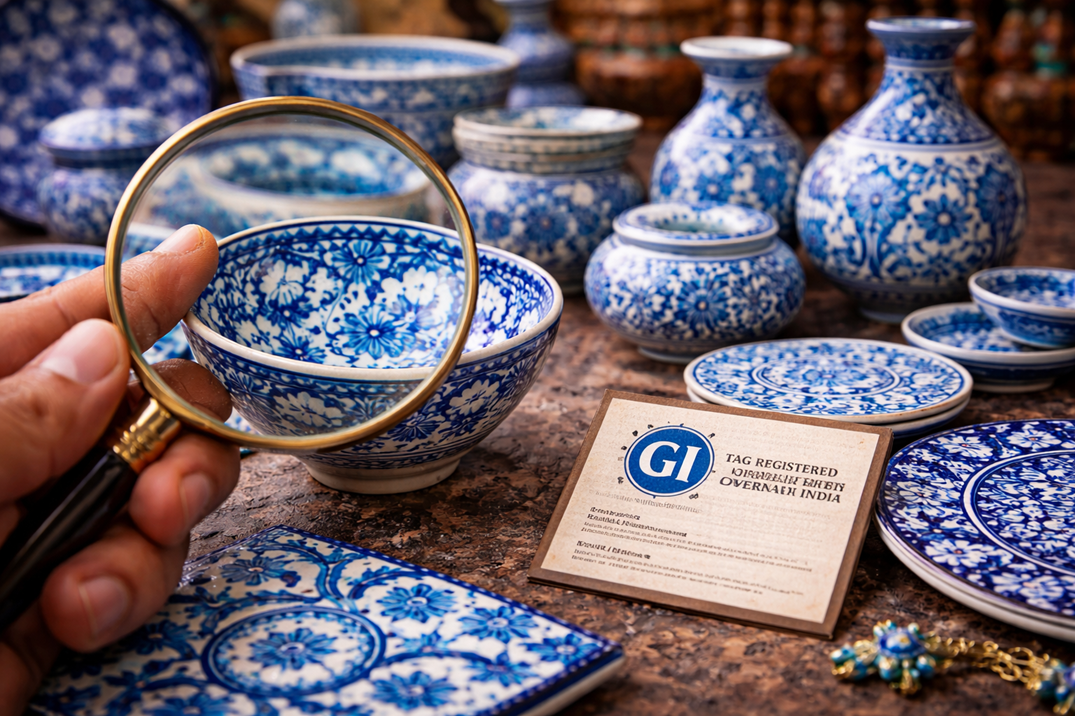
Jaipur Blue Pottery stands out as one of India’s most visually recognizable crafts, known for its distinctive turquoise-blue palette, Persian-inspired motifs, and glossy finish. But as its popularity grows—especially among global buyers—the market has also seen a surge in imitations.
For buyers, the challenge is no longer finding Blue Pottery. It’s learning how to separate authentic Jaipur craftsmanship from mass-produced replicas that mimic its aesthetic but lack its heritage and technique.
This guide breaks down exactly what to look for when buying genuine Jaipur Blue Pottery.
What Makes Jaipur Blue Pottery Unique
Unlike conventional ceramics, Jaipur Blue Pottery is not made from clay. Instead, it uses a quartz-based composition, typically combining powdered quartz, glass, multani mitti (Fuller’s earth), borax, and natural gums.
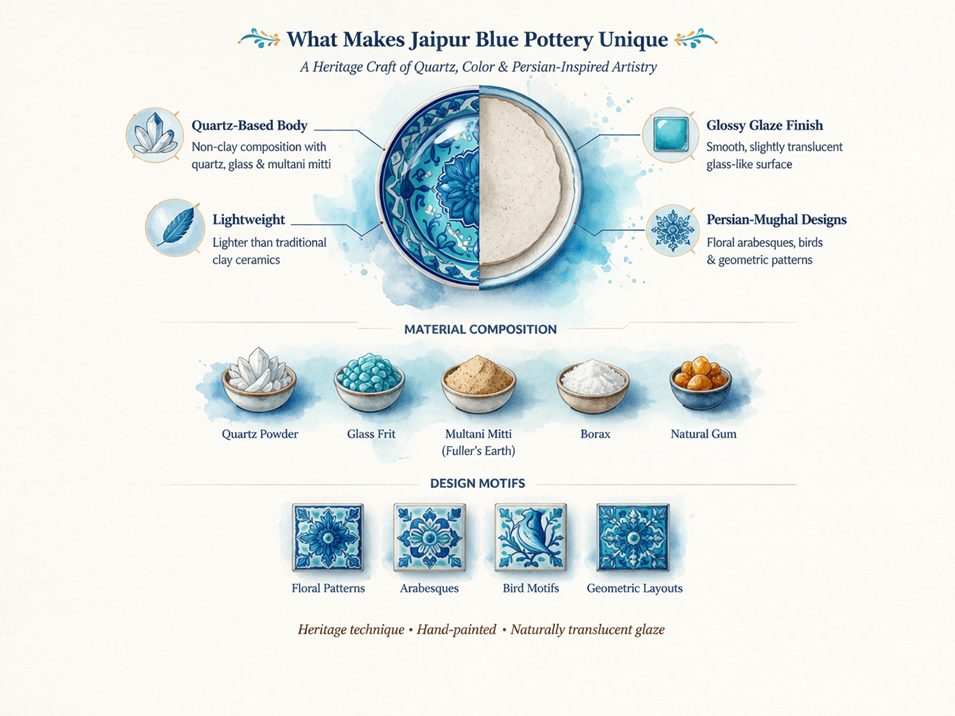
This composition gives it several defining characteristics:
- A smooth, almost glass-like surface
- A lighter weight compared to clay pottery
- A slightly translucent glaze finish
The designs are equally distinctive, featuring floral patterns, arabesques, birds, and geometric layouts rooted in Persian and Mughal artistic traditions.
This combination of material and design is what makes authentic Blue Pottery immediately recognizable—when you know what to look for.
Why Authenticity Matters For Buyers
Authentic Jaipur Blue Pottery is still produced in small artisan clusters, often using techniques passed down through generations. As demand increases, cheaper alternatives—often factory-made—have entered the market.
For buyers, authenticity directly affects:
- Durability and finish quality
- Cultural and artistic value
- Long-term collectibility
- Fair compensation to artisans
In many cases, imitation pieces are made using standard ceramic clay and synthetic paints, which lack the defining features of true Blue Pottery.
Key Differences Between Authentic And Imitation Blue Pottery
Understanding the differences side-by-side can help buyers make confident decisions:
| Feature | Authentic Jaipur Blue Pottery | Imitation Products |
|---|---|---|
| Base Material | Quartz-based (non-clay) | Regular ceramic clay |
| Weight | Light | Heavier |
| Finish | Smooth, slightly translucent glaze | Opaque or overly glossy |
| Colors | Soft blues, turquoise, natural tones | Bright, artificial hues |
| Patterns | Hand-painted, slightly varied | Uniform, printed designs |
| Price | Mid-range to premium | Low-cost |
This comparison highlights a critical insight: authenticity reveals itself in subtle imperfections and material behavior, not just appearance.
Visual Signs Of Genuine Craftsmanship
When examining a piece in person—or even online—there are specific visual cues that indicate authenticity.
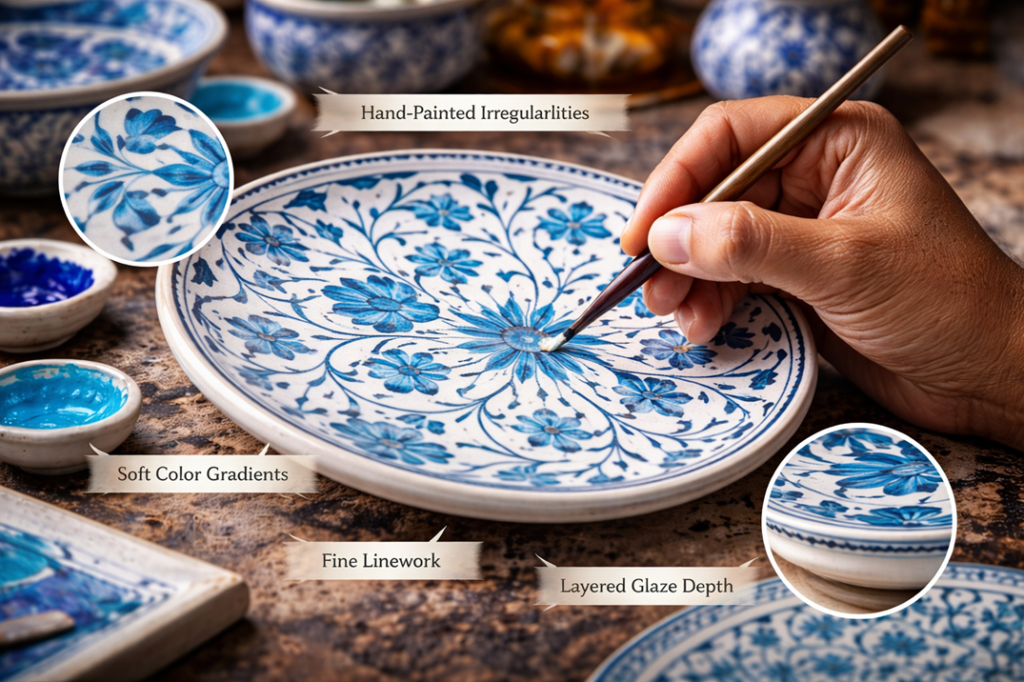
Look closely for:
- Hand-painted irregularities: Slight variations in pattern symmetry are a positive sign
- Soft color gradients: Authentic pieces avoid overly saturated or neon tones
- Fine linework: Motifs should be precise but not mechanically perfect
- Glaze depth: A subtle layered look rather than a flat surface
Authentic Blue Pottery often feels refined but not machine-perfect, which is exactly what distinguishes it from factory-made replicas.
Understanding The Production Process
Knowing how Jaipur Blue Pottery is made can significantly improve your ability to identify genuine pieces.
The process typically involves:
- Preparing the quartz-based dough
- Molding the shape without a potter’s wheel
- Hand-painting designs using natural pigments
- Glazing and firing at low temperatures
Because this process is labor-intensive and fragile—many pieces break during firing—authentic products naturally carry a higher price and limited supply.
This is similar to other region-specific crafts where process defines authenticity, such as traditional textiles of Gujarat, where technique plays a central role in value.
Pricing Expectations And Buyer Signals
Authentic Jaipur Blue Pottery is not overly expensive, but it is rarely “cheap.” Pricing depends on size, detail, and craftsmanship.
| Product Type | Typical Price Range (India) |
|---|---|
| Small Tiles / Coasters | ₹200 – ₹800 |
| Bowls / Plates | ₹500 – ₹2,500 |
| Decorative Pieces | ₹2,000 – ₹8,000+ |
If a product is priced significantly below these ranges, it often indicates:
- Machine production
- Use of ceramic clay instead of quartz
- Printed designs instead of hand painting
Price alone doesn’t guarantee authenticity—but extreme affordability is usually a warning sign.
Where Buyers Should Be Careful
The rise of e-commerce has made Jaipur Blue Pottery more accessible—but also more vulnerable to misrepresentation.
Be cautious when:
- Sellers do not disclose material composition
- Listings use generic terms like “blue ceramic pottery”
- There is no mention of Jaipur origin
- Product images appear overly uniform or digitally enhanced
For verified authenticity and regional credibility, buyers can refer to institutions supported by the Development Commissioner for Handicrafts, which promotes genuine Indian artisan products.
Why Jaipur Origin Still Matters
Despite widespread replication, Jaipur remains the authentic center of Blue Pottery production. The craft’s identity is deeply tied to the region’s artisan communities and historical influences.
Buying authentic Jaipur Blue Pottery is not just about product quality—it’s about preserving:
- Traditional knowledge systems
- Regional craft identity
- Sustainable artisan livelihoods
As with many Indian crafts gaining global popularity, origin is becoming a key factor in value, not just aesthetics.