
Imagine finding a pair of sandals that look amazing. Then, you find out a big fashion brand copied its design. This shows how much the world values real, protected art from India.
A Geographical Indication (GI) tag is more than a label. It’s a legal proof of where something comes from. It keeps unique items safe by linking them to a place’s traditions. For buyers, it means you’re getting the genuine article.
The 2025 update added new items, making it harder to know what’s what. Our state-organized guide helps you sort it out. It’s a must-have buyer’s list for anyone who cares about buying right and respecting cultures.
Learn how to read the GI label and find the best local crafts. Get tips for buying with confidence. Let’s explore India’s protected handicrafts together.
Why the GI Tag Matters: Authenticity, Livelihoods, and Fair Prices
The GI tag makes traditional Indian crafts more than just products. It turns them into legally protected cultural treasures. This system does more than just mark a product’s origin. It protects heritage and fights for economic fairness, helping both the craftsman and the buyer.
A geographical indication india tag is a must for authenticity. It ensures that products like “Kashmir Pashmina” or “Patola Silk” are made the right way. This stops fake goods from ruining the craft’s value and disappointing buyers.
For artisans, the GI tag’s impact is huge. It legally recognizes their work as unique. This stops big companies from making cheap copies and selling them as the real thing. It makes sure the real makers get the benefits.
This system helps rural areas grow by making traditional skills valuable jobs. When artisans own their GI, they can ask for better prices. This lets them invest in their communities and keep their crafts alive.
Prices for real GI items are fair because they reflect the true value. You’re paying for the skill, care, and tradition that goes into each piece. It’s not just about making something cheap.
This system is fair for both the maker and the buyer. Artisans get paid well for their work. Buyers know they’re getting something special, with a story behind it.
The Indian diaspora is key to this. By buying GI products, you support these rich cultural traditions. Your choice helps keep these crafts alive for future generations.
The table below shows what the geographical indication india system is all about:
| Pillar | Impact on Artisans & Communities | Benefit for the Buyer |
|---|---|---|
| Authenticity & Heritage | Prevents misuse of traditional names and techniques. Safeguards cultural identity. | Guarantee of receiving a genuine product made with defined standards and regional methods. |
| Livelihoods & Ownership | GI is public property owned by producer groups. Ensures a fairer share of profits stays local, empowering rural development. | Confidence that your purchase directly supports the authentic artisan community, not middlemen or copycats. |
| Price Fairness & Value | Justifies premium pricing based on skill, time, and sustainable practices, improving artisan income. | Transparent pricing linked to quality and heritage. You understand what you are paying for. |
In short, a geographical indication india tag is a symbol of honor and integrity. It connects you to the real story behind a product. This balance between keeping traditions alive and helping artisans thrive is why GI is so important.
What is a GI tag? How it’s granted and enforced
A GI tag is more than a label. It’s a legal proof that a product is truly from where it says it is. It shows that a product’s special qualities come from its place of origin.
Imagine a trademark like “Nike” protecting a brand name. A GI tag works like that but for places, like “Darjeeling Tea.” It’s a right for a whole community, not just one company.
In India, the Geographical Indications of Goods (Registration and Protection) Act, 1999, governs GI tags. The GI Registry in Chennai oversees this. For more on GI tags, check out this detailed guide.
Getting a GI tag is a tough process. It’s designed to protect real heritage. It’s not given out easily.
- Application: A group of producers or an association from the region files an application with the GI Registry.
- Examination: Officials check the application. They make sure the product is truly linked to the place and made in a traditional way.
- Publication & Opposition: The details are published. Anyone can object to the registration.
- Registration: If it passes, the GI is registered for ten years. It can be renewed forever.
This process makes sure you get real regional heritage when you buy a GI-tagged item.
| Feature | GI Tag | Trademark |
|---|---|---|
| Primary Purpose | Protects the name of a place-linked product (e.g., Kanchipuram Silk). | Protects a brand’s logo or name (e.g., Apple logo). |
| Owner | Belongs to all authorized producers in the defined geographical area. | Owned by an individual company or organization. |
| Validity | 10 years, renewable perpetually. | 10 years, renewable indefinitely. |
| Geographical Scope | Indicates the product MUST come from a specific region. | No geographical restriction; identifies commercial source. |
| Basis of Protection | Reputation and qualities derived from the geographical origin. | Distinctiveness and brand identity in the marketplace. |
But a tag is useless without enforcement. So, how are GIs protected? Enforcement is key. If someone uses a registered GI name (like “Banarasi Saree”) on products not made in that region, it’s infringement.
The groups behind the GI can take legal action. They can sue for damages and get court orders to stop the misuse. This legal support is what keeps gi handicrafts by state real and lets artisans protect their work.
A key thing for buyers, like those in the diaspora, is that GI protection is primarily territorial. An Indian GI is legally enforceable in India. But, international protection needs specific agreements like the WTO’s TRIPS Agreement and the Paris Convention.
This means a “Kashmir Pashmina” GI tag is strong in India. But, its protection abroad depends on treaties or local laws. Knowing this helps you buy authentic gi handicrafts by state wisely.
How to read a GI label/QR on products and invoices
A genuine GI-tagged product tells its story through specific markings and digital footprints. Every savvy buyer must recognize these signs. This guide will help you verify authenticity. By mastering this skill, you ensure your money supports real artisans and you get true authentic Indian crafts.
When checking a physical product, look for a label, tag, or stamp. It should have three key elements:
- The Official GI Logo: This is a government-certified emblem. It often features the words “Geographical Indication” or “GI” in a stylized design.
- The Registered Name: The product’s name must match exactly what is registered. For example, “Kashmir Pashmina” not just “Pashmina Shawl.”
- Geographical Origin: The label must state the specific region, town, or area granted the tag, like “Made in Chanderi, Madhya Pradesh.”
If any of these elements are missing, vague, or look poorly printed, it’s a major red flag. The label is the product’s birth certificate.
Many newer and official authentic Indian crafts now feature a QR code on their label or packaging. This is a powerful tool for instant verification. Simply scan the code with your smartphone camera. It should link directly to the official GI registry entry or a verified seller’s page. This database entry confirms the product’s registration details, geographical area, and authorized producers.
An invoice from a certified seller is another critical document. A legitimate invoice will reiterate the GI-registered name of the product. It should list the seller’s authorization or license number if they are a registered dealer. This paper trail is essential for high-value items and for buyers in the diaspora seeking proof of origin for customs.
Why is this step so important? It protects you from overpaying for mass-produced imitations. It guarantees the quality and unique characteristics tied to the region’s traditional methods. Most importantly, it ensures your purchase directly benefits the community of artisans whose skills and heritage the GI tag was designed to protect. Verifying the label is the final, essential step in securing truly authentic Indian crafts.
In short, do not complete a purchase without checking for the official logo, the exact registered name, and the stated geographical origin. Use the QR code when available. Trust comes from verification, not just a seller’s word.
Regional Highlights: A Snapshot of Iconic GI Crafts
Let’s explore three Indian states known for their unique handicrafts. These states have items with the GI seal. This gives us a glimpse into the rich diversity of these crafts.
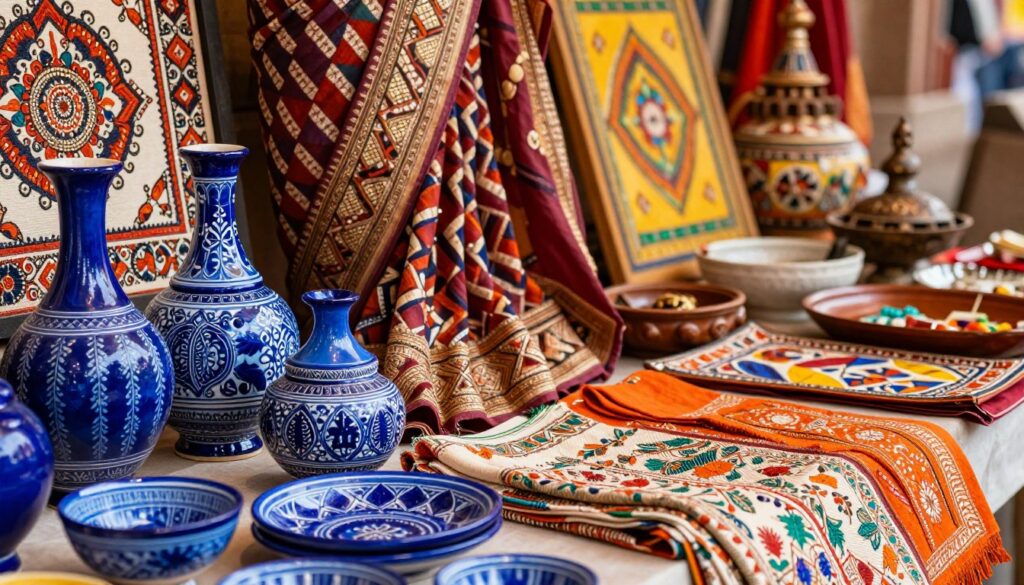
Each region’s crafts reflect its geography, history, and community. Knowing these stories makes owning a piece even more special.
Rajasthan: The Royal Canvas
Rajasthan’s art is as bold and vibrant as its desert landscapes. The state’s GI tags protect techniques passed down through generations of master artisans.
- Blue Pottery of Jaipur: Famous for its distinctive cobalt blue dye, this pottery is unique for being crafted from a special dough-like mixture of quartz, glass, and multani mitti (fuller’s earth), not clay.
- Kota Doria: These legendary sarees and fabrics are prized for their ethereal lightness and signature square-check patterns woven with incredibly fine cotton and silk threads.
Gujarat: The Artisan’s Laboratory
Gujarat is a powerhouse of textile and painting arts. Precision and patience define every creation.
- Patan Patola: The pinnacle of silk weaving, a genuine Patola saree uses the complex double-ikat technique where both the warp and weft threads are tie-dyed before weaving, creating flawless patterns on both sides.
- Kutch Rogan Art: A newly recognized GI (2025), this ancient craft uses a thick, castor oil-based paste to paint intricately on fabric. The artist uses a metal rod, not a brush, for the stunningly detailed work.
West Bengal: The Weavers’ Poetry
The looms of West Bengal produce textiles of legendary finesse and narrative depth. Often inspired by nature and epics.
- Banglar Muslin: Once known as the “woven wind” for its impossible delicacy, this cotton fabric is experiencing a revival. Its extraordinary thread count creates a texture that is both strong and whisper-soft.
- Baluchari Sarees: These silk sarees are distinguished by their elaborate brocaded borders and pallus (end pieces) that depict entire mythological scenes and stories from the epics, woven with exquisite detail.
These highlights are just the beginning. When you’re ready to buy GI crafts online, searching for these specific names will lead you to authentic, certified collections. Our next sections will guide you on evaluating provenance and making a secure purchase.
Price & provenance: why GI items cost more and how to budget
The high price of GI crafts is not random. It shows their special heritage and careful making. It’s about more than the item itself; it’s about its history and the effort put into it.
Several real reasons explain why gi tag crafts list india are worth more.
- Intensive Hand Labor: Most GI crafts need a lot of handwork. Making a Patola sari or Blue Pottery can take days or even months.
- Specific Local Materials: Real items use special clay, dyes, or wool. Finding these can be hard and expensive.
- Decades of Skill Development: Artisans learn for years. Their skill in complex techniques comes from a lifetime of practice.
- Traditional Tools & Processes: Keeping old tools and methods alive is hard. But it’s key to making true GI crafts.
Buying a GI-tagged item means you’re getting a piece of history. Your money helps artisans and keeps old skills alive.
Smart budgeting lets you enjoy GI crafts without breaking the bank. Here are some tips.
Begin with small, famous items. A nice scarf or hand-painted tiles is a good start.
Think of each buy as a long-term investment. These crafts last a long time and are beautiful forever.
Compare these crafts to cheap, mass-made items. While they might seem cheaper, GI crafts have a unique story and quality.
In the end, the price buys you provenance. This means you know where and how it was made. It’s a way to own a piece of India’s art and make a good choice.
Diaspora buyer tips: customs codes, duties, returns from US/UK/CA/UAE
Buying Indian crafts is personal. But, importing them has practical steps. Here’s how to do it smoothly. Purchasing a geographical indication india product is an investment in heritage. Getting it to your home abroad requires navigating customs rules.
Buying an authentic geographical indication india product is exciting. But, unexpected fees or paperwork can be frustrating. This guide helps protect your purchase and your peace of mind.
Every international shipment has a Harmonized System code. This code tells customs officials what the item is. For handicrafts, the correct code affects the duty rate.
Common codes for handmade items like textiles, pottery, or metalware often fall under Chapter 97 (Works of art, collector’s pieces). The exact code can vary. How to find it:
- Ask the seller. Reputable vendors of GI-tagged goods often know the code.
- Use the online tariff database of your destination country (e.g., USITC Tariff Database).
- When in doubt, consult a freight forwarder or customs broker.
Providing the correct HS code on invoices streamlines clearance. It proves your item’s nature and value.
Navigating Customs Duties and Taxes
Most countries charge import duties and taxes on goods over a certain value. These are separate from shipping costs. Rates depend on the item’s declared value, material, and the trade agreement between India and your country.
You must check your local regulations proactively. Budget an extra 5-20% of the item’s cost for possible fees. The table below offers a general snapshot for key diaspora destinations.
| Country | Typical HS Code for Handicrafts | Duty/Tax Estimate | Key Consideration |
|---|---|---|---|
| United States | 9701.90 (Carvings, statuettes) | 0% – 6.5% duty + possible state tax | Items over $800 may incur duty. Formal entry may be required. |
| United Kingdom | 9702.00 (Original engravings, prints) | 0% – 5% duty + 20% VAT | VAT is charged on item value + shipping + duty. Use the UK’s Global Tariff tool. |
| Canada | 9706.00 (Antiques over 100 years old) | 0% – 8% duty + 5% GST/HST | Handicrafts not classified as antiques may have different rates. Check CBSA. |
| UAE | 9701.10 (Paintings, drawings) | 5% VAT only | Generally no import duty for commercial samples/personal effects. VAT applies. |
These are estimates. Official government portals are your final source. Factor these costs into your total budget for the geographical indication india item.
Managing Returns and Warranties
Returning a handmade, GI-tagged item is complex and often costly. These are not mass-produced goods. Clear communication with the seller before purchase is non-negotiable.
Ask these questions directly:
- What is your return and exchange policy for international buyers?
- Who bears the cost of return shipping and customs for a refund?
- Is any warranty provided against manufacturing defects?
Many artisans and cooperatives offer repair services instead of returns. Understand this upfront. For high-value pieces, strongly consider purchasing shipping insurance from the carrier. It protects against loss or damage in transit.
Your role as a diaspora buyer supports vital artisan communities. A little preparation on codes, duties, and policies ensures your cherished piece of Indian heritage arrives safely. It turns a complex process into a confident purchase.
Red flags: misused GI names, vague origin claims
Before you buy that beautiful shawl or pottery, watch out for red flags. Fake GI products are common. They use protected names to charge high prices for regular items.
Your careful eye protects your wallet and the artisans. It also keeps the GI handicrafts by state system honest. Here are the warning signs every buyer should know.
One big red flag is a product with a GI name but no official tag. For example, “Kolhapuri-style” chappals not made in Kolhapur district are fake. Even big brands like Prada have been caught selling fake “Kolhapuri” sandals.
Vague descriptions are another clue. Saying “Indian silk” or “Rajasthani art” is not specific. Real GI items will say “Kanchipuram Silk” or “Kashmir Pashmina.”
If the price is too low, it’s likely fake. GI-protected crafts are made with care and specific materials. Low prices usually mean cheap, machine-made items.
Lastly, a seller who can’t give basic info is a big worry. They should talk about the item’s origin, the artisans, and how it’s made. If they’re vague, it’s a warning sign.
| Red Flag | What It Means | How to Verify Authenticity |
|---|---|---|
| Unauthorized GI Name Use | Product uses a protected name (e.g., “Patola”) but lacks the GI tag or certificate. | Look for the official GI logo, hologram, or registration number on the product or its packaging. |
| Vague Origin Claims | Descriptions are generic, like “Rajasthani Handicraft,” instead of a specific GI like “Blue Pottery of Jaipur.” | Ask the seller for the exact geographical origin and the registered name of the craft. |
| Suspiciously Low Price | The cost is far below market rate for a handmade, GI-protected item. | Research average prices for the authentic GI product from official seller lists or government portals. |
| Missing Provenance Info | The seller cannot detail where, how, or by whom the item was made. | Request invoices, artisan details, or a certificate of origin. Legitimate sellers will provide this. |
Knowing these signs makes you a smart buyer. You support real artisans and get value for your money. Remember, buying GI handicrafts by state is about tradition, not just a label.
If unsure, don’t buy. There are many genuine options from certified sellers. Your choice matters a lot.
Checklist download + links to GI collections
You now know how to spot and buy real GI-tagged crafts. This helps keep cultural heritage safe and supports artisans directly.
Get a free checklist to check GI labels, ask about the craft’s history, and plan your budget. It’s all about finding authentic Indian crafts.
Look at official GI registries or places like CraftsVilla, GoCoop, or the India Handmade Collective. These sites offer verified authentic Indian crafts from all over the country.
Your choice matters. Download the guide, check out the collections, and start supporting India’s craft traditions with confidence.