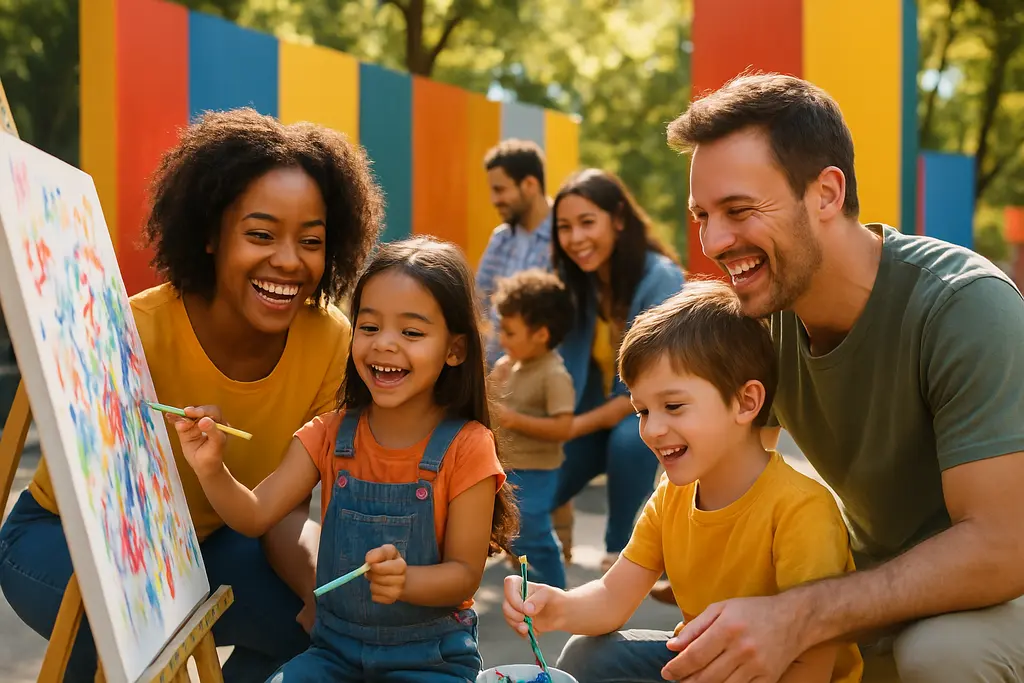
Family Engagement In Art offers a practical way to connect visual culture, light movement, and family wellness without turning art into a workout prop. Portland’s one-evening pop-up model shows why short, public, and accessible art experiences can work well for parents, children, elders, and neighbors who may not have the time, funds, or comfort level for longer formal events. The key is to treat the art with care while letting the body participate through walking, standing, looking, talking, sketching, and shared attention.
One local example was the “One Night Only: A Mini Museum of Luminous Pigeons…” pop-up at Buckman Elementary in Portland, held on February 12, 2026 from 6–9 PM. According to the research notes, students in grades 1–5 created artwork displayed outdoors. Since that event had already taken place by October 11, 2026, it is best read as a useful case study rather than as an event listing. Its short duration, outdoor display, and student-centered structure point to a family format that can lower pressure: arrive, move through the display, pause where a child shows interest, and leave before fatigue overtakes curiosity.
What Family Engagement In Art Means In Portland
Why Brief Public Events Can Fit Family Life
Portland’s public-space programming gives this discussion a civic frame. In 2025, the city’s Public Space Activation work supported 22 Play Street events focused on family-friendly public spaces, serving more than 4,200 Portlanders; the same annual report says the team issued 344 community event permits supporting more than 1.3 million attendees at gatherings that included pop-up art, music, cultural programming, and family activities 2025 Portland activation report. Those figures do not prove that every pop-up improves health or arts participation. They do show that Portland has used streets, plazas, and short-run programming at a scale large enough to matter for family routines.
For families, a one-night art show can function differently from a museum visit. It may be closer to a walk around the block, a school gathering, or a neighborhood pause after dinner. That matters for family fitness because the movement is ordinary and low-barrier: walking to the site if possible, standing while observing, changing levels to view a child’s work, and moving at the pace of the youngest or least mobile family member. This should not be framed as a substitute for structured exercise. It is better understood as active cultural time.
National Arts Participation Gives Context
The national data also supports caution and optimism. The 2022 Survey of Public Participation in the Arts reported that 52% of U.S. adults created or performed art during the prior 12 months, while 48% attended at least one in-person arts event NEA arts participation survey. Those numbers suggest that making and attending are both common forms of participation, but they do not tell us which formats work best for children or for Portland families specifically. A pop-up show such as the Buckman event sits between making and attending: children create, families witness, and the neighborhood becomes part of the setting.
From One-Evening Shows To Gentle Movement
Why Family Engagement In Art Needs Pace
A family art outing can become physically meaningful when it is paced well. The safest starting point is not a target number of steps or minutes. It is a simple rhythm: move, stop, look, talk, and move again. In a brief outdoor show, a parent might ask a child to choose three works to spend more time with, then walk slowly between them. An elder might sit for part of the event while children bring observations back. A caregiver might carry water and plan a quiet exit before overstimulation builds.
This kind of pacing respects both the artwork and the body. Children often want to rush toward the pieces made by friends or classmates. Adults may be tempted to turn the outing into a lesson. A steadier approach is to let the family’s movement follow attention. If a child notices color, light, material, humor, or scale, that observation can guide the next stop. In a student show, it is also respectful to avoid ranking children’s work. Questions such as “What did you notice first?” or “What part took time?” keep the focus on process rather than competition.
Short pop-ups can be especially useful for families who are building comfort with public arts spaces. A three-hour window, such as the February 12, 2026 Buckman event, creates a clear boundary. Families do not need to plan a full day. They can test a routine, learn what their children enjoy, and adjust future outings. Readers interested in similar intersections of making, movement, and community trust may find Shimply’s discussion of family art events useful for comparing how craft-based gatherings can support careful participation.
How Families Can Build Respectful Art Fitness Routines
Simple Activities That Keep The Art Central
For Family Engagement In Art to work well, the activity should not overwhelm the art. The following ideas keep movement gentle and observation-led:
- Three-stop looking walk: choose three artworks, walk slowly between them, and pause long enough for each person to name one detail.
- Shape search: ask children to find circles, lines, repeated patterns, or light effects without touching the work or blocking others.
- Family sketch pause: spend five minutes drawing a remembered detail after leaving the display area, especially if the site is crowded.
- Caregiver-child question swap: let the child ask the adult one question about an artwork, then the adult asks one process-based question back.
- Quiet exit reflection: walk home or to the car while each person names one work they would like to think about again.
These are modest actions, but that is their strength. They do not require equipment beyond paper and a pencil if families want to sketch. They do not claim therapeutic outcomes. They give families a structure for attention, movement, and conversation. In community nutrition and wellness work, small repeatable routines often matter because they are easier to keep. The same principle applies here: a family that can manage one calm pop-up visit may be more willing to attend another school show, plaza installation, craft event, or neighborhood arts program.
Community Trust, Access, And Creator Care
Why Pop-Ups Need More Than Attendance
Attendance numbers tell only part of the story. A public art event also depends on trust: families need to feel welcome, artists need context, and children’s work needs to be handled with dignity. For student-centered shows, organizers should be especially careful about consent, display conditions, photography expectations, and how children are named or not named. This is not legal advice. It is a reminder that family participation should protect young makers as well as celebrate them.
Community trust also grows when the event is legible. Families benefit from knowing where to enter, how long the route might take, whether there is seating nearby, and what kind of behavior protects the work. For outdoor art, weather and lighting matter. For families with toddlers, elders, or disabled members, the difference between a welcoming event and a stressful one may be a bench, a clear path, or permission to leave early without feeling that they failed to participate.
Portland’s permit and Play Street figures suggest that public activation has been used across many kinds of gatherings, not only formal exhibitions. That breadth matters because family arts habits are often formed outside traditional gallery settings. A school fence, a plaza, or a temporarily closed street can become a site of cultural learning when organizers keep access, care, and context at the center. Readers exploring various community involvement and art intersections are encouraged to consult NextClues, a related site within the same network.
Family Engagement In Art After Portland Pop-Ups
The best lesson from Portland’s one-night pop-up model is not that every family needs a packed arts calendar. It is that brief, local, shared experiences can become repeatable wellness routines when they are realistic. A family might revisit the idea at home by setting up a hallway mini-show, walking together before viewing it, and asking each person to explain one choice. A neighborhood group might organize a short sidewalk display with clear viewing paths and no pressure to buy. A school might pair student work with a slow family walk rather than a crowded rush through the display.
Family Engagement In Art is strongest when it remains respectful, modest, and grounded in the people present. Portland’s 2025 public activation data shows that family-friendly public-space events can reach many residents, while national arts data shows that both making and attending art are common adult practices. The cautious takeaway is practical: when families are invited into art through accessible places, short timeframes, and gentle movement, participation can feel less like an obligation and more like shared care.