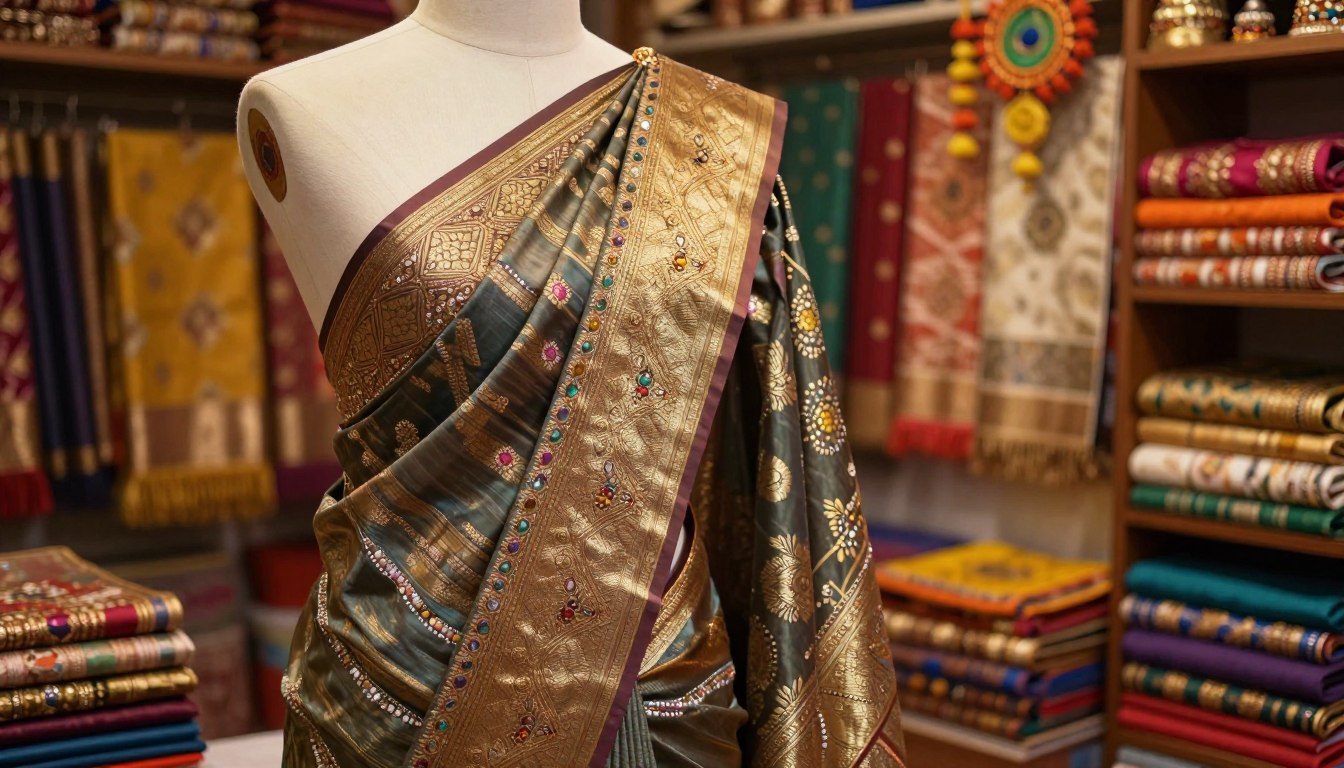
Choosing a real Banarasi is more than just adding a beautiful piece to your wardrobe. It’s a choice that honors centuries of tradition. For those who value quality, it stands for elegance and heritage.
The market is full of fake versions. That’s why a reliable checklist is key. Our guide gives you the knowledge to make a confident choice.
True authenticity is marked by official tags. Look for the Handloom Mark, Silk Mark, and Geographical Indication (GI) tags. Sellers like HMR Handlooms meet these standards. This guide will show you how to spot genuine craftsmanship.
Buying a saree is more than a purchase. It’s about keeping a tradition alive. Let’s make sure your choice is as authentic as the art itself.
Intro: Banaras weaving heritage and GI
Before you start, learn about the legal and historical sides of a Banarasi saree. This is your first step to knowing if it’s real.
For over five centuries, Varanasi’s looms have done more than just weave fabric. They’ve woven a cultural legacy. This tradition, passed down through generations, defines the city’s identity. The kadhua and brocade work are a peak of Indian textile art.
This rich heritage is now protected by a strong legal tool: the Geographical Indication (GI) tag. Awarded in 2009, the GI tag legally safeguards the name “Banaras Brocades and Sarees.” Only sarees handwoven in six specific districts of Uttar Pradesh can bear this label.
The GI tag is your non-negotiable proof of origin. It fights against mass-produced imitations and protects artisan livelihoods. Modern GI labels often include security features like holograms and QR codes. These features allow for instant verification against a central database.
While the GI tag confirms where a saree is from, the Silk Mark confirms what it is made of. Managed by the Silk Mark Organisation of India, this certification is a guarantee of 100% pure silk. No synthetic blends or adulterated fibers are allowed.
Think of these two certifications as your primary quality shields. The GI tag protects the artistry, and the Silk Mark guarantees the material. Any seller of an authentic Banarasi should be able to provide clear evidence of both. Checking for these marks should be the very first action in your evaluation process.
| Aspect | Heritage Value | Certification Assurance | What It Means for You |
|---|---|---|---|
| Origin & Craft | Centuries-old handweaving tradition in Varanasi. | Geographical Indication (GI) Tag. | Legal assurance of authentic handloom origin, supporting artisans. |
| Material Purity | Historical use of pure silk and real zari (gold/silver thread). | Silk Mark Certification. | Guarantee that the saree is made from 100% pure silk, not synthetic blends. |
| Modern Verification | Artisan family signatures, unique weaving patterns. | Holograms, QR codes on tags. | Ability to instantly verify authenticity via smartphone or database check. |
| Market Protection | Reputation built on unmatched quality and design. | Legal action against misuse of “Banarasi” label. | Protection from counterfeit powerloom or printed imitations. |
In summary, never separate a Banarasi saree from its story and its seals. The deep history justifies its value, and the modern certifications protect your investment. Always look for the GI tag and the Silk Mark before you fall in love with the design.
Weave Types: Kadhua vs Fekwa (Cutwork), Tanchoi, Jangla—How to Tell from Photos
Four top handloom weaves—Kadhua, Fekwa, Tanchoi, and Jangla—each has its own story. Spotting these differences is key for online shopping. This guide shows you how to see these clues in photos.
First, know the two main pattern-making techniques. Kadhua weave (also called Kadwa) is the highest art in handloom. Each motif is woven with extra thread. This makes the fabric’s surface look embossed.
The back of a kadhua fabric is perfectly clean. You won’t see loose threads where the pattern is.
Fekwa (also called Cutwork or Phekua) uses a thread that floats across the back. This thread is later cut by hand. The back of a cutwork saree shows tiny thread ends or lines behind motifs.
This technique is faster and cheaper than kadhua.
From the front, both weaves look stunning. But the reverse side is the giveaway. A seller showing a clean back is likely selling kadhua. A busy back with lines means cutwork.
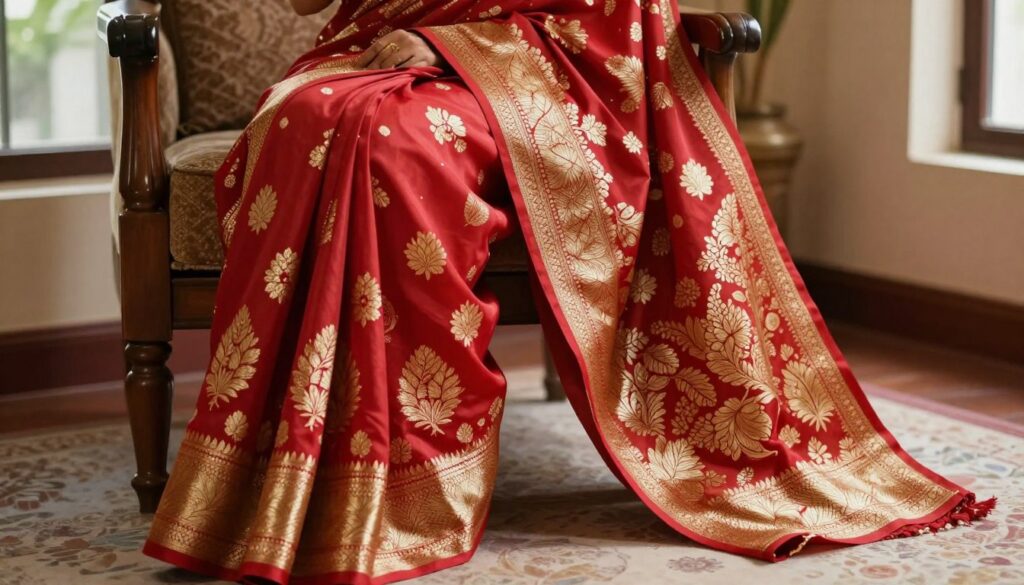
Tanchoi has a unique feel. It uses a satin base for a smooth, glossy look. The pattern is woven into the fabric, giving an embossed effect all over.
Tanchoi sarees often use many colored threads. This creates subtle, shaded patterns. In photos, look for a shiny, uniform texture without raised work.
The jangla is a historic kadhua weave. It’s called “jungle” because of its dense, interlocking floral vines and net (jali) patterns. It’s a dense tapestry of design. In photos, a jangla saree looks very ornate, with little plain background.
| Weave Type | Key Identifying Feature (Front) | Back Side Clue | Complexity & Typical Use |
|---|---|---|---|
| Kadhua (Kadwa) | Raised, individual motifs with sharp definition. | Clean and neat. No loose threads around patterns. | Most complex and time-consuming. Used for premium & bridal wear. |
| Fekwa (Cutwork) | Beautiful motifs, but may appear slightly flatter than kadhua. | Visible “floats” (long threads) or cut thread ends behind patterns. | Less complex than kadhua. Common for elegant everyday and festive wear. |
| Tanchoi | Smooth, glossy satin finish with an all-over, inlaid pattern. | Pattern is woven in, so the back is a muted mirror of the front. | Unique satin weave. Prized for its luxurious drape and sheen. |
| Jangla Butidar | Extremely dense coverage of floral and net (jali) patterns. | Clean back (it’s a kadhua technique), but the pattern density is the real clue. | Specialized, antique style of kadhua. Heirloom and statement bridal pieces. |
Use this table as your cheat sheet when browsing online. Zoom in on close-up shots of the fabric. Always ask for a picture of the saree’s reverse side. That single image can confirm the weave type and the craftsmanship you’re investing in.
Reverse‑side cues: floats, tuck‑ins, motif clarity
The back of a Banarasi saree is key to knowing its true value. While the front shines with colors, the back shows its real making. It’s your best way to spot a real handloom treasure from a fake one.
Always ask for a clear photo of the saree’s underside from any seller. A real artisan or a good dealer will show it to you. If they don’t want to, it’s a big warning sign.
True handloom Banarasi sarees have small, beautiful flaws. Look for tight knots where threads meet. These are part of the hand-weaving magic.
Also, check for neat “tuck-ins” where threads are woven back in. This keeps the fabric smooth and prevents snags.
Motif clarity from the back is a sign of quality. Patterns like flowers or paisleys should be clear even from the back. The design is woven in, not just slapped on. Fake ones have a flat back with unclear patterns.
Watch for thread “floats” on the reverse. These long threads show the fekwa or cutwork technique. In kadhua brocade, the weaver uses every thread, making the reverse smooth with no long floats.
Use the table below as your quick-reference guide during inspection:
| Feature to Inspect | Authentic Handloom Cues | Power‑Loom Imitation Cues |
|---|---|---|
| Overall Texture | Slight irregularities, a soft, textured feel. | Mechanically uniform, stiff, and flat. |
| Knots & Joints | Small, visible knots where threads are joined. | No knots; perfectly continuous threads. |
| Thread Tuck‑Ins | Neatly woven‑in ends; secure and clean. | Threads may be cut or glued, potentially loose. |
| Motif Clarity (Reverse) | Design is clear and recognizable from the back. | Pattern is blurred, faded, or unrecognizable. |
| Presence of Floats | Long floats indicate fekwa; short threads indicate kadhua. | Float pattern is overly regular or absent in a fake way. |
Learning to inspect the reverse side makes you a savvy buyer. It lets you ask the right questions and judge the craftsmanship. Remember, the beauty of a handloom saree is in its human touch, and that touch leaves a unique mark on the back.
Silk & zari choices; what “butidar/minakari” really indicate for price
When sellers talk about ‘butidar’ or ‘minakari,’ they’re talking about special design techniques. These techniques affect the price a lot. The materials, like silk and zari, are key to every Banarasi saree. Their quality and the work done with them greatly influence the cost.
Let’s look at the base fabric: silk. Not all silks used in Banarasi are the same. The type affects the saree’s weight, drape, and when to wear it.
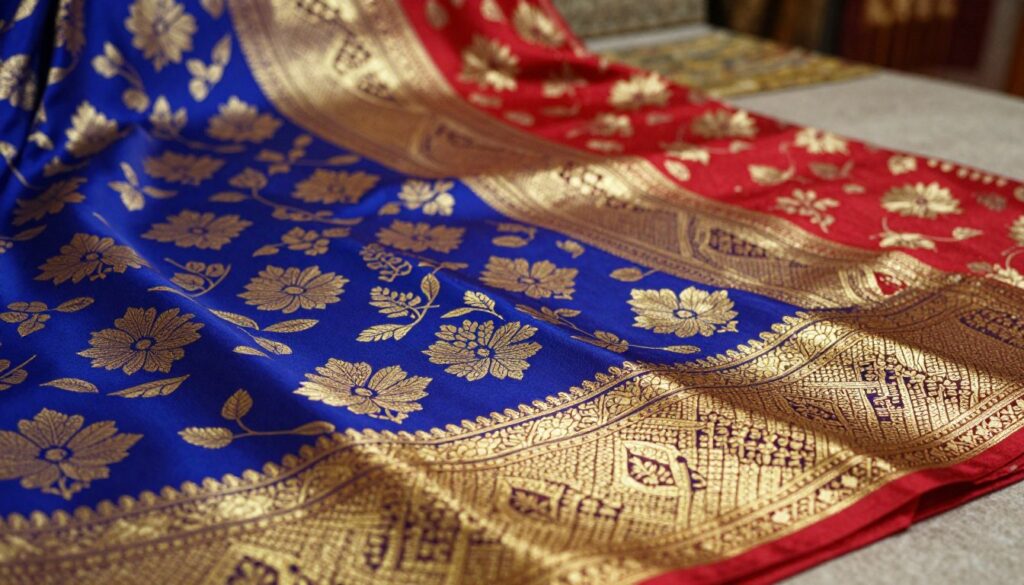
Katan silk is the classic choice. It’s pure, twisted silk that makes a dense, shiny fabric. Katan sarees are heavy, rich, and often chosen for weddings. Organza (or Kora) silk is sheer and crisp. It’s perfect for creating stunning visual effects with zari, making it great for lighter, festive occasions. Georgette and Chiffon are lighter, flowy silks used for more modern, everyday Banarasi designs.
| Silk Type | Description | Texture & Drape | Best For |
|---|---|---|---|
| Katan | Pure, twisted silk threads | Heavy, structured, high sheen | Bridal wear, formal events |
| Organza (Kora) | Sheer, crisp silk | Stiff, transparent, lightweight | Daytime weddings, festive parties |
| Georgette | Crepe silk with grainy texture | Fluid, drapes easily, matte finish | Daily wear, office occasions |
| Chiffon | Fine, plain-weave silk | Ultra-light, flowing, soft | Evening wear, summer events |
Now, let’s talk about zari. Real zari is a metallic thread made from silver or gold. Today, many zari threads are ‘imitation’ or ‘tested’—a metallic-coated polyester or copper thread. The cost difference is huge.
A simple rub test can tell you if it’s real. Rub the zari thread on white paper. Real silver or gold zari might leave a faint gray or yellow mark. Imitation zari often leaves a shiny, plastic-like residue or nothing at all. Real zari glows more and gets better with time, while imitation can tarnish or break easily.
This brings us to design terms. Butidar means ‘with motifs.’ A saree called butidar is full of patterns like flowers and paisleys. More patterns mean more weaving time, which raises the price.
The term minakari is where art meets cost. It’s inspired by jewelry enamel work. In Banarasi, minakari means putting many colored silk threads within a zari-outlined motif. Weavers insert tiny shuttles of different colored silk to create stunning effects. This is very time-consuming and requires great skill.
A true minakari piece shows clear, crisp color changes inside the motifs. The back will have many small, neat ‘tuck-ins’ from the colored threads. This hard work is why a minakari-heavy saree costs more. It’s not just a design; it’s a sign of high-quality craftsmanship.
So, what does this mean for price? A butidar Katan silk saree with real zari is a big investment. Add genuine minakari work, and the price goes up even more. When you see these terms, you know they mean a lot of skilled labor on the loom. This justifies the value of the beauty.
Common counterfeits: jacquard powerloom, printed “banarasi”
Before buying a Banarasi saree, it’s key to know the common fakes. Knowing these scams helps you avoid overpaying for a fake.
The first scam is the power-loom jacquard saree. These are made fast on machines, using cheap materials like polyester. They look like real brocade but don’t have the real thing’s soul.
Here’s how to spot a power-loom fake:
- Too-Perfect Patterns: The designs are too perfect and even, lacking the charm of handmade work.
- Lightweight Feel: They’re much lighter than real silk Banarasi, due to cheaper materials.
- Synthetic Hand-Feel: The fabric feels slick and stiff, unlike the softness of real silk.
These fakes are made fast and cheap, but they’re not durable or well-made.
The second scam is the printed “Banarasi” saree. Traditional Banarasi designs are printed on plain fabric. This makes the design flat and lacks texture.
Spotting a printed fake is easy:
- No Raised Texture: The design feels smooth, not textured like real zari or silk.
- Lifeless Look: The colors and designs look pixelated or blurry, showing it’s ink, not thread.
- Reverse-Side Clarity: A real brocade shows a shadow of the design. A print shows nothing or a faint stain.
This method just copies the look, without the real weaving.
Here’s a quick guide to help you tell the difference:
| Feature | Authentic Handloom | Power-Loom Jacquard | Printed Saree |
|---|---|---|---|
| Production | Handwoven on pit loom | Machine-made, automated | Digital printing on fabric |
| Texture & Feel | Rich, raised, textured motifs | Flat pattern, synthetic feel | Completely smooth, no texture |
| Pattern Perfection | Slight, charming irregularities | Mechanically perfect, uniform | Can be pixelated, flat colors |
| Durability | Heirloom quality, lasts decades | Prone to pilling, less durable | Print may fade or crack |
Knowing these facts helps you avoid bad buys. Always check the weight, texture, and the back side. A real Banarasi shows its quality in both looks and feel.
What to Ask Sellers: Loom Information, Artisan, Weight (g/m), Close‑ups
Talking to a seller is key to knowing if a Banarasi saree is real and good quality. You need to ask smart questions to find out. This helps you tell the good sellers from the not-so-good ones.
Think of this as your guide to check everything before you buy. It helps you make sure you’re getting what you pay for.
Start with the basics: the loom. Always ask, “Is this saree made on a handloom or a powerloom?” Handloom sarees are made with a lot of care and cost more. They have a special touch that powerloom ones don’t.
Then, ask about the weave technique. Say, “Is this a Kadhua (kadhwa) or a Fekua (cutwork) weave?” Knowing this tells you how detailed and special the saree is. Kadhua is known for its luxury because of its gold or silver threads.
The zari type also matters a lot. Just ask, “Is the zari real (silver/gold thread) or imitation?” Real zari shines and is heavy, making the saree more valuable. Imitation zari is cheaper but doesn’t last as long.
Ask for the weight in grams per meter too. A heavier saree means it’s made with more care and material. Sellers like HMR Handlooms or The Sangam Silks usually share this info.
Lastly, ask for pictures. Say, “Can you provide close-up photos of the weave and the reverse side of the saree?” Good pictures let you see the saree’s details and check if it’s real.
Here’s a quick list of questions to ask:
- Is this a handloom or powerloom saree?
- What is the primary weave technique (Kadhua, Fekua, Tanchoi)?
- What type of zari is used—real or imitation?
- What is the saree’s weight in grams per meter?
- Can I see close-up photos of the weave and the reverse side?
- Can you share any details about the master weaver or artisan cluster?
A seller who answers these questions clearly is likely trustworthy. Being open is a sign of a good seller. This way, you know you’re buying a true piece of Banaras heritage.
Budget tiers for bridal vs everyday
When choosing a Banarasi saree, your budget depends on the occasion. Is it for a special event or everyday wear? The price reflects the materials, labor, and artistry.
There are three budget tiers to consider. Knowing these helps you find value and avoid scams.
Budget Tier (₹3,000 – ₹8,000): This range includes powerloom imitations or sarees with silk blends and synthetic zari. They’re good for everyday wear but lack the quality of handloom.
Mid-Range (₹8,000 – ₹20,000): Here, you find authentic handloom sarees. Expect pure silk or fine blends with real or tested zari. These have moderate weaving complexity and are perfect for festivals and special occasions.
Premium & Bridal (₹20,000 – ₹50,000+): This tier offers heirloom-quality pieces. You’ll find the finest pure silk, kadhua handweaving, and lavish zari use. Bridal wear is the most expensive due to its density and labor.
- Silk Purity: Pure Banarasi silk (like katia or organza) is more expensive than blended fabrics.
- Zari Type: Real silver-thread zari is the most expensive. “Tested zari” (copper alloy) is a quality, more affordable alternative.
- Weaving Complexity: A kadhua (continuous extra-weft) weave is more time-consuming than a fekwa (cutwork) technique, affecting the cost.
- Labor Intensity: Denser motifs and smaller patterns require more artisan hours.
For everyday wear, a lighter Tanchoi or simple jangla design in the mid-range tier is perfect. It offers elegance without the cost of a bridal piece.
A bridal Banarasi is an investment. It’s heavier, with complex kadhua or detailed jangla work, and uses premium materials. This justifies its premium tier price.
Understanding this helps you appreciate the value of a saree with elaborate butidar work or intricate embroidery designs on sarees. If a seller offers a “pure kadhua silk Banarasi” for a budget-tier price, it’s likely a counterfeit.
Use these budget tiers as your financial compass. They help you align your aspirations with a realistic investment. Then, confidently ask your seller the right questions.
Diaspora shipping, duties, and return windows
When your dream Banarasi saree is thousands of miles away, knowing about shipping, duties, and returns is key. For buyers in the United States and other countries, a successful international purchase depends on these details.
Reputable online sellers of authentic Banarasi silks usually offer international shipping with secure packaging. Your first step should be to check if the seller has shipping insurance. Make sure the policy covers the item’s full value during transit. This is essential for high-value items like bridal or heirloom pieces.
Import duties can be a surprise. Customs duty rates differ by country and are your responsibility. Ask the seller for the Harmonized System (HS) code they’ll use on the customs form. Then, use your country’s duty calculator to estimate the final cost.
Before you buy, check the return policy and return window. A clear policy from a trusted seller shows confidence. Ask yourself:
- How many days do I have to start a return or exchange?
- What condition must the saree be in? (Often, tags must be attached and the item unworn)
- Who pays for international return shipping and any restocking fees?
- Is store credit offered instead of a full refund?
By turning these challenges into planned steps, you can focus on the beauty of your Banarasi saree. Choosing sellers with clear logistics protects your investment and makes the journey from loom to home smooth.
Downloadable checklist
Your journey to owning a genuine piece of Varanasi’s heritage is now clearer. This guide has detailed the hallmarks of an authentic Banarasi saree. You can spot the difference between kadhua and cutwork brocade.
You know to check the reverse side for clean tuck-ins and motif clarity.
To make your search easier, we created a one-page tool. Our free Banarasi saree buying checklist condenses every key point. It covers weave identification, silk and zari verification, and questions for sellers.
Use this checklist while shopping online or visiting a store. It helps you quickly assess a saree’s authenticity. Refer to it when examining product photos for loom marks and weight details.
The checklist is your shield against common counterfeits like jacquard powerloom imitations.
Focus your investment on sarees from trusted, certified sellers. A genuine Banarasi piece from a GI-registered source holds lasting value. This downloadable checklist turns complex knowledge into simple, actionable steps.
Carry this resource with you. Let it guide your decision for a bridal masterpiece or an everyday treasure. An authentic Banarasi saree is a wearable heirloom. Make your choice with confidence.