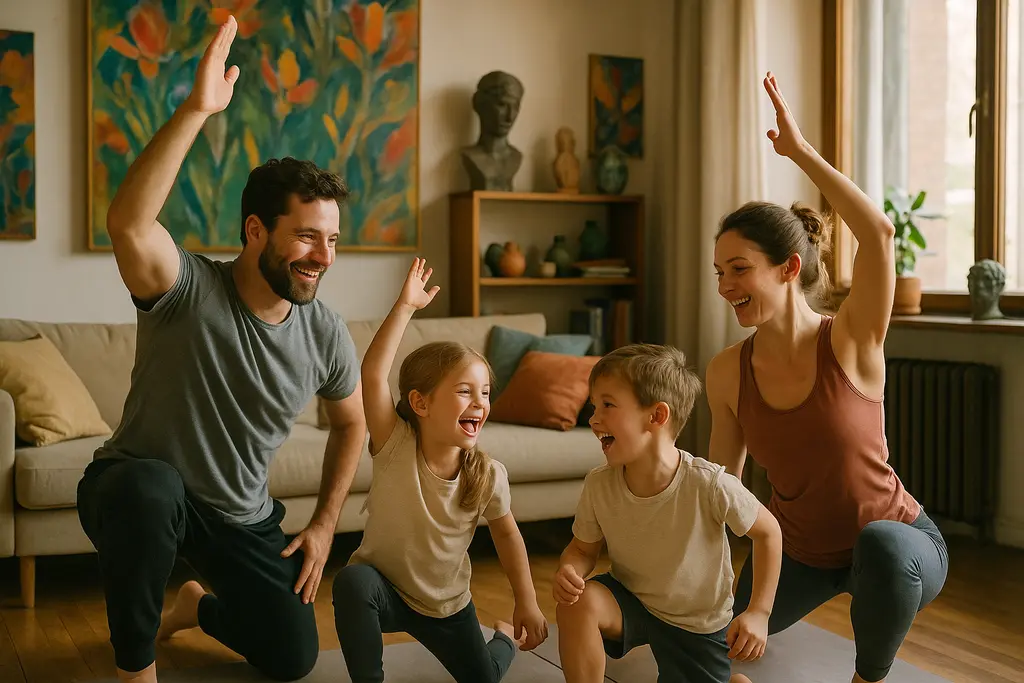
Art family fitness can make movement feel less like a workout checklist and more like a shared act of looking, imagining, and responding. Using the Museum of Arts and Design’s “Uncanny Valley” exhibition as a reference point, families can build activities around sculpture walks, art-inspired yoga, museum scavenger hunts, dance interpretation, sketching hikes, relay games, obstacle courses, and timed art challenges. The safest reading here is not that art automatically improves fitness outcomes, but that art can give families a stronger reason to move together with curiosity and attention.
The research prompt connects “Uncanny Valley” with the Haas Brothers and their fantastical, creature-like visual language. That matters for family wellness because fantasy, oddity, and playful forms can invite children and adults to move in ways that feel less rigid than standard exercise drills. As a home-workout advocate, I see this as especially useful for families who do not have much equipment or who need movement to fit between school, work, cooking, and care routines.
Families should treat the exhibition as inspiration, not as a template to copy or commercialize. If you visit the Museum of Arts and Design or view exhibition materials, focus on observation: posture, scale, texture, color, creature-like shapes, and emotional response. From there, convert those observations into movement prompts that respect the artwork’s context while keeping the session accessible.
Why Art Family Fitness Works At Home
An Art Family Fitness Warm-Up
A simple warm-up can begin with “gallery walking.” Ask each person to move slowly through a room as if they are viewing sculptures in a museum. Every 30 seconds, one family member calls out a visual cue: tall, curved, spiky, soft, heavy, tiny, surprised, sleepy, or floating. Everyone changes posture in response. This keeps the movement low-impact while inviting imagination.
The purpose is not to imitate a specific artwork. It is to translate visual qualities into safe motion. A “tall” cue might become a gentle reach. “Heavy” might become a slow squat. “Floating” might become side steps with loose arms. For younger children, this can be framed as play. For adults, it can become mobility work, especially for shoulders, hips, ankles, and spine.
Movement Without Pressure
Art-based movement works best when families avoid ranking performance. One person may create a dramatic creature pose; another may prefer small movements. Both are valid. The research suggests that integrating art into family fitness activities can enhance creativity and engagement, and that is where the value sits: not in perfect technique, but in participation.
This approach can also help households where fitness has become tense or overly goal-driven. Rather than beginning with calories, competition, or endurance targets, start with a question: “What would this shape feel like if it moved?” That question gives everyone permission to experiment. For families with limited space, even a hallway, living room, or backyard can become a temporary studio.
Activities Inspired By The Uncanny Valley Exhibition
Sculpture Walks And Public Art
Sculpture walks are one of the most practical starting points. Families can explore local parks, plazas, campuses, or public streets and look for sculptures, murals, or designed objects. The movement is simple walking, but the art changes the pace. Stop at each artwork and ask three questions: What shape stands out first? What movement does it suggest? What emotion does it seem to hold?
After each stop, walk for two minutes using a movement inspired by the discussion. A tall sculpture might suggest long strides. A rounded form might suggest slow circular arm movements while walking. A work that feels strange or creature-like might inspire careful tiptoe steps. Keep the intensity moderate and adjust for age, weather, and mobility.
Yoga, Dance, And Creature Poses
Art-inspired yoga can draw from the whimsical creatures mentioned in the research without copying a named figure. Families can create “creature poses” based on imagined qualities: a crouched forest creature, a long-necked watcher, a many-legged bug, or a sleepy soft-bodied character. Each pose can be held briefly, then released with a breath.
Dance interpretation gives the same idea more energy. Choose a remembered image, shape, or exhibition mood, then build an eight-count family phrase. One person adds a reach, another adds a turn, another adds a stomp, and another adds a pause. The finished phrase can be repeated three to five times, with rest as needed. This is a useful indoor option because it requires no equipment and can be scaled down for small rooms.
- Low-energy version: slow creature poses, seated arm shapes, gentle gallery walks, and short sketch breaks.
- Medium-energy version: dance phrases, obstacle steps, relay stations, and standing art challenges.
- Outdoor version: public sculpture walks, nature-trail sketching, and movement stops at safe landmarks.
Building A Family Session With Art And Movement
A 30-Minute Home Plan
A structured session helps keep the play from becoming chaotic. Begin with five minutes of gallery walking and shape cues. Move into eight minutes of creature yoga, where each person invents one pose and teaches it to the group. Use the next seven minutes for a dance interpretation based on one chosen artwork, memory, or fantasy form from the exhibition theme. Then spend five minutes on an art relay, such as running or fast-walking between a sketch station, a clay or paper-sculpture station, and a pose station. End with five minutes of quiet sketching or reflection.
This art family fitness format is flexible. A child who dislikes dance may prefer drawing the movement. A parent with sore knees may lead from a chair. A grandparent may contribute observation prompts. The main goal is shared participation, not uniform exertion.
Obstacle Courses With Imagination
Themed obstacle courses can borrow from fantastical elements in the research while staying grounded in safety. A sofa cushion can become a “soft hill,” a line of tape can become a “narrow bridge,” and a laundry basket can become a “sculpture tunnel” only if the setup is stable and age-appropriate. Families can crawl, step, balance, reach, and turn through the course.
For a stronger art connection, place a drawing prompt at the end of each station. After the bridge, sketch a long-legged creature. After the soft hill, draw a rounded form. After the balance point, create a pose that looks half-human and half-imagined. This keeps the activity close to the exhibition’s unusual energy without reducing the artwork to a costume party or a copy exercise.
Respecting Art, Rights, And Community Trust
Inspiration Is Not Replication
Families can respond to museum art through movement, discussion, and private sketching while still respecting artists. The boundary becomes more sensitive if families post content, sell activity kits, or use exhibition names and images in a commercial setting. This is not legal advice, but it is wise to treat artist names, artwork images, and exhibition materials with care. The U.S. Copyright Office provides general educational information on copyright, and creators should seek qualified guidance for specific permission questions.
Community trust also matters. In family arts spaces, authenticity is not only about being original. It is about being honest about sources, crediting museums or artists where appropriate, and avoiding claims that a homemade activity is officially connected to an exhibition unless that connection is verified. The same principle applies across handmade culture, costume culture, and fantasy fashion communities; readers interested in those intersections may find related context at Fairytale Fashion.
Scavenger Hunts With Care
Museum scavenger hunts can be a strong family movement tool because they combine walking with observation. Keep the prompts general: find a curved form, find an object that feels playful, find something that looks like it might move, or find a color that changes the mood. Avoid turning the visit into a race if the space is crowded or quiet. The physical activity should fit the setting.
If the museum has visitor rules about photography, food, sketching materials, or group behavior, follow them. A family fitness session should never disrupt other visitors or treat the museum as a gym. The better model is slow attention: walk, stop, observe, interpret, and move again outside or at home.
Art Family Fitness And The Uncanny Valley At Home
The strongest use of the “Uncanny Valley” prompt is not to reproduce an exhibition in the living room. It is to let unusual art widen the family’s movement vocabulary. Sculpture walks teach looking while walking. Yoga poses turn creature-like forms into flexibility practice. Dance interpretation gives children and adults a way to express mood physically. Sketching hikes pair outdoor movement with quiet focus. Relays and obstacle courses add energy when the household needs more active play.
For families, art family fitness is most useful when it stays simple, respectful, and repeatable. Choose one visual cue, one movement idea, and one reflection question. Then let the session grow from there. A museum exhibition can spark the idea, but the lasting benefit comes from the family habit: moving together, noticing more, and treating creativity as part of everyday wellness.