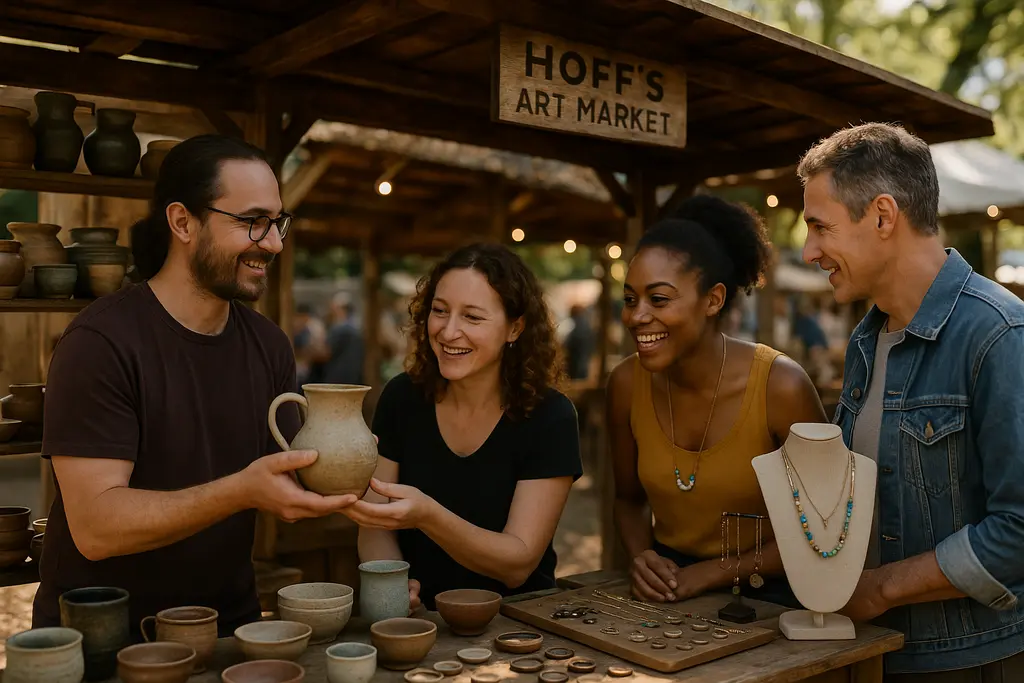
Hoff’s Art Market in Chagrin Falls, Ohio, offers a useful case for thinking about handmade commerce at a local scale. The public event listing identifies the 2026 market dates as August 14–16 and gives the location as 17711 Ravenna Rd, Chagrin Falls, OH 44023, with a curated mix of local artisans, makers, vendors, live music, and food trucks listed as part of the program event listing. Those facts do not, by themselves, prove a measurable economic effect. They do show a regional art market built around gathering, direct maker visibility, and a setting where buyers can see handmade and homegrown products in person.
For artisan markets, that distinction matters. A market is not only a sales site. It is also a trust site. The buyer can ask how an item is made, compare materials, understand small-batch variation, and connect the object to the person or local business presenting it. For artists and craft sellers, especially those working outside large retail channels, that face-to-face exchange can carry more weight than a polished online listing.
What Hoff’s Art Market Confirms About Place
Locality As More Than A Label
The research provided supports a narrow but meaningful claim: the market brings local artisans, makers, vendors, residents, food trucks, and live entertainment into one shared event setting. In handmade commerce, that kind of place-based format can help buyers understand that craft is not an abstract product category. It is tied to people, materials, time, display choices, and community recognition.
For Chagrin Falls, the event also appears to fit a regional shopping pattern where art, food, music, and social gathering reinforce one another. A visitor may come for a particular vendor, stay for music, buy food, and discover another maker by walking the market. The available sources do not name specific artists, vendor counts, attendance totals, or sales outcomes, so any claim beyond the listed event features should be treated with care.
Hoff’s Art Market As A Buyer Trust Setting
The handmade arts depend on trust because buyers are often judging qualities that cannot be reduced to price alone. They may ask whether a ceramic piece is functional or decorative, whether a textile has natural variation, whether a wood object needs special care, or whether a print is original, limited, or reproduction-based. A local art market can make those questions easier to ask.
For artisans, Hoff’s Art Market can function as a public point of contact. That does not guarantee sales or long-term customer loyalty. It does create an environment where the seller can explain process, answer care questions, and present the work with context rather than relying only on signage or social media captions.
How The Venue Shapes The Market Experience
Art, Music, And Hospitality In One Setting
The official venue page describes Reithoffer’s Art, Spirits & Entertainment as the host for its Annual Summer Markets and presents the location as connected to art, music, and hospitality venue page. This matters because the setting can affect how handmade work is encountered. A gallery-adjacent or art-centered environment may invite slower looking than a purely transactional retail space, while music and food can extend the time visitors spend on site.
At Hoff’s Art Market, the combination of vendors, live music, and food trucks suggests a hybrid format: part market, part community gathering, part cultural event. That format can help remove some of the distance between an artist and a buyer. It can also create challenges. Sellers must compete for attention in a social environment where visitors may be listening to music, eating, talking with friends, and browsing casually.
Display Choices And Cultural Respect
For handmade sellers, event context affects presentation. Work should be displayed in ways that respect its cultural and artistic origins, especially if the object draws from regional, familial, or traditional methods. Clear labels, material notes, maker statements, and care cards can help buyers understand the difference between handmade work and generic decor.
This is where cultural craftsmanship needs restraint as well as pride. Sellers should avoid vague heritage language if they cannot explain the origin, technique, or maker relationship behind a work. A local market rewards honest context: what the work is, who made it, how it should be used, and why the price reflects labor and material choices.
Artisan Visibility And Buyer Trust
What Makers Can Communicate In Person
Direct interaction is one of the strongest advantages of a regional market. A product page can list dimensions and materials, but a conversation can explain why a glaze varies, why a handwoven edge is not perfectly uniform, why a piece takes several stages to finish, or why a small-batch object cannot be restocked instantly.
That kind of explanation is not a defensive act. It is part of craft education. Buyers who understand process are better prepared to value handmade work, care for it properly, and avoid comparing it unfairly with factory-made goods. For a local artisan, the market table becomes a short-form classroom as much as a sales counter.
Practical Trust Signals For Handmade Sellers
Because the market is described as featuring a curated mix of makers and vendors, individual presentation still matters. The event may bring people together, but each seller carries responsibility for accuracy and clarity. A cautious trust-building setup can include:
- Material information that avoids exaggerated claims.
- Care instructions for ceramics, fiber, wood, metal, paper, or other media.
- Clear pricing that reflects labor, scale, and process.
- Artist or maker background without romanticizing hardship or identity.
- Honest notes about handmade variation, repair, and restock limits.
These details help protect artistic integrity. They also reduce buyer confusion after the event. A well-informed buyer is more likely to treat the object as a living piece of craft rather than a disposable souvenir.
Reading Economic Impact With Caution
What The Public Facts Support
The research notes state that the market attracts visitors and contributes to local business activity, but the cited public pages do not provide attendance data, vendor revenue, business receipts, tax figures, or independent economic analysis. For that reason, the safer conclusion is that the event creates conditions associated with local spending: visitors gather in Chagrin Falls, vendors offer goods, food trucks serve attendees, and the venue hosts entertainment.
That is still meaningful. Small markets can matter even when their impact is not quantified. A maker may gain a repeat customer, a local food vendor may meet new patrons, and a visitor may associate Chagrin Falls with creative activity. Yet evidence-based writing should not turn those plausible outcomes into verified figures without documentation.
Why Community Value Is Not Only Financial
Art markets also carry social value. They give residents a reason to meet artists, bring friends to a local venue, hear live music, and spend time with nearby businesses. This is not the same as measuring income, but it is a real part of how community events operate. The public listing describes the market as an annual tradition, which suggests repetition and local recognition, though the available research does not establish how long the event has run or how attendance has changed over time.
The same caution applies across regions: public listings can confirm dates, venues, and stated activities, but they rarely prove deeper economic claims without supporting data.
Chagrin Falls Meaning Of Hoff’s Art Market
A Regional Model Based On Presence
The strongest reading of Hoff’s Art Market is not that it single-handedly defines the arts economy of Chagrin Falls. The available evidence does not support that scale of claim. Its clearer meaning is more grounded: it creates a recurring place where handmade sellers, residents, visitors, music, food, and an art-centered venue meet.
That kind of gathering can support local artisans in practical ways. It gives makers a public setting for display, a chance to test buyer response, and an opportunity to explain work directly. It gives buyers a way to judge authenticity through conversation rather than marketing alone. It gives the community a shared cultural occasion that is specific to place, season, and participation.
For handmade markets, authenticity is built through repeated small signals: clear sourcing, respectful presentation, direct maker contact, accurate material language, and honest limits on what is known. Chagrin Falls does not need inflated claims for this event to matter. A well-run regional art market can be valuable because it keeps art, craft, food, music, and local trust in public view.