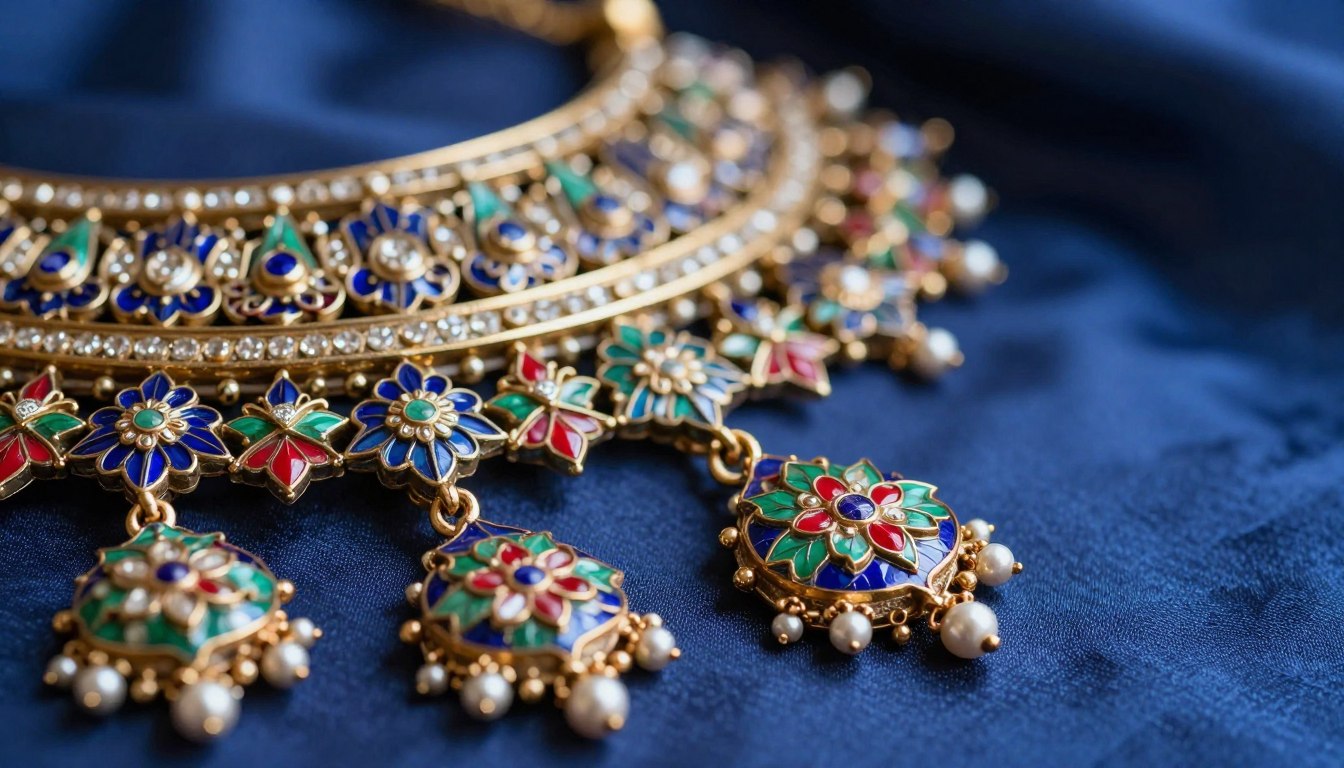
Imagine a piece where centuries-old craft meets modern elegance. This is the world of meenakari art. It transforms precious metals into canvases of vibrant, fired enamel.
True appreciation goes beyond beauty. It requires understanding the craftsmanship. This guide unlocks the knowledge for the discerning professional or enthusiast.
We will explore three essential pillars. First, mastering enamel quality and its luminous finish. Second, deciphering hallmarks to guarantee authenticity. Third, unlocking versatile styling ideas for any occasion.
This knowledge is not just for admiration. It is the key to making informed, valuable additions to any collection. Let’s begin your journey from admirer to expert.
Intro: Color-rich heirlooms with contemporary styling
Meenakari jewelry comes from the Mughal Empire and Jaipur. It turns jewelry into personal art. This craft uses molten glass painted on metal, then fired and polished.
Each piece has a story, thanks to color psychology. Artisans choose colors like sapphire for calm and red for passion. This makes enamel jewelry a way to express oneself.
Originally, it showed wealth in Jaipur jewelry. Now, it blends tradition with modern style. It’s perfect for today’s wardrobe.
Meenakari stands out in a world of cheap accessories. It’s for those who love craftsmanship and history. It’s known for its mix of old and new.
Its appeal is in its versatility:
- Ethnic Elegance: It’s key for traditional outfits at weddings and festivals.
- Global Fusion: A Meenakari piece can make any outfit special.
- Conversation Piece: It starts conversations about culture and art.
Meenakari’s magic is in its journey from palace treasure to personal statement. It shows that the best accessories are those full of color and meaning.
Types: Gold, silver, copper bases; kundan-meena overview
Exploring Meenakari starts with choosing a base: gold, silver, or copper. Each metal changes the piece’s look, feel, and price. The gold vs silver base debate is key for buyers.
Meenakari uses these metals as its canvas. The base affects the enamel colors. Here’s a quick comparison to clarify the core differences.
| Metal Base | Key Characteristics | Typical Use Cases | Aesthetic Feel |
|---|---|---|---|
| Gold | High value, traditional, enhances warm enamel tones. Often 22K or 18K. | Bridal sets, heirloom pieces, high-end statement jewelry. | Opulent, warm, and luxurious. |
| Silver | More affordable, cool tone makes bright enamels stand out. Usually sterling silver. | Contemporary daily wear, cocktail rings, lightweight necklaces. | Modern, versatile, and elegant. |
| Copper | Most economical, provides a rich, warm undertone. Requires protective plating. | Fashion jewelry, experimental designs, bold bangles. | Artisanal, vibrant, and earthy. |
Your choice in the gold vs silver base question shapes the jewelry’s purpose. Gold bases carry heritage and are investment pieces. Silver offers everyday elegance. Copper allows for playful, colorful expression without a high cost.
Meenakari jewelry comes in many forms. Meenakari earrings range from statement jhumkas to delicate studs. Meenakari necklaces and chokers can be intricately designed or minimalist. Bangles and bracelets often feature enamel on the outer or inner surface, creating a secret flash of color with every movement.
The pinnacle of this craft is the kundan meena technique. This is where two legendary Indian jewelry methods unite. Kundan refers to the setting of gemstones, usually in a pure gold foil, on the front. Meenakari is the exquisite enamel work applied to the reverse side of the very same piece.
A single kundan meena piece is a masterpiece of duality. The front displays the regal sparkle of gemstones, while the back reveals a miniature painted landscape in enamel. It represents the height of craftsmanship, showing wearable art from every angle.
Whether you’re drawn to the luxury of gold, the versatility of silver, or the detailed storytelling of kundan meena, understanding these types helps you find a piece that truly resonates with your style.
How it’s made: Enamel firing and what “quality” means
The ‘quality’ in Meenakari is not just a term. It’s the result of a detailed, multi-step firing process. This ancient method turns metal and minerals into stunning, lasting art.
True mastery comes from controlling the fire. Each step builds on the last, needing patience and a sharp eye from the artisan.
The Four Pillars of Creation
Making enamel jewelry follows a strict sequence. Here are the main stages:
- Khaka (The Design): It begins with a detailed pattern, the khaka, on paper. This blueprint guides every step.
- Ghar (The Metal Canvas): The metal base—gold, silver, or copper—is prepared. Artisans create tiny compartments (ghar) by soldering or engraving to hold the enamel.
- Meena (The Enamel Application): Color comes to life here. Artisans paint a paste of powdered glass and minerals into the ghar. Different colors need unique formulas and firing temperatures.
- Firing (The Transformation): The piece goes into a kiln. The heat melts the enamel paste, fusing it to the metal. This firing is often repeated to build depth and shine.
Knowing these steps helps spot quality. High-quality Meenakari shows specific, tangible traits. Use this table to check pieces you see.
| Feature | High-Quality Indicator | Common Flaw to Avoid |
|---|---|---|
| Color Saturation | Luminous, deep, and bubble-free. Colors appear vibrant and consistent. | Dull, pale, or cloudy areas. Visible air bubbles or pits in the surface. |
| Motif Precision | Sharp, clean lines where colors meet. Designs are distinct and unblended. | Fuzzy edges or colors that bleed into one another, muddying the pattern. |
| Surface Finish | Smooth, glass-like texture that is even across the entire piece. | Rough, uneven texture or a wavy surface that catches the light poorly. |
| Durability | The enamel is firmly fused, with no chips, cracks, or lifting from the metal. | Hairline cracks or areas where the enamel seems detached. |
Regional styles add another layer. For example, Bengali Meenakari is famous for its extraordinary depth and three-dimensional effect. This requires even more meticulous layering and firing.
The artisan’s skill is what truly drives value. Their hand controls the kiln’s heat and the brush’s pressure. This human touch transforms the technical process into heirloom-quality enamel jewelry.
Authenticity & hallmarks: BIS, maker stamps, finish checks
The true value of a Meenakari piece is not just in its colors. It’s in its verified authenticity. This makes a beautiful accessory a trustworthy investment and a future heirloom. For the informed buyer, three pillars support this authenticity: official hallmarks, maker identification, and a meticulous visual inspection.
When buying gold Meenakari jewelry in India, the BIS hallmark is key. It’s a must for quality, as mandated by the Bureau of Indian Standards. A genuine BIS mark has several tiny stamps that tell a complete story.
- Purity Mark: Shows the karatage (e.g., 22K916 for 22-karat gold).
- BIS Logo: The official symbol of the certifying body.
- Assay Center Mark: A unique code identifying the independent center that tested the metal.
- Year of Marking: A letter code denoting the year the piece was hallmarked.
- Jeweler’s Identification Mark: The registered logo or stamp of the selling entity.
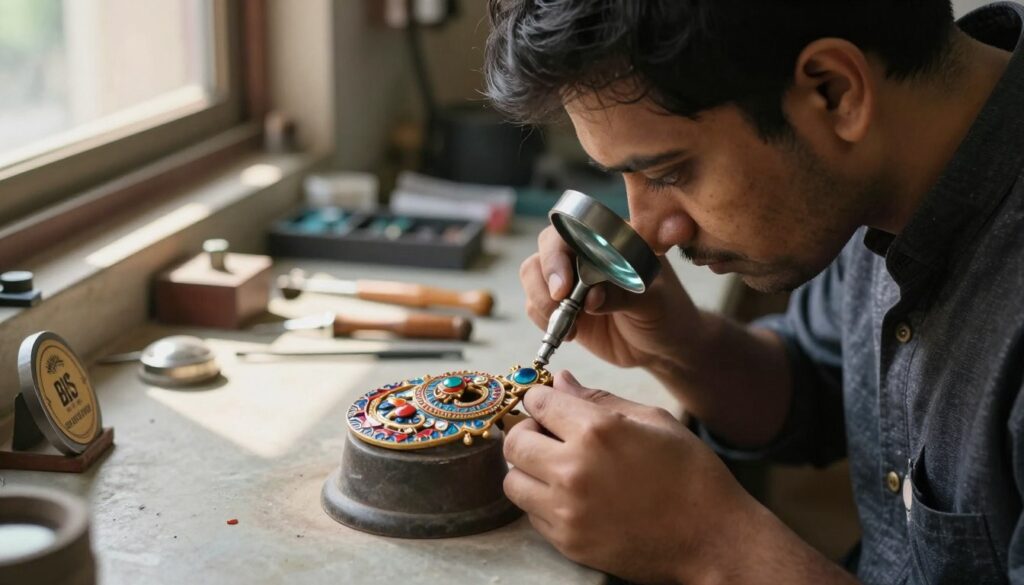
This detailed BIS hallmark system provides a government-backed chain of custody. It certifies the metal’s purity and creates accountability. A respected maker or brand will often have its own distinct stamp or logo. This mark signifies pride in craftsmanship and offers a direct line of provenance. Always ask about the artisan or workshop behind the piece—knowing its origin adds immense intangible value.
Official stamps are important, but your own eyes are the final tool. Perform a thorough finish check. Turn the piece over and examine the reverse side, where the Meenakari work is often applied.
Look for smooth, vitreous enamel with consistent color filling and no visible bubbles or cracks. The metal borders separating the enamel cells (the khat) should be neat, even, and well-defined. Also, inspect the settings for any gemstones or kundan work; they should be secure, with no rough edges or visible glue.
Mastering these checks—understanding hallmarks, recognizing maker marks, and inspecting finish—empowers you to buy with confidence. You move from simply admiring beauty to authentically owning a piece of art.
Price drivers: Metal purity, enamel layers, handwork hours
The price of meenakari jewelry is not random. It’s based on the metal, the skill needed, and the artist’s reputation. Knowing this helps you see the real value and make a smart choice.
A piece has three main cost parts. Each part adds both cost and value.
The main material is a big cost factor. A 22-karat gold piece costs more because of the gold price and its weight. Quality pieces feel heavy because they’re made of solid metal, not just a shell.
Silver is cheaper but the principle is the same. A heavy silver piece is more valuable and lasts longer. Always check the metal type (like 925 Sterling Silver, 22K Gold) and its weight.
2. Craftsmanship Complexity
The art’s value is in its complexity. There are three ways to measure this:
- Number of Enamel Colors: Each color needs a special application and firing. A piece with five colors takes more work than one with two.
- Fineness of Design: Detailed patterns, cloisonné wirework, and smooth colors show a master’s skill. This detail takes a lot of time.
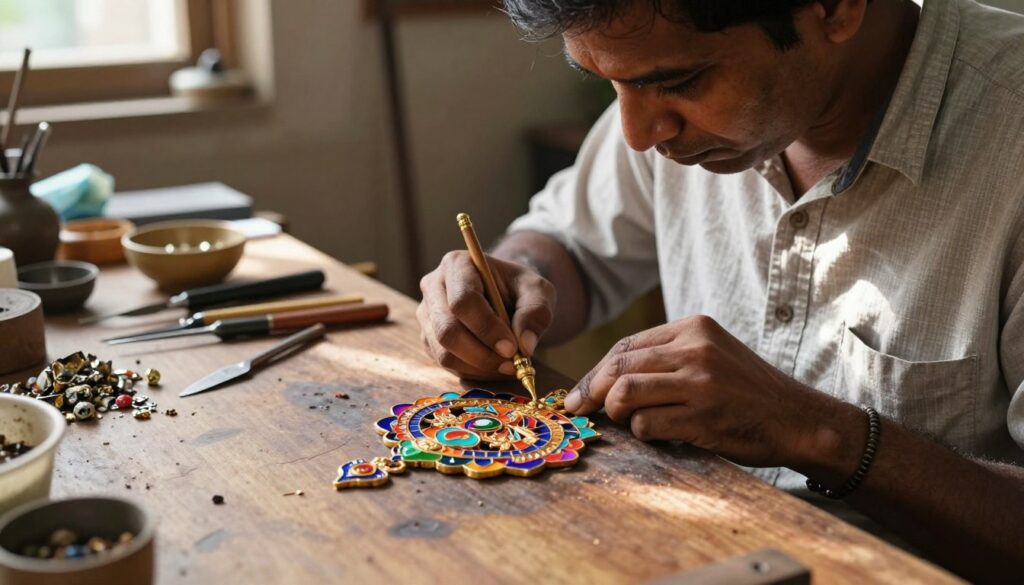
- Handwork Hours: Making a piece involves engraving, applying enamel, and firing. It’s a slow, human process. A single piece can take days or weeks to finish.
The price shows this time and skill.
3. Artisan Provenance and Maker Stamp
Just like a painting, meenakari jewelry from famous makers costs more. A maker’s stamp is not just proof of authenticity. It’s a sign of quality and tradition.
Buying from a famous workshop means investing in a legacy of skill. This ensures quality, new designs, and better enamel. Always ask about the artist or studio.
By looking at metal, craft, and creator, you go from liking a design to seeing its true value. This turns buying into a confident choice of wearable art.
Styling playbook: Workwear, weddings, global cocktail looks
Moving beyond just buying, Meenakari’s true beauty lies in its versatility. It can be used in many ways, from work to big events. This guide helps you use these colorful pieces in your everyday life.
For professional workwear, choose something simple yet elegant. A single piece can add a pop of color without being too much. A delicate meenakari earring or a small necklace can make a tailored outfit stand out.
Match the enamel colors with your outfit’s colors. For example, navy suits look great with deep blue or turquoise. This way, you create a subtle yet stylish look.
At weddings and festive occasions, Meenakari lets you show off. Go for bold necklaces and big earrings. The trick is to find the right balance.
If your outfit is already bold, choose simpler jewelry. For a solid-color outfit, a big, colorful necklace can be stunning. This rule also applies when styling a designer Anarkali suit with jewelry.
The global cocktail look is all about mixing styles. Try a simple cuff with a black dress for a bold look. Geometric pieces look great with modern outfits.
Think of jewelry as art. A modern meenakari earring can change a simple dress. This mix of old and new styles is exciting.
Here are some key tips for any event:
- Create one focal point: Let either the necklace, earrings, or cuff be the star.
- Match enamel to your event’s formality: Muted tones for day, vibrant gems for night.
- Consider the neckline: Chokers complement boat necks, long pendants suit V-necks.
With this guide, Meenakari goes from a special-occasion piece to a daily accessory. Its bright colors add personality to your style every day.
Care & storage: Humidity, perfume, travel packing
Humidity, perfume, and travel can harm your enamel jewelry. But, with the right care, your jewelry can stay beautiful for years. A good care routine keeps the colors bright and the metalwork detailed.
Start by following simple steps every time you wear your Meenakari pieces:
- Apply First, Wear Second: Always put on perfumes, lotions, and hairsprays before your jewelry. These products can dull the enamel’s gloss over time.
- The Gentle Wipe Down: After wearing, use a soft, lint-free cloth to gently wipe the piece. This removes oils, sweat, and any environmental residue before storage.
- Avoid Chemical Baths: Never wear enamel pieces while swimming (chlorine), cleaning (harsh agents), or bathing (soaps). Prolonged moisture is a primary cause of damage.
Smart storage is just as critical as daily care. The goal is to control the environment and prevent physical damage.
Control Humidity: Store your collection in a cool, dry place. For added protection in humid climates, place a small silica gel packet inside your storage box or pouch. This absorbs ambient moisture that can subtly affect the metal and enamel bond.
Prevent Scratches: Never toss pieces loosely into a box. Store each item separately in its own soft fabric pouch or a compartment in a lined jewelry box. This prevents harder stones or metal edges from scratching the delicate enamel surface.
Lay Heavy Items Flat: For statement necklaces or heavy chokers, lay them flat in a drawer instead of hanging them. Hanging can stress the clasp and the setting over time.
Traveling with your enamel jewelry requires a secure and padded approach. Use a hard-sided travel case with individual soft slots. If a dedicated case isn’t available, wrap each piece in a soft cloth or tissue paper before placing it in a small, rigid container like a pill case. This prevents movement and crushing in your luggage.
For extra security during transit, carry your most valuable pieces in your hand luggage. Sudden temperature and pressure changes in the cargo hold are best avoided. With these practices, your enamel treasures will arrive and return home in perfect condition.
Investing a few moments in proper care and storage dramatically extends the life and beauty of your collection. It transforms each piece from a temporary accessory into a protected heirloom, ready for every occasion.
Ethical sourcing: Conflict-free metals, fair pay, recycling
The colors of Meenakari tell a story of art and people. For those who care, buying jewelry is a way to show values. Ethical sourcing makes sure your jewelry has a positive impact.
It connects the rich heritage of Jaipur jewelry to today’s artisans. This section looks at three key parts of ethical sourcing.
Conflict-Free Metals are essential. This means the metals are mined and traded without harming people or causing war.
Good suppliers show where the metals come from. Look for brands that use recycled metals. This helps mining practices worldwide.
Fair Pay and Safe Conditions for karigars (artisans) are a must. Their work, like enamel, needs skill and patience.
Brands that care about ethics pay artisans well and keep them safe. This helps keep old techniques alive for the future.
At J.K. Chandra Jewellers, we honor this legacy with our jewelry. Our commitment shows respect for the artisans.
Recycling Precious Metals is becoming more important. Using recycled metals cuts down on mining’s harm to the environment.
Many shops now recycle old jewelry into new pieces. This mix of sustainability and luxury is appealing.
| Criteria | What to Look For | Why It Matters |
|---|---|---|
| Metal Sourcing | Certificates for conflict-free origin; high use of recycled content. | Prevents funding conflict and reduces environmental degradation from mining. |
| Artisan Welfare | Transparency about wages, workshops; direct partnerships with artisan clusters. | Ensures fair compensation and safe working conditions, preserving craft skills. |
| Environmental Process | Closed-loop water systems for enameling; low-waste production methods. | Minimizes the craft’s ecological footprint, protecting local resources. |
| Community Investment | Brands that support artisan training programs or community initiatives. | Strengthens the entire ecosystem, ensuring the craft’s future vitality. |
Choosing ethically sourced Meenakari is a powerful choice. It turns a beautiful piece into something good.
It supports sustainable heritage and helps artisans. Your jewelry starts conversations about values and vision.
Next time you see Jaipur jewelry, think of its story. Your choice helps write its next chapter.
Buying online: Size/weight, return policies, duties overseas
Buying meenakari jewelry online from an artisan abroad requires careful steps. The internet offers great access, but you need to be smart about it.
First, make sure you know the size of the jewelry. Look for exact measurements in inches or centimeters and weight in grams. Photos with a coin or ruler can help you judge the size.
Then, check the seller’s reputation. Read reviews to see if they are known for accurate products and good service. It’s also important to ask about the artisan’s background. Good sellers will tell you about the piece’s creation.
It’s also key to understand the return and warranty policies. Handcrafted enamel jewelry might be sold as is, but a clear return policy is a sign of a reliable seller. Find out who pays for return shipping.
For buyers in the U.S., don’t forget about import duties. Your meenakari jewelry might face U.S. Customs fees when it arrives. Sellers should tell you about these costs or give you the HS code to look up yourself. This way, you won’t be surprised by extra fees.
Before you buy, follow this quick guide:
- Verify Scale: Check the dimensions, weight, and use reference photos.
- Check Provenance: Ask about the artisan and workshop origins.
- Read the Policy: Know the return rules, restocking fees, and warranties.
- Calculate Totals: Include shipping, insurance, and possible import duties.
With these steps, buying meenakari jewelry online becomes a safe and exciting way to get a beautiful piece of art.
FAQs + links to collections
What is Meenakari jewelry? It’s the art of adding colored enamel to metal. This creates vibrant, detailed pieces.
How is it different from kundan meena? Traditional Meenakari uses enamel on engraved metal. Kundan meena adds this enamel work with uncut gemstones, often in grand bridal sets.
Can you wear it daily? Yes, if it’s high-quality with a smooth, fired enamel finish. It’s durable. But, avoid harsh impacts. Choosing the right affordable fitness gear is as key as picking jewelry that fits your lifestyle.
What does a BIS hallmark guarantee? It certifies the purity of the gold or silver base metal. But, it doesn’t grade the enamel quality. You must check that separately.
How should you clean it? Use a soft, dry cloth. Stay away from chemicals, perfumes, and ultrasonic cleaners to keep the enamel bright.
Your new knowledge helps you shop with confidence. Look at curated collections from trusted artisans like Shreekama. Find pieces that match your style and standards.