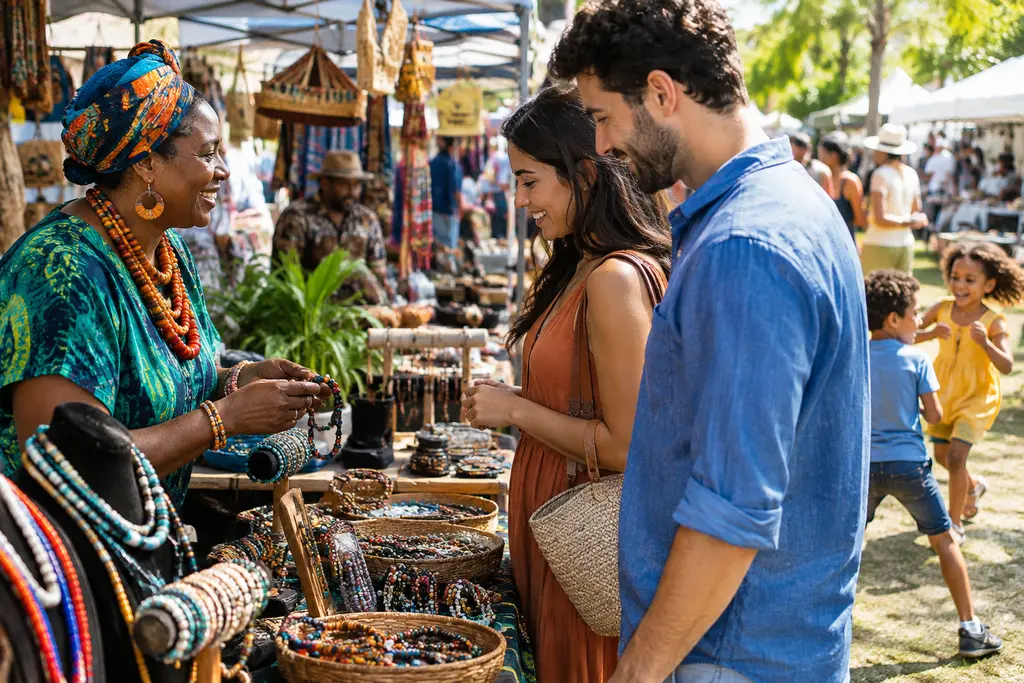
At Atlanta’s LOOP, community handmade commerce is not only a matter of selling objects. It is tied to shared space, public art access, maker visibility, and the trust that forms when buyers encounter creative work in context. LOOP opened on June 6, 2026, in the historic Randall Brothers warehouse at 665 Marietta Street NW, with an inaugural event titled Vulnerable Value that included immersive installations, lighting design, and performances, as reported by ArtsATL.
That opening matters for handmade commerce because it places maker activity inside a wider cultural setting rather than isolating it as retail. The Goat Farm Arts Center operates LOOP, and the research available as of October 31, 2026, places it within a larger Atlanta arts ecosystem of studios, performances, exhibitions, open studios, and public-facing events. For regional craft buyers, this kind of setting can make authorship, process, and local connection easier to read.
What LOOP Shows About Regional Craft
A Warehouse Reworked For Creative Use
LOOP’s physical design is central to its commercial and cultural role. The building retains a large central space for exhibitions, performances, and installations, while 17 artist studios are positioned along the sides. A translucent fabric curtain system allows the central volume to be reconfigured, according to Wallpaper’s architecture report. That combination of open space and studio edges gives the building more than one function: it can host viewing, making, gathering, and market activity without treating those uses as separate worlds.
For handmade sellers, this is a useful model. A market table can show finished work, but it rarely shows the conditions that shaped the work. A studio setting, even when only partly visible, can offer stronger cues: tools, materials, unfinished pieces, scale of production, and the relationship between maker and object. These cues do not prove quality by themselves, but they help buyers ask better questions.
Why Physical Context Changes The Sale
A handmade object often carries information that a buyer cannot judge at first glance. A ceramic vessel may depend on firing knowledge. A textile may reflect a specific fiber choice. A fragrance, print, wood object, or small-batch food item may involve testing, iteration, and personal technique. When these goods appear in a shared arts environment, buyers can connect the product to creative labor rather than reading it as generic merchandise.
This is where community handmade commerce becomes visible. The buyer is not only comparing prices. They are observing whether a market has standards, whether makers are presented respectfully, and whether the site encourages conversation rather than pressure. That matters because trust in handmade commerce often grows through repeat contact, not a single claim on a label.
Community Handmade Commerce Needs Shared Space
Markets As Cultural Meetings, Not Only Sales Events
As of October 31, 2026, research notes list the Indie Craft Winter Experience at LOOP as scheduled for Saturday, December 5, 2026, and Sunday, December 6, 2026. The event is described as featuring more than 100 independent makers, vintage curators, creative small businesses, public workshops, and local food vendors. Its listed categories include jewelry, ceramics, printmaking, fiber, leather, woodwork, fragrance, apothecary goods, vintage, and small-batch food.
Those categories matter because they sit at different points between utility, art, fashion, and gift culture. A buyer may arrive looking for a gift and leave with a stronger understanding of regional craft practice. A maker may gain not only a sale, but direct feedback about function, packaging, care instructions, and the kind of story buyers need before they feel confident. For community handmade commerce, this two-way exchange is often more useful than a purely promotional display.
Originality And Craftsmanship As Selection Signals
The research notes say the Indie Craft market gives priority to craftsmanship and originality rather than scale or trend. That selection principle is significant, though it should be read carefully. A curated market is not automatically fair, inclusive, or successful. Still, clear selection values can help buyers understand why certain makers are present and can help artisans avoid being judged only by production volume.
For sellers, this suggests a practical lesson: trust can be built before a buyer reaches the table. Event standards, maker descriptions, workshop formats, and visible regional participation all act as signals. Shimply has considered similar issues in its analysis of community trust in handmade markets, especially where buyers need clearer origin disclosure and stronger seller identity cues.
Studios, Markets, And The Trust Question
What Buyers Can Reasonably Look For
Buyers should be cautious about broad claims such as “authentic,” “local,” or “handmade” unless the market or seller explains what those terms mean. At a place like LOOP, a better trust signal is specific information: who made the object, what materials were used, whether the item is one-of-a-kind or small batch, how it should be cared for, and whether variation is part of the process.
Community handmade commerce works best when those signals are easy to find. A ceramics seller can explain clay body, glaze care, and food-use limits where relevant. A fiber artist can identify material, technique, and washing guidance. A printmaker can clarify edition size, printing method, and paper type. A woodworker can describe finish and maintenance. These details support artistic integrity because they respect the object as made work, not just inventory.
- Clear maker identity and role in the work.
- Material and process notes that avoid exaggerated claims.
- Care instructions that help the buyer preserve the object.
- Respectful cultural context where tradition or heritage is referenced.
- Market standards that explain why participants were selected.
Why Community Does Not Replace Evidence
Community can build trust, but it should not replace proof. A popular venue, a strong crowd, or a well-designed event does not verify every claim made by every seller. Buyers still need specific information, and sellers still need to avoid unsupported statements about health, sustainability, origin, or cultural meaning.
This caution is especially relevant across adjacent fields such as costume culture, fantasy fashion, and wearable art, where inspiration, identity, and commerce often meet. For more insights into these intersections, readers might explore cultural craft coverage at fairytale fashion. The shared lesson is restraint: creative presentation should not flatten cultural context or imply permissions, histories, or guarantees that have not been shown.
Reading LOOP Through Atlanta’s Maker Economy

The Goat Farm Context
The research notes describe the Goat Farm Arts Center as a 12-acre West Midtown campus that, as of Fall 2026, hosts more than 450 artists and performers across its studios. They also state that Goat Farm produces more than 150 exhibitions and performances annually, spanning theatre, concert, dance, experimental arts, open studios, and community events. Those figures should be understood as context for LOOP rather than as proof that any individual sale is more trustworthy.
What they do show is scale of contact. A campus with many studios and recurring public events can create repeated points of engagement between artists, neighbors, collectors, casual buyers, performers, and small businesses. In handmade commerce, repetition matters. A buyer who sees a maker across several settings may better understand the maker’s practice, pricing, and consistency.
Expansion And Ground-Floor Visibility
The research notes also describe Goat Farm’s expansion as including mixed-use residential and studio spaces, with phase one adding 209 dwelling units, more than 50 studios, and about 60,000 square feet of studio space. The notes say that studio space was about 98% pre-leased before full completion. They also describe ground-floor studios as a way to encourage spontaneous engagement between artists and the broader public.
For regional craft, ground-floor visibility can be meaningful. It can reduce the distance between making and buying, and it can help visitors understand that art commerce is part of daily urban life rather than a temporary pop-up. Yet visibility brings responsibility. Artists should not be treated as permanent entertainment for passersby, and buyer access should respect studio boundaries, privacy, and working time.
Atlanta’s LOOP And Community Handmade Commerce
Practical Lessons For Sellers And Buyers
Atlanta’s LOOP suggests that community handmade commerce is strongest when space, standards, and conversation work together. A flexible art center can host installations and performances, but it can also support handmade markets by giving objects a social and cultural setting. That setting helps buyers read value through process, not only price.
For sellers, the lesson is to bring evidence into the buyer relationship. A table display should be supported by material notes, process language, care information, and a clear account of the maker’s role. For market organizers, the lesson is to state selection values plainly and make room for buyer education. For buyers, the lesson is to ask respectful, specific questions and to value the labor behind an object without expecting every maker to perform their whole practice on demand.
LOOP’s early public life, including its June 2026 opening and its scheduled December 2026 craft market use, shows how one Atlanta site can connect art presentation with maker commerce. The most credible reading is cautious but hopeful: shared space can strengthen handmade trust when it protects artists, informs buyers, and treats regional craft as cultural work rather than decorative stock.