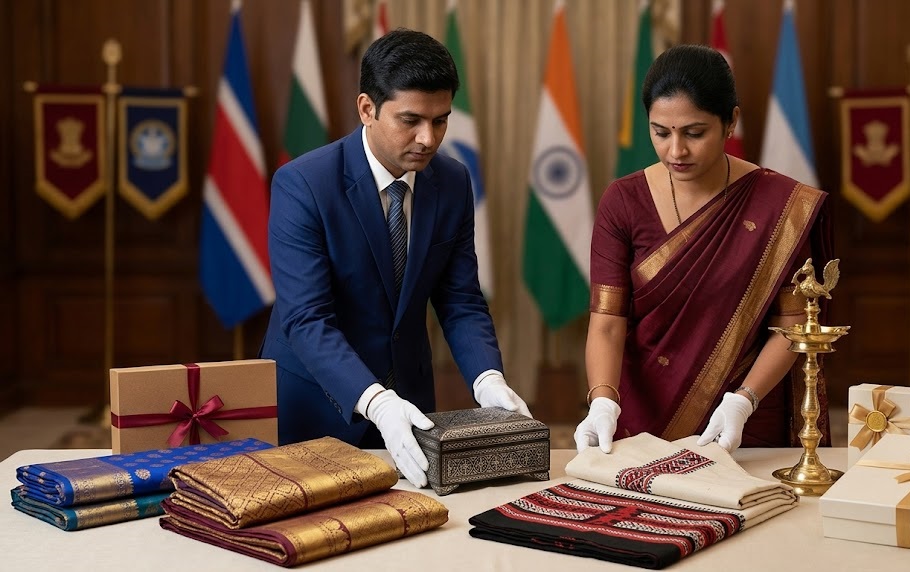
When Indian crafts appear in diplomatic gifting, they stop being only beautiful objects. They become cultural signals, soft-power tools, and proof that handmade products can carry stories bigger than price, material, or decoration. That was clear during Prime Minister Narendra Modi’s June 27–29, 2026 visit to Seychelles, where Indian textiles and handicrafts were presented to the island nation’s leadership during a trip tied to the 50th anniversary of Seychelles’ Independence and 50 years of India-Seychelles diplomatic relations. For handmade sellers, the lesson is not to copy diplomatic gifts. It is to study how Kanchivaram silk, Toda embroidery, Maheshwari silk, Bidriware, Moradabadi brassware, and regional art were positioned: each object had place, provenance, symbolism, material identity, and a recipient-specific story.
Why Diplomatic Gifts Make Handmade Objects More Valuable
A diplomatic gift is never just a present. It is selected to say something without a long speech. It can express respect, shared history, regional identity, environmental meaning, or cultural depth. That is why handmade objects often work better than generic luxury products in state gifting. They carry human labor, origin, and craft memory in a way that mass-produced goods rarely can.
During the Seychelles visit, the official context mattered. The Press Information Bureau reported that Prime Minister Narendra Modi attended the 50th Anniversary celebrations of the Independence of Seychelles as Guest of Honour at the invitation of President Dr. Patrick Herminie. The same official update noted that the celebrations coincided with 50 years of India-Seychelles diplomatic ties, giving the visit a symbolic frame beyond routine protocol. The India-Seychelles diplomatic milestone made the gift choices more meaningful because they were placed inside a relationship of history, maritime cooperation, and cultural connection.
For handmade sellers, this is the first lesson: context raises value. A Kanchivaram silk fabric is already a prestigious textile. A Toda embroidered shawl already has regional identity. A Bidriware box already carries metalcraft tradition. Yet their value grows when the seller explains why the object suits a specific occasion, recipient, or cultural moment.
That principle applies to everyday gifting too. A buyer choosing a wedding gift, corporate gift, housewarming piece, festival set, or international parcel wants more than an attractive object. They want confidence that the gift will feel appropriate and memorable. Shimply’s guide to Indian craft gift sets makes the same point for practical buyers: the strongest craft gifts balance cultural value with usability, packaging, and shipping clarity.
What Kanchivaram Silk Teaches About Place And Prestige
Kanchivaram silk carries prestige because it is tied to place, technique, ceremony, and long-standing cultural recognition. Originating from Kanchipuram in Tamil Nadu, it is associated with heavy silk, rich borders, luminous color, and wedding or ceremonial use. A seller does not need to exaggerate its importance. The craft already has a strong identity when described accurately.
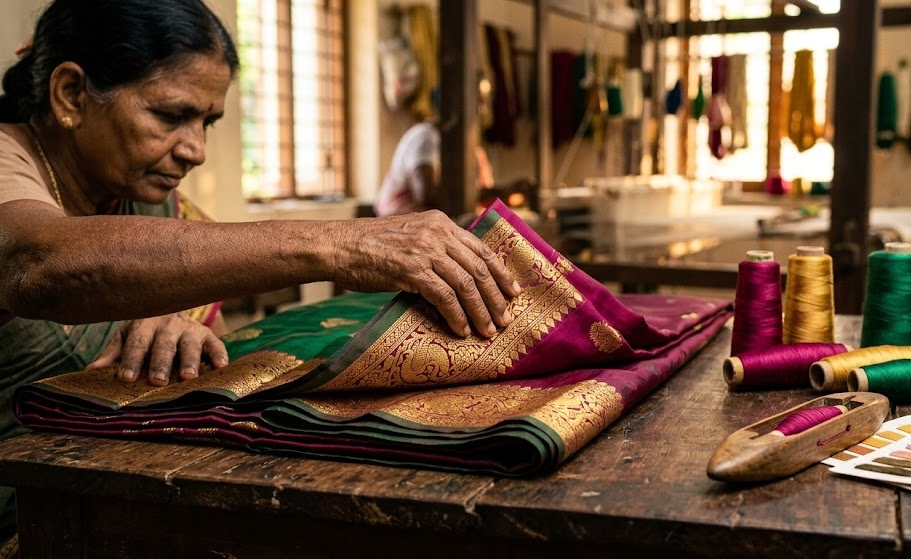
In the Seychelles gifting coverage, Kanchivaram silk appeared alongside other regional crafts as part of a curated set of Indian cultural objects. Rediff reported that Prime Minister Modi’s gifts included Kanchivaram silk, Maheshwari silk, Toda embroidered shawls, and Bidriware, among other handmade pieces. The Seychelles craft gift report also identified President Patrick Herminie, First Lady Veronique Herminie, and Vice President Sebastien Pillay among the recipient context.
For handmade sellers, the takeaway is that place should not be treated as a decorative label. “Kanchivaram” means more than “silk from India.” It signals a weaving region, a buyer expectation, and a premium gift category. A product page for a textile gift should explain origin, fiber, weave character, weight, care, occasion, and whether the item is suitable for ceremonial wear, display, gifting, or collection.
The same rule applies beyond Kanchivaram. A seller offering Banarasi brocade, Chanderi, Maheshwari, Pochampally Ikat, Kullu shawls, Kutch embroidery, or Toda embroidery should make the region legible. Buyers trust products more when they understand where the craft comes from and why the place matters.
What Toda Embroidery Teaches About Cultural Specificity
Toda embroidery offers a different lesson. It is not simply a textile style; it belongs to the Toda community of the Nilgiris in Tamil Nadu. Its visual identity is strongly associated with red and black geometric embroidery on white fabric, and its cultural meaning is tied to a specific community and region. That specificity makes it powerful, but it also demands care.
When a Toda embroidered shawl appears in a diplomatic gifting context, the object signals India’s cultural diversity rather than a single national design language. It reminds buyers and sellers that “Indian craft” is not one aesthetic. It is a network of regional, community-based, material, and ritual traditions.
This matters for product storytelling. A handmade seller should avoid flattening a community-linked craft into vague words such as “tribal,” “ethnic,” or “boho” without explanation. Those terms may attract clicks, but they often weaken trust. A better product description identifies the craft, region, material, technique, and intended use without pretending to speak for the community beyond verifiable facts.
India’s handicraft sector is large enough to require this care. The Press Information Bureau states that India has 318 GI-tagged handicraft products and around 455 formally classified craft categories, with handicrafts supporting artisans across rural and semi-urban regions. That Indian handicraft sector context shows why sellers need precision. The country’s craft diversity is a commercial strength only when it is described responsibly.
For buyers, Toda embroidery also teaches a practical authenticity lesson. Look for clear origin, material, technique, artisan or cooperative information, care instructions, and realistic pricing. If a product uses a recognizable community-linked craft language but gives no source details, that should raise questions.
What Bidriware Teaches About Material Story
Bidriware teaches handmade sellers how a product can carry value through material process. Originating in Bidar, Karnataka, Bidriware is known for its dark metal surface and contrasting silver inlay. Its appeal is not only visual. It comes from technique, patience, and the transformation of material into pattern.
In the Seychelles gifting coverage, First Lady Veronique Herminie was reported to have received a Maheshwari silk stole and a Bidriware box. That pairing is useful for sellers to study because it combines textile softness with metalcraft permanence. It also shows how a gift set can balance utility and cultural display.
Bidriware boxes, trays, vases, and decor objects work well in premium gifting because they feel formal without being generic. They are practical enough to sit on a desk, shelf, or table, yet decorative enough to carry ceremonial weight. Handmade sellers can learn from that balance. A premium gift should not feel fragile without purpose, nor should it feel useful but visually plain.
| Craft Gift | Origin Signal | Seller Lesson | Buyer Trust Detail |
|---|---|---|---|
| Kanchivaram Silk | Kanchipuram, Tamil Nadu | Place creates prestige | Mention weave, silk quality, care |
| Toda Shawl | Nilgiris, Tamil Nadu | Community-linked craft needs accuracy | Explain technique without vague labels |
| Bidriware Box | Bidar, Karnataka | Material process adds value | Describe metal, inlay, finish, care |
| Maheshwari Silk Stole | Maheshwar, Madhya Pradesh | Lightweight luxury can be giftable | Clarify fiber blend and drape |
| Moradabadi Brassware | Moradabad, Uttar Pradesh | Symbolism can support gifting | Explain form, finish, and use |
For sellers, the table points to a simple rule: a premium handmade gift needs more than a product name. It needs the reason behind the name.
What Moradabadi Brassware Teaches About Symbolism
The Moradabadi brass tortoise reportedly presented to President Patrick Herminie shows how symbolism can make a craft gift feel recipient-specific. Moradabad in Uttar Pradesh has long been known for brassware, and the tortoise form carried additional meaning in the Seychelles context because of the Aldabra giant tortoise’s association with the country’s natural heritage.
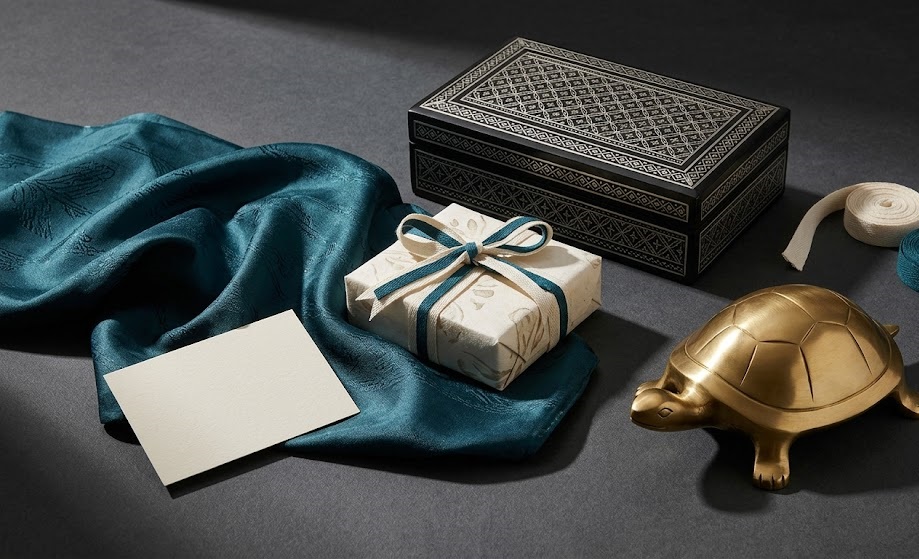
That kind of matching is powerful. It turns a craft object into a conversation between two places. The object still represents Indian brasswork, but it also acknowledges something meaningful to the recipient.
Handmade sellers can apply this principle to gift curation. A buyer choosing a housewarming gift may appreciate a brass diya, lamp, bowl, or tray because it signals warmth, prosperity, and domestic use. A corporate buyer may prefer a desk object or box because it feels formal and display-ready. A wedding buyer may choose textiles or metalware because they carry a sense of permanence.
The India Brand Equity Foundation notes that demand for handmade decor accessories and gifting is helping propel India’s handicrafts market, which reached US$4.56 billion in 2024 and is projected to reach US$8.19 billion by 2033. Its Indian handicrafts market report also lists woodware, embroidered and crocheted goods, art metal ware, hand-printed textiles, scarves, zari goods, and imitation jewellery among major handmade categories.
That market context supports the diplomatic-gift lesson. Buyers are not only buying objects. They are buying meaning, suitability, and confidence. Sellers who explain symbolism clearly can help buyers make better choices.
How Handmade Sellers Can Use Diplomatic Gift Logic Without Overclaiming
Diplomatic gifting can inspire handmade sellers, but it should not encourage inflated claims. A seller should not imply that a product is equal to a state gift, endorsed by a government, or connected to a diplomatic event unless that is factually true. The smarter approach is to borrow the logic, not the status.
That logic has five parts. The product should have a clear origin. It should have a material story. It should suit an occasion. It should be packaged with care. It should explain meaning without turning into fantasy.
Product descriptions should be specific. Instead of “luxury Indian traditional gift,” a seller can write: “Handcrafted Bidri-style metal box inspired by Bidar’s inlay tradition, suitable for desk storage, festive gifting, or keepsake presentation.” Instead of “ethnic shawl,” a seller can describe textile origin, technique, fiber, color, and care. Instead of “royal silk,” a seller can explain whether the product is Kanchivaram, Maheshwari, Banarasi, Chanderi, or another verified textile type.
This is especially important for online selling. Buyers cannot touch the fabric or inspect the inlay. They rely on photographs, descriptions, seller transparency, reviews, packaging details, and return policies. If the story is vague, the product feels risky. If the story is clear, the craft feels more valuable.
The Ministry of Textiles reported that India’s textile exports, including handicrafts, increased from ₹3,09,859.3 crore in FY 2024–25 to ₹3,16,334.9 crore in FY 2025–26, while handicrafts excluding handmade carpets rose 6.1% from ₹14,945.5 crore to ₹15,855.1 crore. That textile export growth shows that value-added craft categories are not only cultural objects; they are part of a competitive export story.
Why Diplomatic Craft Gifts Should Change How Sellers Build Product Pages
The main lesson from Kanchivaram silk, Toda shawls, Bidriware, Maheshwari silk, and Moradabadi brassware is that handmade gifts become stronger when their story is structured. Diplomatic gifts do this naturally because every object is chosen for a reason. Handmade sellers should do the same on product pages.
A strong product page should tell buyers what the item is, where it comes from, how it is made, what material it uses, how it should be cared for, what occasion it suits, and what makes it different from a mass-made substitute. It should avoid vague claims, fake heritage language, and unsupported luxury wording.
For buyers, the takeaway is just as useful. A meaningful Indian craft gift should be traceable, occasion-appropriate, and honest about its materials. A Kanchivaram textile should not be treated like any silk. A Toda shawl should not be described with lazy aesthetic labels. A Bidriware box should not be valued only by shine; the inlay technique and Bidar origin matter. A brass gift should explain form and symbolism, not only weight.
When Indian crafts become diplomatic gifts, they show the standard handmade sellers should aim for: not inflated prestige, but careful selection, clear origin, and meaningful presentation. The best handmade product pages can do the same work at a smaller scale. They can help a buyer understand why this object, from this place, made this way, belongs in this gift moment.