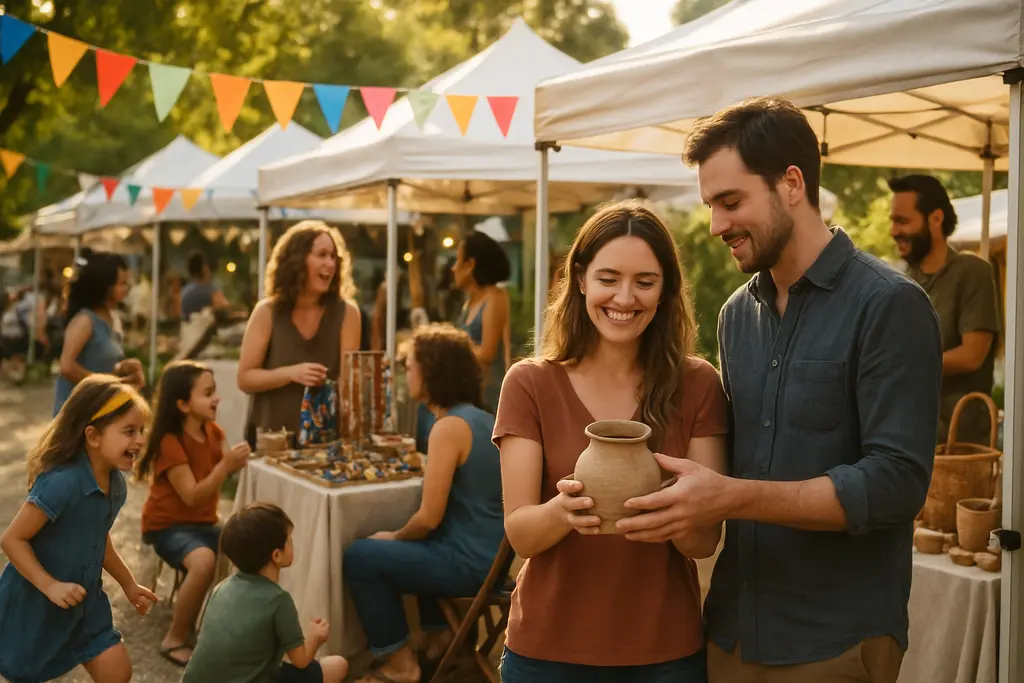
Handmade market trust is not built by product labels alone. At the First Saturday Arts Market in Houston Heights, the trust question begins with structure: who is allowed to sell, how often the market appears, whether the work is original, and whether buyers can meet makers face to face. As of September 2026, the market’s own press materials describe a monthly event with about 40 visual artists selling original handmade work, including painting, sculpture, jewelry, glass, and related art forms, with applicants reviewed through an artist-juried process by First Saturday Arts Market press materials.
How Handmade Market Trust Works in Houston Heights
Houston Heights gives this market a neighborhood frame rather than only a retail frame. The market operates monthly from September through May, on the first Saturday from 11 AM to 6 PM, with free entry and a rain date on the Saturday after the first. That steady pattern matters because trust in a handmade setting is partly social memory. Buyers learn that the event returns. Artists learn that the format is not improvised from month to month. Neighbors learn that original work is part of the public rhythm of the area.
This does not mean every purchase is automatically more ethical, more local, or more culturally grounded. A cautious reading is better. The market format gives buyers more opportunities to ask questions, inspect materials, compare an artist’s body of work, and understand variation. Those are trust conditions, not guarantees. In handmade commerce, the difference matters.
Why Selection and Schedule Create Confidence
Handmade Market Trust Starts With Selection
The artist-juried element is one of the clearest credibility signals in the available information. Juried selection does not prove quality in every buyer’s personal sense, and it does not replace direct conversation with the artist. It does, however, tell the public that participation is not simply open vending. For buyers concerned about mass-produced goods being presented as handmade, that distinction is meaningful.
This is handmade market trust in practical form: the market reduces uncertainty before the buyer reaches a booth. If a shopper sees a handmade necklace, a glass object, or a painting, the event’s selection process gives some reason to believe the work belongs in an original-art setting. The buyer still has to ask about materials, editions, care, and process, but the market has already done part of the filtering.
The Schedule Becomes a Public Promise
The monthly schedule is another trust signal. A recurring event allows artists to build recognition through repetition. A buyer who hesitates in October may return in November after thinking about a work, checking the artist’s information, or comparing prices. This longer rhythm helps handmade purchases feel less pressured than one-time pop-ups.
Free admission also matters. It lowers the barrier to browsing and conversation, which can support education as much as sales. In a handmade market, a visitor may first learn how fused glass differs from cast glass, why a jeweler uses one metal over another, or how an artist prices original work. Those exchanges are not decorative extras. They are part of how trust is formed in person.
What Houston Maker Surveys Suggest
In-Person Sales Still Matter
The Houston maker data in the supplied research points to the continuing weight of physical markets. In a fall 2021 and winter 2022 survey of 107 Houston makers, 65% of artisans said they sold most goods in weekly in-person markets, while 35% said they primarily used online or social media channels. That split does not dismiss online commerce. It does suggest that, for many Houston makers in that sample, in-person selling remained central to how buyers evaluate work and how sellers maintain relationships.
A separate Houston-region maker survey cited in the research included 78 makers and entrepreneurs. In that sample, 67.2% agreed that the region is a good place to start a creative business, while 56.9% agreed that their target customers are local to where they live. The numbers are useful because they connect creative enterprise to place. Trust is not only a payment issue. It is tied to neighborhood recognition, repeat interaction, and the belief that local buyers understand local makers.
Community Feeling Is Not the Same as Support
The same body of Houston research also calls for restraint. More than 80% of makers in the 107-person survey agreed or strongly agreed that Houston is a good place to start a creative business, but only around half agreed that they felt connected to a creative community or had sufficient resources and support. That gap is worth taking seriously. A city can feel promising for starting a creative business while still leaving makers unevenly supported after launch.
Public arts and cultural events appear to help, based on the Houston cultural district data included in the research notes. In that survey, 53% of vendors strongly agreed that they felt more connected to their community after participating in public art events, markets, or cultural festivals. The same research notes reported that 80% said those events provided exposure or increased chances for future professional opportunities. Vendors also reported average sales of about US$1,100 per event, with most sales between US$600 and US$2,400. Those figures suggest that community connection and economic return can overlap, though the results should not be treated as a promise for every maker or every market day.
How Buyers Read Authenticity at a Market
Conversation as Evidence
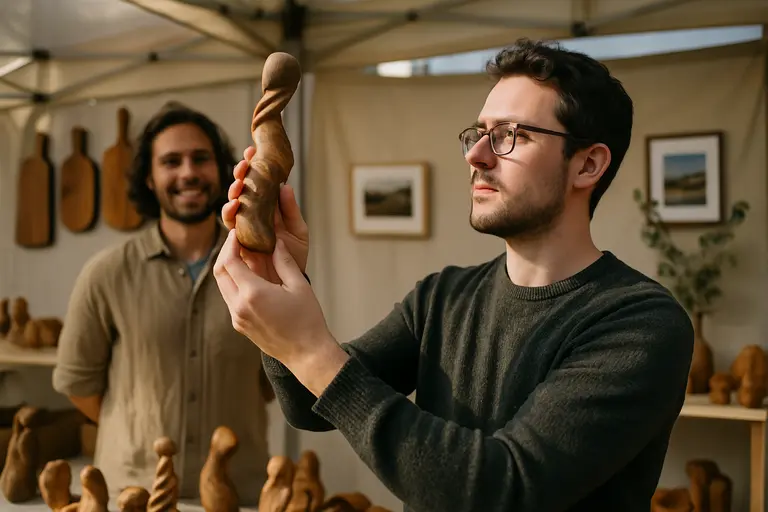
Handmade buyers often seek evidence that cannot be reduced to a tag. They may ask where a piece was made, whether it is one of a kind, how the material behaves, whether repairs are possible, or whether the artist accepts commissions. In-person markets give those questions a human setting. The answer may be technical, personal, cultural, or practical, depending on the work.
This matters for artistic integrity. A craft object is not only an item for sale. It can carry skill, training, regional influence, family practice, material knowledge, and aesthetic decisions. Sellers should not be pushed to perform identity or reveal private details to prove authenticity. At the same time, buyers deserve clear information about process and origin. A respectful market culture protects both sides.
Online Signals Still Shape Offline Expectations
The supplied ecommerce research notes also point to a wider trust problem. In a 2026 consumer survey of 1,295 US consumers, 96% were concerned about vendor legitimacy when dealing with unfamiliar sites, and 82% were more likely to buy where a seller had third-party verified trust badges. Those figures come from online commerce, but the underlying behavior is relevant to handmade markets. Buyers look for signals before they commit.
For an in-person arts market, the signals are different: juried participation, visible maker presence, consistent event information, clear pricing, readable artist statements, material labels, and follow-up contact details. Sellers who also sell online can connect those signals across channels. Shimply has examined related questions in its coverage of buyer-trust questions after marketplace updates, where authenticity becomes harder to judge when handmade goods are mixed with less transparent listings.
There is also a broader cultural context. AP News reported that young people have been embracing hands-on activities such as blacksmithing, needlepoint, and other so-called grandma hobbies, connecting the shift to interest in analog practice and craft skills reported by AP News. That does not prove why any specific Houston shopper buys art. It does support a careful reading that handmade markets may benefit when buyers value longevity, story, and visible human effort.
What Sellers Can Make Visible Without Overclaiming
For makers, the strongest trust signals are often specific rather than grand. A seller does not need to claim that every object is timeless, sustainable, or culturally rare. Stronger claims are narrower and easier to support: the material used, the technique applied, whether the item is original or reproduced, whether the work is made by the booth artist, how to care for it, and how variation appears across handmade pieces.
- State whether the work is original, limited, made to order, or part of a repeatable design.
- Explain materials in plain language, especially for jewelry, ceramics, textiles, glass, and mixed media.
- Offer care notes that help the buyer preserve the object after purchase.
- Use price cards and artist information that make questions easier, not harder.
- Keep cultural references precise and respectful, especially where techniques or motifs come from named communities.
These steps are not substitutes for fair pricing, safe display, or respectful customer service. They are the visible surface of a deeper practice: treating the buyer as someone capable of understanding handmade work, and treating the maker’s labor as something that should not be blurred into generic craft language.
For readers interested in how handmade aesthetics connect with costume, fantasy fashion, and visual culture, the website Fairytale Fashion within the same network offers a related point of reference. The connection is useful because trust questions often travel across categories: who made the object, what traditions or influences are being referenced, and how clearly the creator explains the work.
First Saturday Arts Market and Handmade Market Trust
The First Saturday Arts Market example is valuable because it keeps trust grounded in ordinary structures: a recurring schedule, free public access, artist-juried selection, and a manageable group of about 40 visual artists. None of these elements should be overstated. They do not remove every risk from handmade buying, and they do not prove that all makers experience Houston’s creative economy in the same way.
Still, the available research supports a clear reading. Handmade market trust grows when buyers can see the maker, return to the same setting, ask informed questions, and encounter selection standards that are visible before purchase. For Houston Heights, that makes the market more than a sales row. It functions as a recurring public test of credibility between artists, neighbors, and collectors.