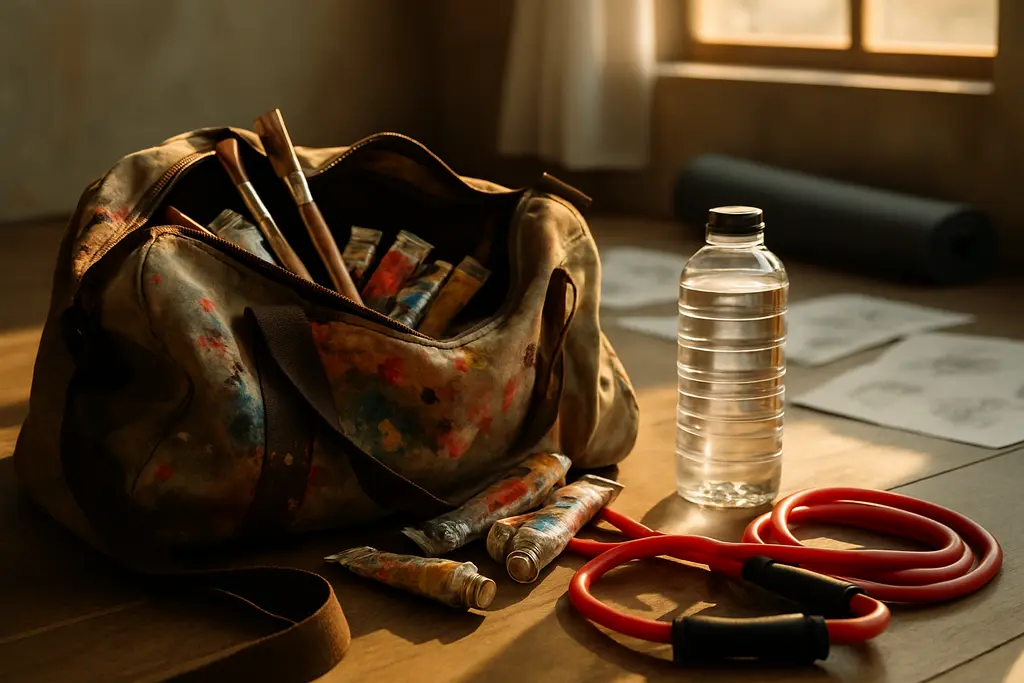
Fitness Gear For Creatives should do more than look attractive beside a studio wall, a sewing table, a print bench, or a home easel. The strongest tools respect the body as part of creative practice: hands that cut, backs that bend over worktables, feet that stand through markets, and minds that benefit from routines with less friction. As of October 20, 2026, the most useful equipment examples sit at the meeting point of function, restraint, and visual coherence. A sculptural treadmill, a screenless wearable, or a foldable machine can support movement, but only if the maker or buyer understands what the object can and cannot prove.
For handmade sellers, designers, and studio-based artists, the question is not whether exercise gear can be beautiful. It can. The harder question is whether a product earns trust through clear materials, realistic claims, safe use, and context. That is where art-aware fitness choices become closer to good craft commerce: the object must be useful, legible, and honest.
Why Fitness Gear For Creatives Needs Context
Fitness Gear For Creatives Starts With Use
A creative person may not need the same setup as someone training in a commercial gym. A ceramicist standing for long hours, a textile artist lifting bolts of fabric, a jeweller leaning over small tools, or a festival seller loading inventory may need recovery, mobility, and strain reduction before high-intensity performance. That distinction changes what counts as essential gear.
Useful tools often start simply: a supportive mat, resistance bands, a stable bench, adjustable dumbbells, walking shoes, a foam roller, and lighting that makes a room feel inviting without turning it into a showroom. More advanced products can be worth considering, but the baseline should be repeatable movement rather than spectacle. Shimply has covered this practical strain-reduction angle in craft festival fitness tools, where carts, seating, canopy weights, and mats matter because art days place real demands on the body.
Respecting Studio Space
Studio space is rarely neutral. It may hold works in progress, drying racks, costume materials, musical gear, or handmade inventory. Large equipment can interfere with workflow if it is hard to move, loud, visually intrusive, or unsafe around delicate objects. This is why small-footprint and furniture-like equipment gained attention in 2026 research notes, including home-fitness concepts that fold, sit within interiors, or use light as part of the exercise experience. Those ideas are promising as design studies, but buyers should still ask basic questions: how much floor space is required, how stable is the tool, and what maintenance does it need?
Design-Led Equipment Without Overclaiming
Design Is Not A Safety Claim
Several 2026 examples showed how fitness equipment has borrowed from furniture, product design, and fashion. PENT presented its Cardio Collection at Milan’s Salone del Mobile in 2026, including sculptural machines such as the IRENA Curve treadmill and JOANA Reformer; the research notes state that JOANA Reformer received a Red Dot Design Award 2026. Technogym also introduced a Sandstone range with natural, tactile finishes and maple furniture-style elements intended to sit more quietly inside modern interiors. These products matter because they show that exercise tools are being judged partly as designed objects.
That does not mean visual design replaces safety, accessibility, or instruction. A curved treadmill may look refined, a reformer may read as furniture, and a maple finish may soften a room, but buyers still need equipment ratings, setup guidance, return policies, repair routes, and realistic training advice. For creators selling handmade accessories around fitness culture, the same principle applies. A hand-dyed strap, carved storage rack, or woven mat carrier should describe materials, load limits where relevant, care needs, and intended use without implying medical outcomes.
Fashion, Wearables, And Identity
In March 2026, Whoop released Project Terrain with designer Samuel Ross, according to the research notes. The line included performance gear such as training shorts, technical outerwear, and an SR_A-branded Whoop band. That pairing is useful for creative-commerce analysis because it shows how fitness gear can act as identity object as well as training tool. Wearable technology, streetwear codes, and performance clothing can carry aesthetic meaning, but sellers should avoid treating affiliation, style, or scarcity as proof of better health results.
For artists and makers, this is also a reminder to respect cultural signals. Streetwear references, rave styling, cosplay-adjacent costume forms, and studio uniforms all carry context. Responsible product writing should credit inspiration clearly, avoid copying living artists’ signatures for commercial deception, and steer away from unlicensed character or celebrity likeness use.
Wearables, AI, And Creative Workflows
Fitness Gear For Creatives And Wearable Data
Wearables can help creative workers notice patterns in exertion, rest, and recovery, but the data should be read with caution. In early May 2026, Google launched the Fitbit Air, described by Engadget as a screenless wearable that was 25% smaller than the Fitbit Luxe and 50% smaller than the Inspire 3, with auto-detection for common high-heart-rate workouts such as running, rowing, and walking Engadget report. For a maker who wants fewer visual interruptions during studio time, a screenless device may be appealing because it reduces the temptation to keep checking a display.
The evidence around AI injury tools is also developing. An April 2026 scoping review reported that AI-based injury prediction tools in sports could reduce injury risk by 23% to 42%, depending on methodology, and that these tools may combine data such as heart rate variability, biomechanics, external loads, and psychological factors scoping review. That is meaningful, but it is not a blank promise for every home user or artist. Predictive systems depend on data quality, population fit, interpretation, and follow-up. A wearable can support awareness; it should not be treated as a clinician, coach, or substitute for pain-related care.
What Data Can And Cannot Do
For creative routines, wearable data is best used for gentle pattern recognition. Did long market days coincide with poorer sleep? Did heavy studio lifting follow several low-recovery days? Does rowing feel better than running during periods of wrist-heavy craft work? These questions can help people adjust habits without turning every bodily signal into a productivity score.
That restraint matters for community trust. Creators are already surrounded by metrics: views, saves, conversion rates, shipping times, and audience comments. Fitness data should not become another pressure system. If gear helps an artist preserve energy, recover from long sessions, or protect consistency, it has value. If it fuels anxiety or overtraining, the design has failed the person using it.
Small-Space Gear For Studios And Home Gyms
Modular Tools And Honest Trade-Offs
Space-saving equipment was another clear theme in the 2026 research notes. FitTransformer introduced an interchangeable Power Core Fitness System at CES on January 8, 2026, using a modular base engine intended to work with different frames, including strength and rowing formats. REP Fitness launched the Strive Air Bike featuring VPR on June 30, 2026, with a patent-pending fan and angle-adjustable blades offering eight resistance levels without electric power. These details point to two different priorities: modularity for space and mechanical adjustability for training range.
For studio workers, both approaches have appeal. A modular system can reduce the number of separate machines in a room. A non-electric air bike can be placed where outlets are scarce, though noise, footprint, and intensity still need assessment. The sensible buying path is to map the room before buying anything. Measure clearance. Check whether equipment can be stored without blocking exits or damaging art. Consider noise if the space shares walls with neighbors, family, or other makers.
Mirrors, Screens, And Visual Fatigue
The smart fitness mirror category also appeared in the research notes, with the market valued at about USD 347 million in 2025 and forecast at USD 382.4 million in 2026, with projected growth through 2035. Market figures show commercial interest, not guaranteed personal fit. For some creatives, a reflective screen can make a compact room feel larger and provide instruction. For others, it can add visual pressure, surveillance feelings, or distraction.
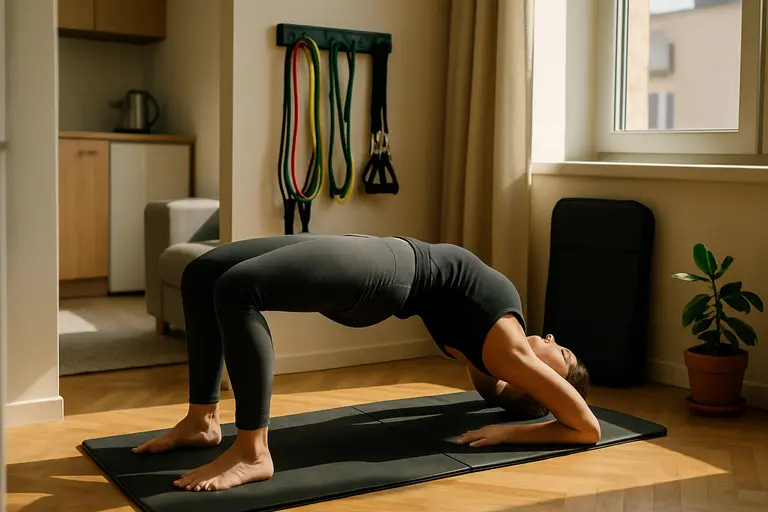
Because art workers often rely on visual attention all day, a low-stimulation setup may be more sustainable than a screen-heavy one. A mat near natural light, a quiet timer, bands stored in a handmade basket, and a simple wearable may support consistency better than a device that demands constant looking. The best equipment choice is the one a person can use safely without crowding the work they care about.
Buying And Selling Art-Aware Fitness Tools
What Buyers Should Ask
Fitness Gear For Creatives also belongs in creator commerce because many makers sell adjacent products: storage, straps, bags, recovery accessories, printed workout journals, festival mobility kits, or home-gym decor. Buyers should evaluate these goods with the same care they bring to handmade gifts. The object should state what it is made from, who made it, where it was produced when known, how to clean it, and what use it is not designed for.
- Ask whether the product is decorative, functional, or both.
- Check load, grip, heat, moisture, and cleaning limits where relevant.
- Look for plain-language care instructions, not only mood-led copy.
- Be cautious with health, recovery, posture, or injury-prevention claims that lack evidence.
- Favor sellers who explain variation in handmade work rather than hiding it.
Creative communities often build trust through repeat contact: studio visits, fairs, workshops, local markets, and shared references. Online product pages need to carry some of that same accountability. For broader culture coverage within the same network, visiting Robsonic can provide insight into how audiences interpret objects, sound, performance, and trust signals across creative scenes.
What Sellers Should State Clearly
A seller offering art-aware fitness goods should not rely on vague inspiration language. If a mat bag is made from canvas, say so. If a balance board is for light mobility rather than athletic training, say so. If a storage rack is intended for resistance bands rather than weights, say so. Clarity protects the buyer and respects the maker’s work.
Photography should also be honest. Show scale beside common objects, not just cropped beauty shots. Show seams, handles, closures, texture, and underside construction. For wearable accessories, describe hardware, wash guidance, skin-contact materials, and whether colors may transfer. These details may feel less glamorous than art direction, but they create the trust that lets a buyer return.
Fitness Gear For Creatives And Trust
The strongest path for Fitness Gear For Creatives is not more spectacle. It is better fit between the tool, the body, the room, and the creative life around it. The 2026 examples in the research notes suggest clear directions: smaller wearables, fashion-linked bands, sculptural machines, furniture-like finishes, modular bases, non-electric resistance options, and AI-assisted monitoring. Each can be useful, but none removes the need for judgment.
For artists, designers, musicians, makers, and event sellers, equipment should support continuity. It should help a person return to the studio with less strain, prepare for long fair days, recover after performance work, or make a home workout corner feel visually coherent. For sellers, the responsibility is similar to good craft practice: name the material, state the use, avoid inflated claims, and respect the communities whose aesthetics inform the object.
Fitness Gear For Creatives works best when inspiration is grounded in care. Beauty can invite use, but trust keeps people using the object safely and honestly over time.