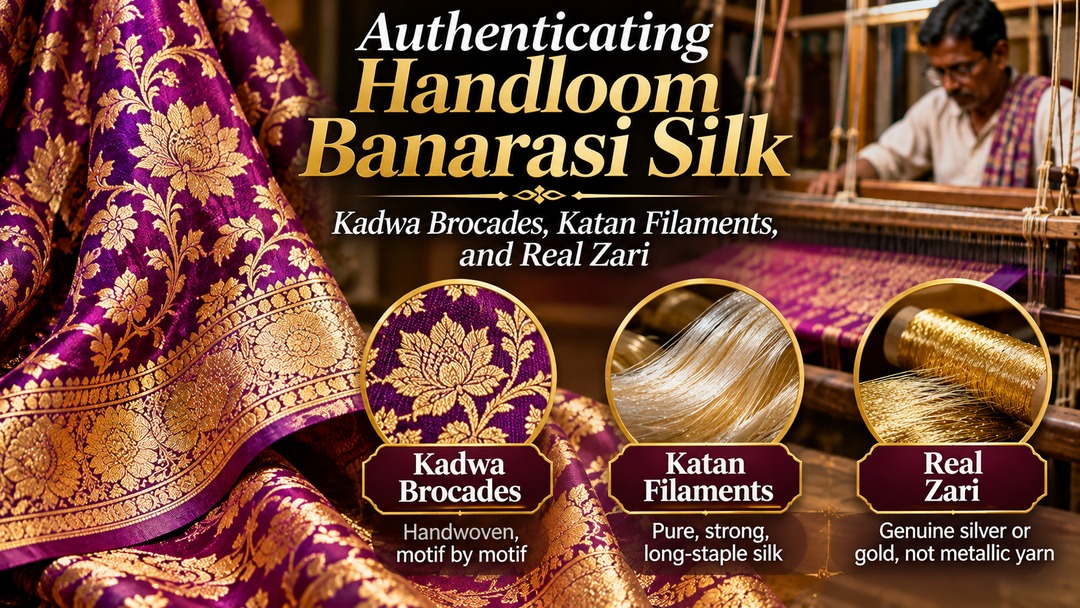
The handwoven Banarasi silk saree represents the pinnacle of Indian textile heritage, blending centuries of indigenous weaving traditions along the ghats of Varanasi with refined Mughal aesthetic sensibilities. Historically, acquiring a genuine Banarasi heirloom was an intimate rite of passage characterized by direct visits to family-run Kothis in Chowk or Madanpura, where connoisseurs evaluated pure mulberry yarns and precious metal brocading by hand. In today’s globalized marketplace, consumer discernment faces unprecedented challenges. Online platforms and educational hubs such as Shimply serve a vital role for conscious collectors by establishing rigorous criteria for handmade verification, demystifying traditional techniques, and separating authentic handloom brocades from industrial imitations.
Modern powerloom production, computerized jacquard systems, and synthetic metallic yarns have flooded retail channels with convincing visual duplicates. What appears to be an intricate gold-embellished drape often proves to be an electroplated polyester facsimile woven in mere hours on an automated loom. According to technical documentation maintained by the Ministry of Textiles, genuine Varanasi handloom weaves are legally protected under geographical indication laws, which mandate rigorous standards for yarn purity, weaving mechanisms, and artisan attribution. For collectors seeking heirloom investment value, mastering the structural mechanics of Katan silk, Kadwa brocading, and metallurgic zari composition is essential.
The Foundations of Purity: Katan Mulberry Filaments
Every authentic Banarasi masterpiece begins with the structural integrity of its warp and weft yarns. Traditional master weavers rely predominantly on Katan silk, a plain-woven fabric constructed using pure mulberry silk filaments that undergo meticulous preparatory twisting. In Katan preparation, two or more degummed raw silk filaments are twisted firmly together to generate high tensile resilience, providing the dimensional stability required to endure months of rigorous manual shuttle beating on a traditional pit loom.
Discerning buyers can evaluate filament authenticity through sensory tactile cues and physical burn testing. Synthetic polyester and viscose yarns exhibit a glassy, uniform sheen that reflects light harshly at single angles. In contrast, genuine mulberry Katan displays a warm, prismatic iridescence resulting from the triangular prism-like crystalline protein structure of natural fibroin. The regulatory standards codified by the Silk Mark Organisation of India certify that pure mulberry filament burns slowly with a distinct singed-hair aroma, crumbling into a brittle, dark carbonaceous ash, whereas synthetic polymer substitutes melt rapidly into an unyielding plastic bead.
Weaving Typologies: Kadwa Versus Fekwa and Cutwork
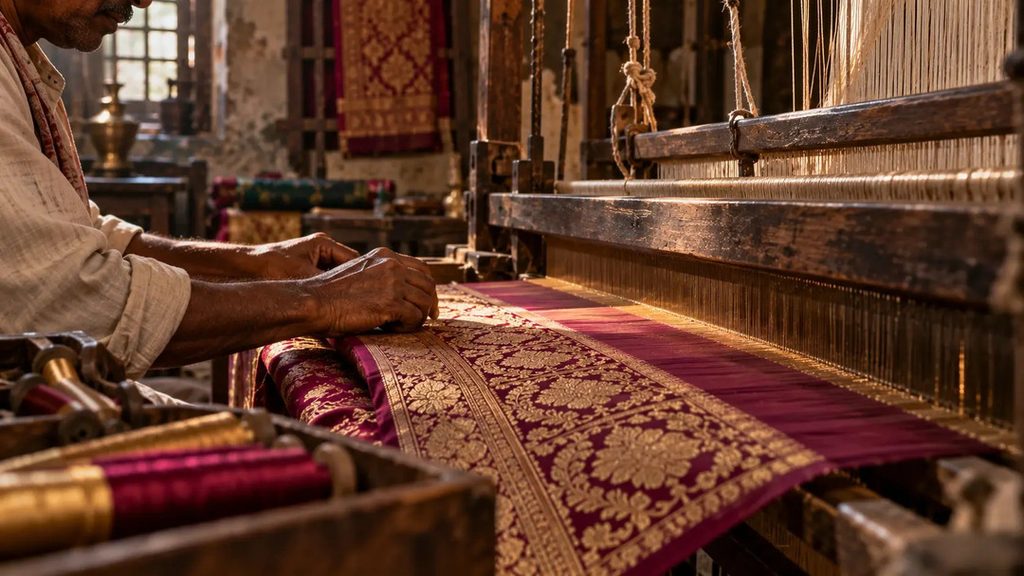
The hallmark of artisan virtuosity in Varanasi lies in the execution of its brocaded ornamentation, termed zari butis and floral jaal networks. Banarasi brocades are divided into two fundamental weaving methodologies: the revered Kadwa (engraved) technique and the supplementary weft Fekwa (thrown shuttle) process. A genuine handloom Kadwa saree requires exceptional manual patience; each decorative motif is individually woven into the warp using dedicated miniature wooden spools known as tillis.
In Kadwa weaving, each design element is locked and completed independently without carrying extra metallic threads across the underside of the adjacent ground fabric. As a result, the reverse side of a genuine Kadwa drape remains remarkably smooth, devoid of loose floats, and comfortable against the wearer’s skin. By contrast, automated powerloom counterfeits and commercial handloom Fekwa textiles throw continuous weft threads across the entire width of the loom, creating dense layers of floating floats on the reverse side that are subsequently severed with automated mechanical shearing blades—a compromise known colloquially as cutwork.
| Evaluation Parameter | Authentic Handloom Kadwa | Traditional Handloom Fekwa | Automated Powerloom Cutwork |
| Weaving Timeline | 60 to 180 days per saree | 15 to 30 days per saree | 4 to 8 hours per saree |
| Motif Construction | Individually locked discontinuous spools (tillis) | Continuous throw shuttle across body width | Automated electronic jacquard feeder |
| Reverse Fabric Texture | Completely clean and smooth, zero floats | Long structural floats woven into adjacent motifs | Rough clipped thread stubs and fraying fringes |
| Edge and Selvedge Form | Soft pin-mark holes and gentle artisan irregularities | Natural handloom selvedge with slight tension shifts | Rigid, machine-uniform edges with perforated needle tracks |
| Heirloom Durability | Exceptional; brocade resists snagging and abrasion | Moderate; unclipped floats require careful handling | Poor; clipped wefts unravel after repeated dry-cleaning |
Metallurgy of Zari: Real, Tested, and Synthetic Grades
Beyond filament purity, a substantial portion of a Banarasi saree’s cultural prestige and economic valuation resides in its metallic brocading. Historically referred to as Zari Zardozi, genuine traditional zari consists of a core silk yarn wound tightly with a flattened silver ribbon (badla) that has been electroplated or dipped in liquid gold. This metallurgical alloy bestows authentic antique brocades with their signature subdued golden patina, which matures gracefully over decades rather than tarnishing into a brittle brassy film.
Due to surging precious metal valuations, contemporary commercial markets have witnessed the proliferation of “Tested Zari” and purely synthetic copper-polyester laminates. Tested zari replaces precious silver with an electroplated copper wire base coated with gold-tinted lacquer, mimicking the density of real bullion at a fraction of the cost. To protect consumers and support transparent commerce, standards developed alongside the Crafts Council of India emphasize verifying certified laboratory assay reports, which specify the exact percentage of silver and 24-karat gold plating per kilogram of textile weight.
Five-Step Physical Inspection Protocol for Handloom Verification
When assessing a potential heirloom piece in person or verifying a gallery delivery, collectors can execute a systematic sequence of non-destructive physical inspections. Evaluating these subtle artisan footprints establishes clear proof of human craftsmanship over mechanical automation:
- Selvedge Pinhole Inspection: Examine the parallel outer borders of the unstitched fabric. Handloom pit looms utilize wooden tenterhooks (temples) to maintain uniform warp tension, leaving tiny, irregular pin-marks along the selvedge that machine feeds do not replicate.
- Reverse Weft Architecture: Turn the saree inside out across dense pallu motifs. Genuine Kadwa reveals completely clean fabric recesses between motifs, whereas machine cutwork exhibits thousands of blunt clipped fiber stubs that catch on delicate jewelry.
- Chromatic Thermal Test: Gently wrap a fold of the silk around your palm. Natural mulberry protein absorbs and radiates body warmth within seconds, producing a subtle, luxurious tactile heat that cold synthetic polyester weaves cannot match.
- Zari Core Fiber Scratch Check: In an inconspicuous corner of the pallu fringe, gently untwist an exposed metallic thread. Genuine zari reveals an interior core of natural silk filament, whereas imitation varieties wrap metallic foil around bright white polyester or nylon cores.
- Geographical Indication Registry Verification: Check for the official GI logo and registration number issued under the Geographical Indications of Goods Act, confirming provenance from authorized Varanasi weaver clusters.
Sustaining the Varanasi Weaving Ecosystem
Preserving authentic Varanasi handloom weaving is fundamentally an ecological and economic imperative as much as an aesthetic one. Handloom pit looms consume zero industrial electrical power, operating through the rhythmic physical harmony of the weaver’s pedals and shuttles. Each complex masterwork represents a decentralized micro-economy that sustains yarn winders, punch-card artists (naqshabandhas), dyers, and auxiliary finishing artisans across historic regional neighborhoods.
When informed collectors deliberately invest in authenticated handloom Katan silk rather than inexpensive machine-made replicas, they directly sustain this living cultural heritage. Discerning patronage ensures that hereditary technical knowledge is transmitted to emerging generations of master weavers. By demanding transparency in raw fiber sourcing, certifying authentic metallic zari purity, and appreciating the irreplaceable subtleties of the Kadwa loom, collectors ensure that the golden weaves of Varanasi continue to flourish for centuries to come.