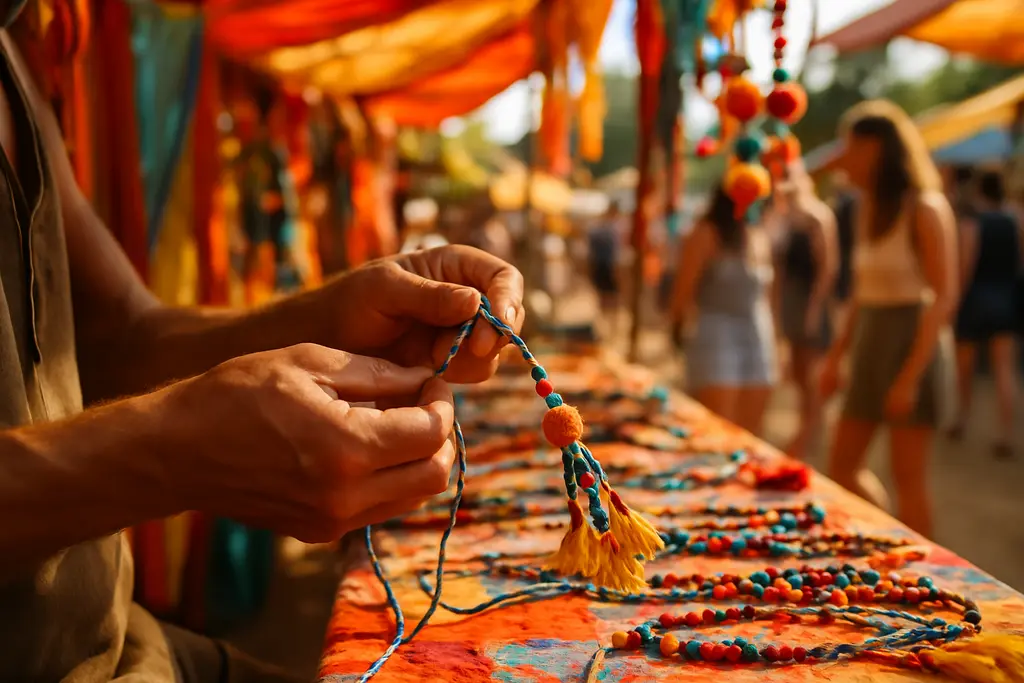
Festival fashion authenticity is becoming harder to separate from planning, proof, and craft literacy. SHEIN’s March 2026 Festival Trends Survey, which sampled more than 18,000 U.S. shoppers, reported that 58% of festival attendees bring two or more outfits per day, while 69% assemble looks at least one month in advance, nearly double the 35% reported in 2024 SHEIN survey. Those figures do not prove that every attendee is buying handmade pieces, but they do show that festival dressing has become a planned activity rather than a last-minute costume choice for many shoppers.
For handmade sellers and craft-led fashion makers, the useful question is not whether festival dressing is expressive. That has been visible for years across music, rave, cosplay-adjacent, and art-market cultures. The sharper question is how a buyer can tell the difference between a thoughtful handmade garment, a mass-made item using craft language, and a look assembled mainly for short-term visual impact. The answer sits in evidence: materials, construction, sourcing, care guidance, and honest limits.
Festival Fashion Authenticity And Buyer Trust
Why Festival Fashion Authenticity Needs Proof
Festival buyers often shop under mixed pressures: comfort, identity, heat, photography, movement, packing space, and social context. A garment can look striking in a product image yet fail after hours of walking, dancing, sitting on grass, or being packed into a small bag. That is why festival fashion authenticity should not rest only on visual style. It needs practical proof that the maker understands both the object and the event setting.
The 2025 SHEIN Global Circularity Study, with results released in March 2026, found that 78.1% of respondents always or often considered product quality and craftsmanship when buying clothes online, ranking that factor just below size or fit and personal identity 2025 Global Circularity Study. The source is from a major fashion retailer, so it should be read with that context. Even so, the result is useful because it places workmanship close to identity in online fashion decisions.
For an artisan seller, this points to a trust task. A product page should not only say hand-embroidered, hand-dyed, crocheted, appliqued, or upcycled. It should explain what that means for fit, variation, wear, washing, repair, and expected use. Buyers can value craft more fairly when they understand the work behind it.
What Recent Planning Behavior Suggests
The survey figure showing that many festival attendees plan looks at least a month ahead is not a small detail. Earlier planning gives handmade sellers a better chance to communicate lead times, made-to-order limits, and care needs. It also reduces the temptation to imitate whatever is moving fastest on social feeds. A craft-led seller can use that planning window to educate buyers, confirm sizing, and prevent rushed expectations.
This is where the productivity angle matters. Sellers who answer the same questions repeatedly lose time. Sellers who build clear listing templates, care cards, and order timelines save effort while giving buyers better information. Authenticity becomes more than a value statement; it becomes an operating system for trust.
Craftsmanship As A Practical Signal
Construction Is Part Of The Aesthetic
In festival wear, construction is not hidden behind the look. Seams, straps, fastenings, linings, fringe attachments, beadwork, crochet tension, dye stability, and fabric weight all affect whether a piece can survive event use. Handmade work may include small variations, and those variations can be part of the object’s character. Yet variation should not be used to excuse unclear sizing, weak finishing, or vague care instructions.
A cautious maker explains the difference between natural handmade variation and functional inconsistency. For example, a hand-dyed garment may vary slightly in tone. A hand-beaded accessory may have small differences in placement. A crochet top may stretch with wear depending on fiber. These details should be described before purchase because the buyer is making both a style choice and a use choice.
Festival clothing and fantasy fashion themes are beautifully intertwined. For those interested in related cultural context, the site FairyTale Fashion offers a fascinating exploration of this connection. It emphasizes the need to balance creative expression with respect for the cultural and material origins involved.
Care Guidance Protects The Object
Care instructions are often treated as a small after-sale note, but they are central to craft preservation. A festival garment may face sweat, sunscreen, dust, rain, drink spills, compression in luggage, and repeated wear over several days. If a piece uses delicate trim, natural dye, reclaimed textiles, or handwork, the care note should say so plainly.
Good care content does not need to be lengthy. It needs to be specific. A seller can state whether an item should be hand washed, spot cleaned, dried flat, kept away from rough bags, or stored without crushing. This protects the buyer and respects the artisan labor embedded in the piece.
A Productivity Framework For Handmade Sellers
Turn Repeated Questions Into Trust Assets
For small studios, productivity should not mean faster production at the cost of artistic integrity. It can mean fewer unclear exchanges, fewer returns caused by mismatched expectations, and fewer rushed custom requests. The simplest path is to convert common buyer doubts into permanent trust assets on each listing.
- Maker context: Say whether the item is made by the seller, a studio team, a partner artisan, or a small batch workshop.
- Material clarity: Name the fibers, trims, closures, recycled elements, or mixed materials where known.
- Use setting: Explain whether the piece is suited to dancing, layering, warm weather, cooler evenings, or light decorative wear.
- Care and repair: Give cleaning guidance and state whether minor repairs, replacement ties, or adjustment advice are available.
- Lead time: Separate ready-to-ship pieces from made-to-order work so festival buyers can plan responsibly.
This structure is useful for sellers working across handmade festival clothing, accessories, rave wear, wearable art, and small-batch costume pieces. It keeps the product page from becoming only a mood board. It makes the page a record of choices.
Plan Content Before The Event Cycle Peaks
Because many shoppers are assembling festival looks weeks ahead, sellers benefit from preparing content before demand rises. A small studio can draft size notes, alteration policies, packing advice, and care cards before listing new pieces. That preparation can reduce pressure during high-order periods and helps protect the quality of communication.
Shimply has also examined handmade festival buying through event culture in its coverage of handmade festival fashion at Outside Lands, where local vendors, self-made pieces, and careful buying were treated as part of festival culture rather than separate from it. That framing is useful because trust is often built through context: who made the item, where it is sold, and how buyers learn to use it.
Community Context Without Overclaiming
Avoid Vague Heritage Language
Festival style frequently borrows from many visual sources. That can create space for respectful craft exchange, but it can also produce unclear or careless marketing. Sellers should be cautious with words such as tribal, sacred, traditional, indigenous, or ritual unless they can explain the cultural context accurately and have a responsible basis for using the term. This is not legal advice; it is a trust principle.
Specific language is safer and more useful. Instead of broad claims, a seller can identify a material, process, region where appropriate, or maker relationship. If the seller does not know the origin of a motif or technique, it is better to avoid making cultural claims. In craft commerce, uncertainty should be handled honestly rather than covered with romantic phrasing.
Pricing Needs Visible Reasons
Handmade festival pieces may cost more than mass-produced alternatives. Buyers are more likely to understand the price when the listing shows labor, material, finishing, and after-care. This does not require exposing private supplier terms or personal finances. It means showing enough process for the buyer to see why the object is not interchangeable with a generic item.
Visible reasons can include time-intensive stitching, limited fabric supply, small-batch dyeing, reinforced closures, adjustable construction, or repair-friendly design. These are not decorative details. They are signals that connect price to work.
Festival Fashion Authenticity At Recent Events
What Makers Can Take From The Evidence
The strongest supported takeaway from recent data is not that one style has replaced another. The evidence used here points to planning, multiple outfits, and buyer attention to quality and craftsmanship. That is enough to support a careful claim: festival dressing is an area where identity and workmanship meet under practical pressure.
For handmade sellers, festival fashion authenticity depends on repeatable proof. A buyer should be able to see who made the item, what it is made from, how it behaves, how to care for it, and what limits it has. That clarity protects artists from being reduced to trend suppliers and helps buyers treat garments as crafted objects rather than disposable event props.
The most productive response is simple but demanding: make fewer vague claims, show more evidence, and respect the communities, materials, and makers behind the look. Recent festival culture may reward strong visuals, but long-term trust still comes from craft that can be explained, worn, cared for, and credited.