
Across India’s historic craft clusters—from the woodblock carving ateliers of Bagru and Sanganer to the jacquard pits of Varanasi and the bell-metal casting foundries of Bastar—the handmade sector represents both an ancient repository of material culture and a vital rural livelihood generator. Operating as the country’s second-largest employment sector after agriculture, Indian handicraft production sustains tens of millions of master weavers, silversmiths, terracotta sculptors, and lacquer artisans. Yet, the rapid expansion of global e-commerce and algorithmic marketplace aggregation has introduced severe market distortion. Mass-manufactured industrial imitations, synthetic digital screen prints, and machine-molded metal alloys increasingly flood consumer channels under the label of “traditional craft,” diluting artisan wages and eroding cultural provenance. Establishing transparent verification standards for collectors and conscious buyers is central to the regional craft directories and sourcing guides published across Shimply.
Protecting handcrafted authenticity requires navigating a multifaceted ecosystem where statutory intellectual property rights intersect with grassroots cooperative auditing. India’s landmark enactment of the Geographical Indications of Goods (Registration and Protection) Act, 1999, established a legal rampart designed to link exceptional product quality, aesthetic distinction, and human technique directly to specific geographic origins. However, legal registration alone does not automatically protect rural makers from commercial counterfeiting. Safeguarding traditional artisan communities requires consumers and commercial buyers to understand the mechanics of GI certification, the tactile indicators of manual technique, and the socio-economic protocols that ensure capital flows directly to the hands that shape the raw material.
The Statutory Architecture of Geographical Indication in India
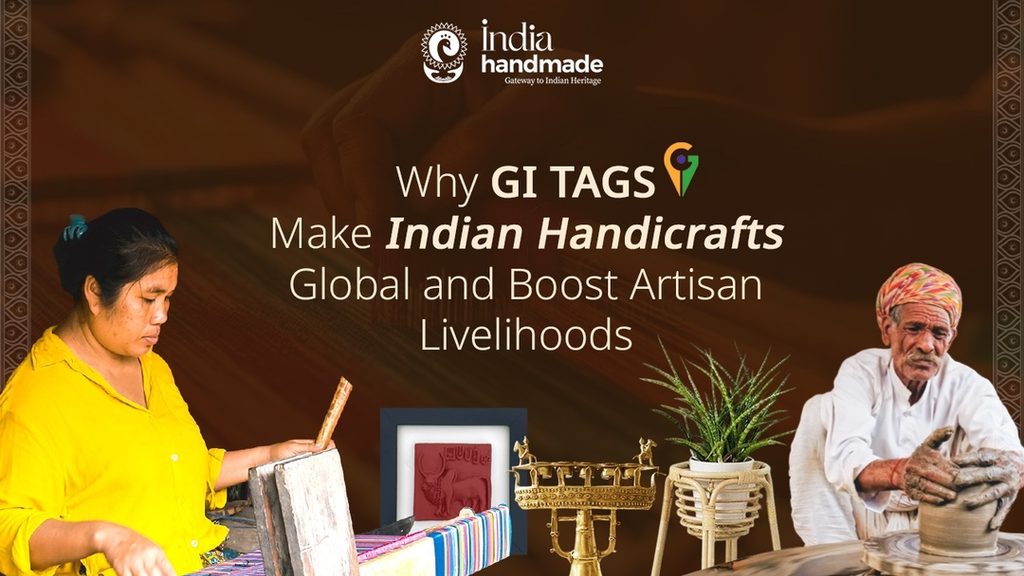
A Geographical Indication (GI) is fundamentally an intellectual property right that identifies a good as originating in a specific territory, region, or locality, where a given quality, reputation, or other characteristic is essentially attributable to its geographical provenance. Unlike patents, copyrights, or corporate trademarks that protect private commercial entities, a GI tag functions as a collective community asset. It legally prohibits unauthorized industrial manufacturers located outside the demarcated production zone from marketing generic imitations under the registered regional nomenclature.
Administration of these collective titles is governed through the Geographical Indications Registry, functioning under the Office of the Controller General of Patents, Designs and Trade Marks (CGPDTM) in Chennai, aligned with global trade covenants outlined by the World Intellectual Property Organization (WIPO). Securing a GI tag is an exhaustive, multi-year evidentiary undertaking. Artisan associations, cooperative societies, or state development boards must furnish historical documentation proving centuries of continuous cultivation, define the unique micro-environmental variables—such as water mineral content, regional silkworm diets, or local clay chemistry—and codify standard operational metrics that define genuine production.
| Craft Category | Iconic GI-Tagged Tradition | Core Regional Hub | Statutory Material Standards & Technique |
| Textiles & Handlooms | Chanderi & Banarasi Brocades | Madhya Pradesh & Uttar Pradesh | Pure mulberry silk, hand-twisted zari, pit loom extra-weft patterning |
| Block Printing | Bagru & Dabu Mud-Resist | Rajasthan | Hand-carved teak woodblocks, natural vegetable and mineral dyestuffs |
| Metalwork & Casting | Dhokra Bell-Metal | Chhattisgarh, Odisha & West Bengal | Non-ferrous lost-wax casting (cire perdue), indigenous clay and wax cores |
| Terracotta & Pottery | Blue Pottery & Nizamabad Black | Jaipur (Rajasthan) & Azamgarh (UP) | Quartz stone and fuller’s earth composition; low-temperature kiln reduction |
Despite the registration of hundreds of indigenous crafts, legal gazetting represents only the initial barrier against IP dilution. The critical regulatory bottleneck occurs at the secondary tier: the registration of “Authorized Users.” Under statutory rules, only individual artisans, master craftspeople, and registered cooperative societies who undergo physical inspection and verification are legally entitled to affix the statutory GI logo and unique alphanumeric user certificate to their retail goods. When uncertified retail brokers market generic goods using protected regional identifiers, they commit actionable trademark infringement subject to statutory civil damages and criminal seizure.
Differentiating Manual Heritage From Industrial Replication
For discerning consumers and commercial supply chains, evaluating authentic Indian craft demands an appreciation of structural nuance. Machine manufacturing aims for mathematical uniformity, geometric precision, and microscopic repetition. True manual craft, by contrast, is characterized by subtle human rhythm, organic micro-irregularities, and materials processed without harsh industrial polymers.
In handloom weaving, such as authentic Kanchipuram or Chanderi textiles, inspecting the reverse side of the fabric provides conclusive diagnostic evidence. Industrial power-loom jacquard machines leave a dense, uniform web of floating synthetic warp threads across the back of the textile, creating a smooth, flattened artificial sheen. A handwoven sari, executed on traditional pit looms using manual shuttle throws, displays distinct weft locking, natural selvedge boundaries, and subtle density variations where the weaver compressed the reed. Furthermore, genuine zari incorporates pure silver and gold leaf electroplated over silk filament, contrasting sharply with the brittle, high-gloss polyester metallic yarns (Lurex) that dominate fast-fashion imitations. Official fiber testing benchmarks curated by the Handloom Export Promotion Council (HEPC) establish strict compositional parameters separating authenticated handloom silk from powerloom synthetic blends.
Similarly, in manual block printing, the human hand registers slight misalignments (gud) between overlapping color blocks, demonstrating the organic layering of vegetable mordants and hand-pressed pressure. Machine roller-printed textiles present mathematically rigid, pixelated registration devoid of depth or chromatic variation. In traditional metallurgical crafts like Dhokra casting, the lost-wax technique dictates that every clay mold is broken during metal cooling to release the sculpture; consequently, every authentic Dhokra piece is an irreplaceable, singular artifact bearing distinct surface striations from beeswax threading that cannot be duplicated by industrial zinc die-casting.
The Socio-Economic Calculus of Fair-Trade Artisan Commerce
The cultural preservation of traditional craftsmanship is inseparable from the economic dignity of the artisan. For centuries, rural Indian craft supply chains were choked by exploitative multi-tiered intermediary networks (mahajans and speculative trading cartels). These brokers advanced raw materials at usurious interest rates, monopolized access to metropolitan consumer markets, and captured up to eighty percent of final retail margins while leaving primary producers trapped in generational debt cycles.
Direct creator commerce models and audited cooperative networks dismantle this extractive dynamic. When buyers engage through transparent sourcing channels that certify fair living wages, provide upfront raw material capital, and maintain documented worker welfare standards, artisan communities experience rapid socioeconomic stabilization. Fair-trade benchmarks published by the World Fair Trade Organization (WFTO) highlight that securing stable, predictable market access prevents distress migration from rural craft villages to urban construction sites, encouraging the intergenerational transfer of complex technical skills from master artisans to apprentice youth.
Furthermore, economic auditing must account for gender equity. Across embroidery traditions like Lucknowi Chikankari, Phulkari in Punjab, and Lambani mirror-work in Karnataka, women constitute the overwhelming majority of the primary labor force. Because needlework is predominantly executed within rural household compounds between agricultural cycles, centralized brokers frequently undercompensate female makers through arbitrary piece-rate pay. Ethical buying systems mandate direct bank transfers to individual women artisans, verified self-help group (SHG) records, and collective price-setting committees that guarantee equitable remuneration.
Strategic Frameworks for Authenticating Indian Handicrafts
To navigate the contemporary craft marketplace safely, individual collectors, interior designers, and retail procurement managers should adopt systematic auditing practices. Verifying provenance before issuing purchase orders ensures that capital directly reinforces authentic artisanal lineages rather than industrial counterfeiting:
- Statutory Mark Verification: Actively inspect textiles and craft objects for statutory government authentication marks, including the Silk Mark, the official Handloom Mark, and the registered Geographical Indication (GI) alphanumeric Authorized User certification tag.
- Material and Fiber Combustion Testing: Conducting simple fiber burn diagnostics on textile fringe scraps; genuine natural mulberry silk burns slowly with an odor resembling singed hair and leaves fragile, crushable ash, whereas synthetic polyester melts rapidly into a hard plastic bead.
- Supply Chain Documentation Auditing: Requiring vendors to disclose primary artisan cooperative affiliations, physical cluster locations, and fair-wage compliance certificates rather than accepting vague corporate declarations of “ethically sourced” goods.
- Natural Dyestuff and Pigment Inspection: Evaluating botanical dyes such as natural indigo, madder root (manjistha), and pomegranate rind through olfactory and wash-fastness traits; natural plant dyes possess an earthy scent and exhibit subtle, living tonal variations that mature gracefully over time.
Adhering to these criteria transforms purchasing from a passive transaction into an active act of cultural preservation. By demanding verified documentation, buyers exert commercial pressure on aggregators to uphold statutory transparency across regional product pipelines.
The Contemporary Future of Traditional Craftsmanship
The future of Indian handicrafts will not be secured by treating master artisans as static museum relics of an idealized past, but by empowering them as innovative creative entrepreneurs within the modern global economy. When centuries of inherited technical genius are paired with strict Geographical Indication enforcement, transparent direct-to-consumer infrastructure, and informed collector appreciation, traditional craftsmanship transitions from a vulnerable heritage sector into a dynamic, sustainable economic engine.
As global consumers increasingly reject the disposable, homogenizing impulses of industrial mass production, authentic handmade objects carry profound emotional and aesthetic resonance. An authenticated piece of handloom silk, carved wood, or cast bronze represents weeks of focused human devotion, ecological harmony, and regional storytelling. By learning to distinguish between counterfeit copies and verified heritage crafts, conscious buyers ensure that the diverse artistic traditions of the Indian subcontinent continue to thrive, innovate, and inspire generations to come.